Hemmig Elisa A, Creatore Celestino, Wünsch Bettina, Hecker Lisa, Mair Philip, Parker M Andy, Emmott Stephen, Tinnefeld Philip, Keyser Ulrich F, Chin Alex W
Cavendish Laboratory, University of Cambridge , Cambridge CB3 0HE, United Kingdom.
Institut für Physikalische und Theoretische Chemie, TU Braunschweig , 38106 Braunschweig, Germany.
Nano Lett. 2016 Apr 13;16(4):2369-74. doi: 10.1021/acs.nanolett.5b05139. Epub 2016 Mar 1.
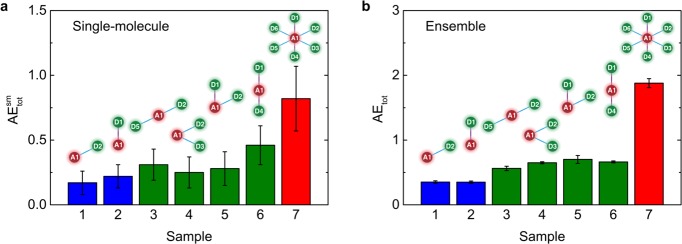
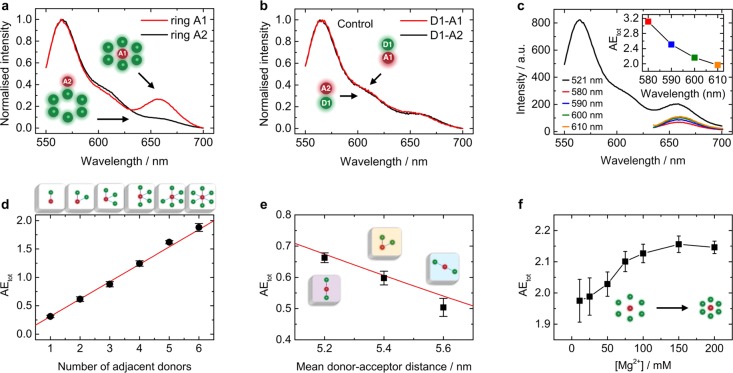
The remarkable performance and quantum efficiency of biological light-harvesting complexes has prompted a multidisciplinary interest in engineering biologically inspired antenna systems as a possible route to novel solar cell technologies. Key to the effectiveness of biological "nanomachines" in light capture and energy transport is their highly ordered nanoscale architecture of photoactive molecules. Recently, DNA origami has emerged as a powerful tool for organizing multiple chromophores with base-pair accuracy and full geometric freedom. Here, we present a programmable antenna array on a DNA origami platform that enables the implementation of rationally designed antenna structures. We systematically analyze the light-harvesting efficiency with respect to number of donors and interdye distances of a ring-like antenna using ensemble and single-molecule fluorescence spectroscopy and detailed Förster modeling. This comprehensive study demonstrates exquisite and reliable structural control over multichromophoric geometries and points to DNA origami as highly versatile platform for testing design concepts in artificial light-harvesting networks.
生物光捕获复合物卓越的性能和量子效率激发了多学科领域对构建受生物启发的天线系统的兴趣,这可能是通往新型太阳能电池技术的一条途径。生物“纳米机器”在光捕获和能量传输方面有效性的关键在于其光活性分子高度有序的纳米级结构。最近,DNA折纸术已成为一种强大的工具,能够以碱基对精度和完全的几何自由度来组织多个发色团。在此,我们展示了一种基于DNA折纸平台的可编程天线阵列,它能够实现合理设计的天线结构。我们使用系综和单分子荧光光谱以及详细的福斯特模型,系统地分析了环状天线中供体数量和染料间距离对光捕获效率的影响。这项全面的研究展示了对多发色团几何结构的精确且可靠的结构控制,并表明DNA折纸术是用于测试人工光捕获网络设计概念的高度通用的平台。