Lee Matthew K, Most Sam P
Division of Facial Plastic and Reconstructive Surgery, Department of Otolaryngology-Head and Neck Surgery, Stanford University School of Medicine, Palo Alto, Calif.
Plast Reconstr Surg Glob Open. 2016 Feb 4;4(2):e611. doi: 10.1097/GOX.0000000000000592. eCollection 2016 Feb.
Currently, there is no validated quality-of-life instrument that evaluates both functional and aesthetic outcomes after rhinoplasty. The goal of this study was to develop and validate a comprehensive quality-of-life instrument to assess patient satisfaction with both functional and aesthetic outcomes after rhinoplasty.
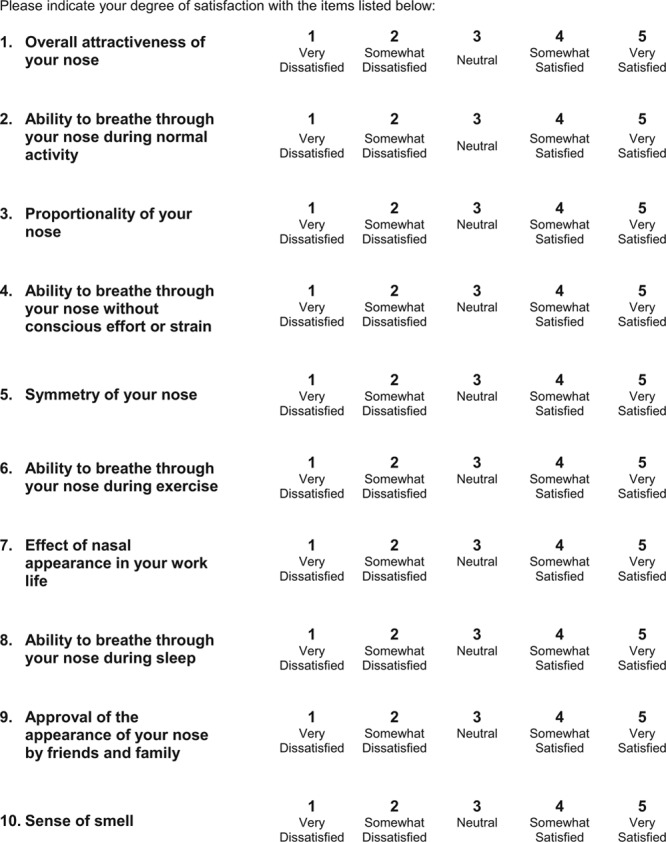
The study was designed as a prospective instrument validation study at a university-affiliated academic medical center. Inclusion criteria included patients with nasal obstructive symptoms, nasal aesthetic deformity, or both, who underwent functional and/or aesthetic rhinoplasty by a single surgeon between December 2014 and June 2015. A novel 10-item instrument (the Rhinoplasty Health Inventory and Nasal Outcomes [RHINO] scale) was developed to assess physical, mental, and social well-being after functional and/or aesthetic rhinoplasty. Instrument validation was performed by assessment of test-retest reliability, internal consistency reliability, construct validity, and concurrent validity.
Twenty-two patients (10 males and 12 females) were enrolled. Mean age was 34.9 years (range: 18-67 years). All patients were followed for a minimum of 12 weeks (range: 12-23 weeks; mean: 16.5 weeks). Mean RHINO score was 51.4 ± 13.8 on the first preoperative evaluation and 51.7 ± 12.5 when repeated preoperatively on the day of surgery (r = 0.94; P < 0.001). Internal consistency demonstrated Cronbach's α value of 0.74. Mean postoperative RHINO score was 84.7 ± 14.1 (mean difference from preoperative RHINO = 33.2 ± 18.9; P < 0.001).
The RHINO instrument demonstrates robust reliability and validity in assessing patient-reported satisfaction with rhinoplasty outcomes.
目前,尚无经过验证的生活质量评估工具可同时评估隆鼻术后的功能和美学效果。本研究的目的是开发并验证一种综合生活质量评估工具,以评估患者对隆鼻术后功能和美学效果的满意度。
本研究设计为在一所大学附属学术医疗中心进行的前瞻性工具验证研究。纳入标准包括患有鼻阻塞症状、鼻美学畸形或两者兼具的患者,这些患者在2014年12月至2015年6月期间由同一位外科医生进行了功能性和/或美学隆鼻手术。开发了一种新颖的10项工具(隆鼻健康量表和鼻部结果[RHINO]量表),以评估功能性和/或美学隆鼻术后的身体、心理和社会幸福感。通过评估重测信度、内部一致性信度、结构效度和同时效度来进行工具验证。
共纳入22例患者(10例男性和12例女性)。平均年龄为34.9岁(范围:18 - 67岁)。所有患者至少随访12周(范围:12 - 23周;平均:16.5周)。首次术前评估时的平均RHINO评分为51.4 ± 13.8,手术当天术前重复评估时为51.7 ± 12.5(r = 0.94;P < 0.001)。内部一致性显示Cronbach's α值为0.74。术后平均RHINO评分为84.7 ± 14.1(与术前RHINO的平均差值 = 33.2 ± 18.9;P < 0.001)。
RHINO工具在评估患者报告的隆鼻效果满意度方面显示出强大的信度和效度。