Bian Weiguo, Lian Qin, Li Dichen, Wang Jin, Zhang Weijie, Jin Zhongmin, Qiu Yusheng
The First Affiliated Hospital of Xi'an Jiaotong University, Xi'an, 710061, Shaanxi, China.
State Key Lab for Manufacturing System Engineering, Xi'an Jiaotong University, Xi'an, 710049, Shaanxi, China.
Biomed Eng Online. 2016 Jul 14;15(1):82. doi: 10.1186/s12938-016-0200-3.
There is a lack of understanding of the morphological characteristics of the cartilage-bone interface. Materials that are currently being used in tissue engineering do not adequately support the regeneration of bone and cartilage tissues. The present study aimed to explore the morphological characteristics of cartilage-bone transitional structures in the human knee joint and to design a biomimetic osteochondral scaffold based on morphological data.
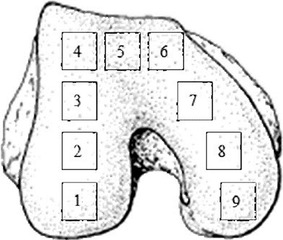
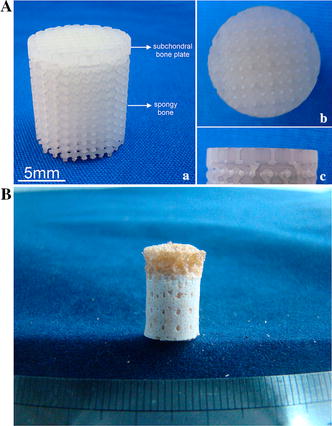
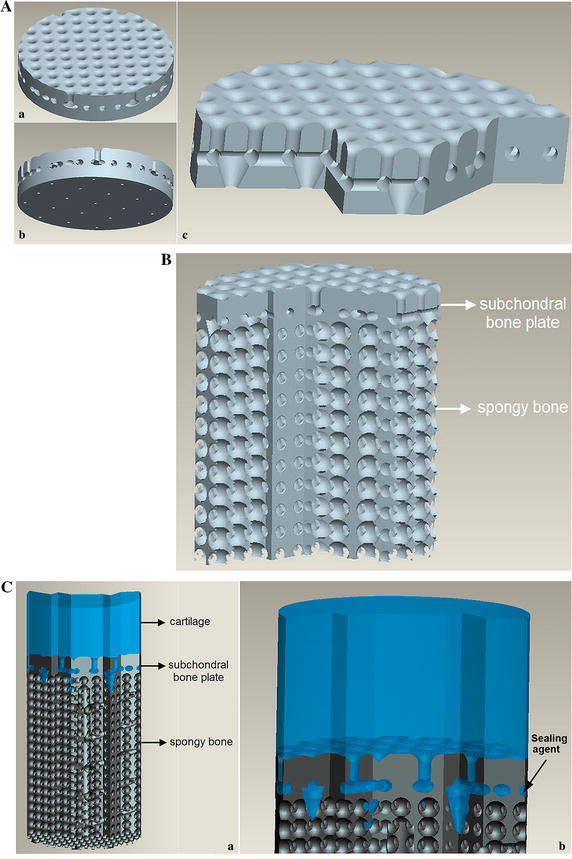
Histology, micro-computed tomography (micro-CT), and scanning electron microscopy (SEM) were used to investigate the microstructure of the cartilage-bone transitional structures. Morphological characteristics and their distribution were obtained and summarized into a biomimetic design. A three-dimensional model of a biomimetic osteochondral scaffold was CAD designed. A prototype of the resulting subchondral bone scaffold was constructed by stereolithography using resin.
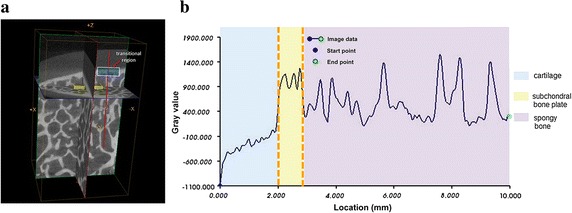
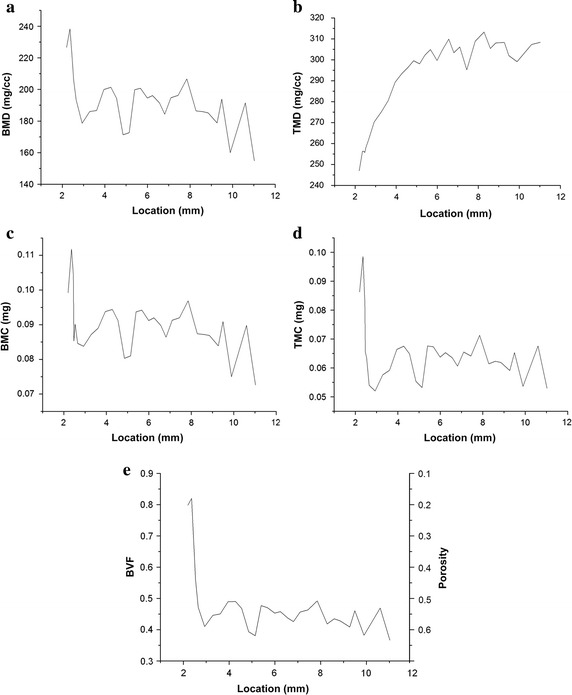
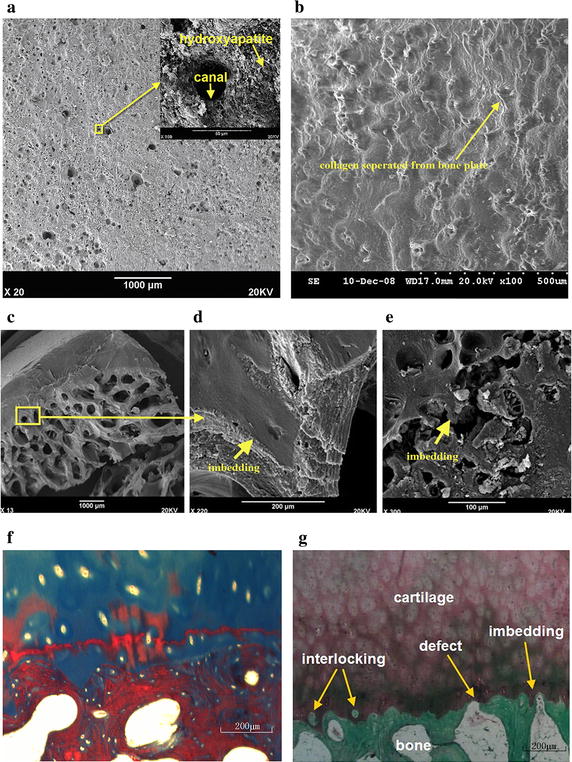
Micro-CT revealed that subchondral bone presented a gradually changing structure from the subchondral to spongy bone tissue. The subchondral bone plate was more compact with ~20 % porosity compared with ~60 % porosity for the spongy bone. Histology and SEM showed that cartilage was stabilized on the subchondral bone plate by conjunctions, imbedding, interlocking, and binding forces generated by collagen fibers. Some scattered defects allow blood vessel invasion and nutritional supply.
The subchondral bone plate is not an intact plate between the cartilage and bone cavity, and some scattered defects exist that allow blood vessel invasion and nutritional supply. This characteristic was used to design an osteochondral scaffold. This could be used to construct an osteochondral complex that is similar to native bones.
目前对软骨-骨界面的形态学特征缺乏了解。组织工程中目前使用的材料不能充分支持骨和软骨组织的再生。本研究旨在探索人类膝关节软骨-骨过渡结构的形态学特征,并基于形态学数据设计一种仿生骨软骨支架。
采用组织学、微计算机断层扫描(micro-CT)和扫描电子显微镜(SEM)研究软骨-骨过渡结构的微观结构。获取形态学特征及其分布并总结成仿生设计。利用计算机辅助设计(CAD)构建仿生骨软骨支架的三维模型。使用树脂通过立体光刻技术构建所得软骨下骨支架的原型。
Micro-CT显示,软骨下骨呈现出从软骨下到松质骨组织逐渐变化的结构。软骨下骨板更致密,孔隙率约为20%,而松质骨的孔隙率约为60%。组织学和SEM显示,软骨通过胶原纤维产生的连接、嵌入、互锁和结合力稳定在软骨下骨板上。一些分散的缺陷允许血管侵入和营养供应。
软骨下骨板不是软骨和骨腔之间的完整板,存在一些分散的缺陷,允许血管侵入和营养供应。利用这一特性设计了一种骨软骨支架。这可用于构建类似于天然骨的骨软骨复合体。