Amano Tatsuya, González-Varo Juan P, Sutherland William J
Conservation Science Group, Department of Zoology, University of Cambridge, Cambridge, United Kingdom.
Centre for the Study of Existential Risk, University of Cambridge, Cambridge, United Kingdom.
PLoS Biol. 2016 Dec 29;14(12):e2000933. doi: 10.1371/journal.pbio.2000933. eCollection 2016 Dec.
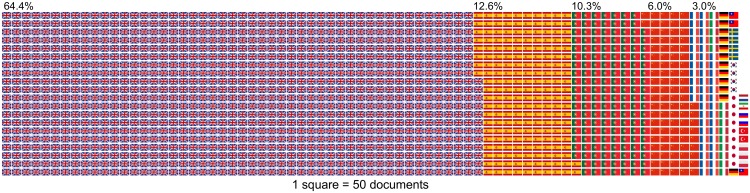
While it is recognized that language can pose a barrier to the transfer of scientific knowledge, the convergence on English as the global language of science may suggest that this problem has been resolved. However, our survey searching Google Scholar in 16 languages revealed that 35.6% of 75,513 scientific documents on biodiversity conservation published in 2014 were not in English. Ignoring such non-English knowledge can cause biases in our understanding of study systems. Furthermore, as publication in English has become prevalent, scientific knowledge is often unavailable in local languages. This hinders its use by field practitioners and policy makers for local environmental issues; 54% of protected area directors in Spain identified languages as a barrier. We urge scientific communities to make a more concerted effort to tackle this problem and propose potential approaches both for compiling non-English scientific knowledge effectively and for enhancing the multilingualization of new and existing knowledge available only in English for the users of such knowledge.
虽然人们认识到语言可能对科学知识的传播构成障碍,但英语作为全球科学语言的趋同可能表明这个问题已经得到解决。然而,我们用16种语言在谷歌学术上进行的调查显示,2014年发表的75513篇关于生物多样性保护的科学文献中,有35.6%不是英文的。忽视这些非英文知识可能会导致我们对研究系统的理解产生偏差。此外,随着英文出版物的盛行,科学知识往往没有以当地语言提供。这阻碍了实地从业者和政策制定者将其用于当地环境问题;西班牙54%的保护区主管将语言视为障碍。我们敦促科学界更加齐心协力地解决这个问题,并提出一些潜在的方法,既有效地汇编非英文科学知识,又为这类知识的使用者增加仅以英文提供的新知识和现有知识的多语言化。