Chakravarty Rubel, Goel Shreya, Dash Ashutosh, Cai Weibo
Radiopharmaceuticals Division, Bhabha Atomic Research Centre, Mumbai, India -
Materials Science Program, University of Wisconsin, Madison, WI, USA.
Q J Nucl Med Mol Imaging. 2017 Jun;61(2):181-204. doi: 10.23736/S1824-4785.17.02969-7. Epub 2017 Jan 26.
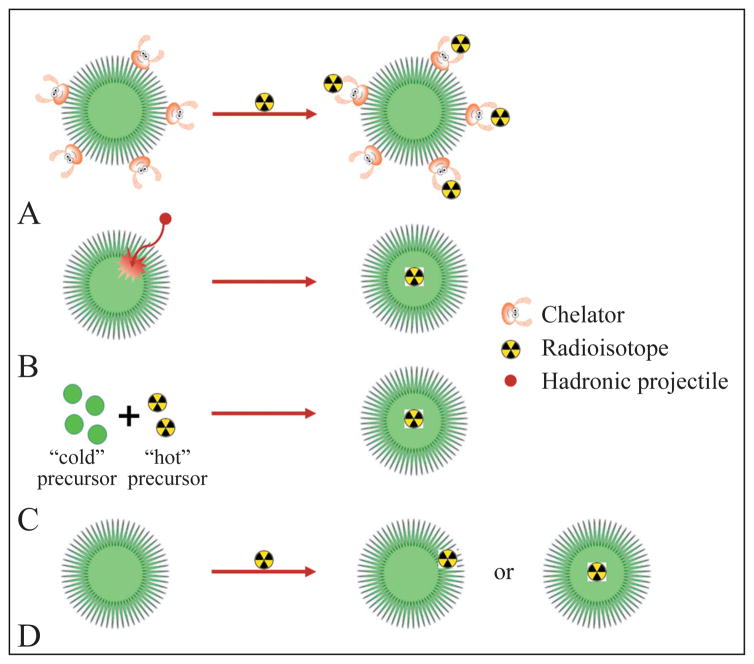
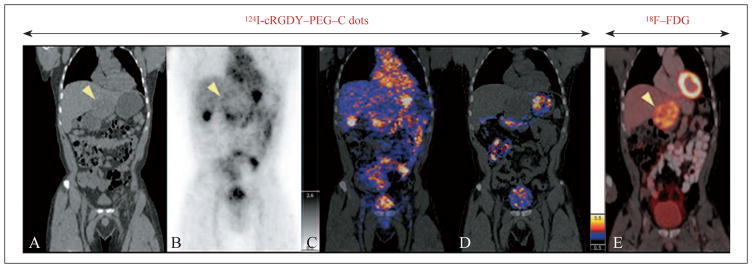
Over the last few years, a plethora of radiolabeled inorganic nanoparticles have been developed and evaluated for their potential use as probes in positron emission tomography (PET) imaging of a wide variety of cancers. Inorganic nanoparticles represent an emerging paradigm in molecular imaging probe design, allowing the incorporation of various imaging modalities, targeting ligands, and therapeutic payloads into a single vector. A major challenge in this endeavor is to develop disease-specific nanoparticles with facile and robust radiolabeling strategies. Also, the radiolabeled nanoparticles should demonstrate adequate in vitro and in vivo stability, enhanced sensitivity for detection of disease at an early stage, optimized in vivo pharmacokinetics for reduced non-specific organ uptake, and improved targeting for achieving high efficacy. Owing to these challenges and other technological and regulatory issues, only a single radiolabeled nanoparticle formulation, namely "C-dots" (Cornell dots), has found its way into clinical trials thus far. This review describes the available options for radiolabeling of nanoparticles and summarizes the recent developments in PET imaging of cancer in preclinical and clinical settings using radiolabeled nanoparticles as probes. The key considerations toward clinical translation of these novel PET imaging probes are discussed, which will be beneficial for advancement of the field.
在过去几年中,已经开发并评估了大量放射性标记的无机纳米颗粒,以探讨其在多种癌症的正电子发射断层扫描(PET)成像中作为探针的潜在用途。无机纳米颗粒代表了分子成像探针设计中的一种新兴模式,它能够将各种成像方式、靶向配体和治疗载荷整合到单个载体中。这项工作中的一个主要挑战是开发具有简便且稳健的放射性标记策略的疾病特异性纳米颗粒。此外,放射性标记的纳米颗粒应表现出足够的体外和体内稳定性、在疾病早期检测时具有更高的灵敏度、优化的体内药代动力学以减少非特异性器官摄取,并改善靶向性以实现高效能。由于这些挑战以及其他技术和监管问题,到目前为止,只有一种放射性标记的纳米颗粒制剂,即“C点”(康奈尔点)进入了临床试验阶段。本综述描述了纳米颗粒放射性标记的可用方法,并总结了在临床前和临床环境中使用放射性标记的纳米颗粒作为探针进行癌症PET成像的最新进展。讨论了这些新型PET成像探针临床转化的关键考虑因素,这将有助于推动该领域的发展。