Hammond G, Hannan C, Yeh T, Fischer K, Mauthe G, Straus S E
University of Manitoba, Winnipeg, Canada.
J Clin Microbiol. 1987 Oct;25(10):1881-5. doi: 10.1128/jcm.25.10.1881-1885.1987.
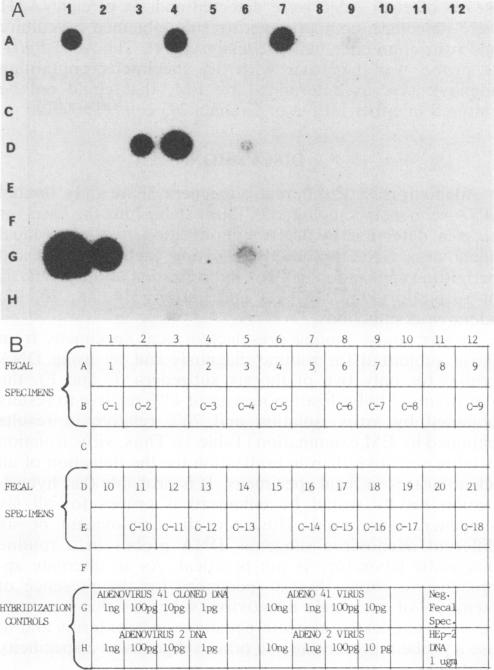
By using a genomic probe, DNA hybridization for adenovirus type 41 (Ad41) showed equivalent sensitivity with a direct spot method from clinical specimens compared with a more laborious DNA phenol extraction procedure. By using this direct spot preparation method, fecal specimens of 67 patients were examined under code for blind testing for the presence of adenovirus by DNA hybridization by using two Ad41 probes (genomic and cloned BglII-D) and an adenovirus type 2 genomic probe. Identical results were obtained with both of the Ad41 probes. Of the fecal specimens from 42 children with adenovirus gastroenteritis studied prospectively (16 of whom had enteric adenoviruses), 13 specimens (81%) were detected by DNA hybridization with a cloned Ad41 BglII-D probe. There were 14 fecal specimens that were positive by electron microscopy (EM) and culture for nonenteric adenovirus, and 2 specimens were positive by DNA hybridization (87% specificity); these 2 specimens may have been from a mixed enteric adenovirus and nonenteric adenovirus infection. None of 26 specimens from age-matched healthy control patients was positive for adenovirus by EM or DNA hybridization. Our data indicated that DNA hybridization gives highly reproducible results. The direct spot technique is the method of choice for specimen preparation in the diagnostic laboratory, since it requires only the simplest manipulations in specimen preparation. By using DNA hybridization with the BglII D fragment of a cloned enteric Ad41, both adenovirus type 40 and Ad41 were detected directly from fecal specimens, but it was less sensitive than EM following direct ultracentrifugation of specimens. The Bg1II-D Ad41 DNA probe was highly specific for enteric adenoviruses, and DNA hybridization with this probe could be a useful diagnostic test for these fastidious adenoviruses.
通过使用基因组探针,41型腺病毒(Ad41)的DNA杂交显示,与更为繁琐的DNA酚提取程序相比,其与临床标本直接斑点法的灵敏度相当。通过使用这种直接斑点制备方法,对67例患者的粪便标本进行了编码盲测,使用两种Ad41探针(基因组探针和克隆的BglII-D探针)以及2型腺病毒基因组探针,通过DNA杂交检测腺病毒的存在。两种Ad41探针获得了相同的结果。在对42例前瞻性研究的腺病毒肠胃炎儿童的粪便标本中(其中16例患有肠道腺病毒),使用克隆的Ad41 BglII-D探针通过DNA杂交检测到13份标本(81%)。有14份粪便标本通过电子显微镜(EM)和非肠道腺病毒培养呈阳性,2份标本通过DNA杂交呈阳性(特异性为87%);这2份标本可能来自肠道腺病毒和非肠道腺病毒的混合感染。26份年龄匹配的健康对照患者的标本中,没有一份通过EM或DNA杂交检测到腺病毒呈阳性。我们的数据表明,DNA杂交产生的结果具有高度可重复性。直接斑点技术是诊断实验室标本制备的首选方法,因为它在标本制备中只需要最简单的操作。通过使用与克隆的肠道Ad41的BglII D片段进行DNA杂交,40型腺病毒和Ad41都可以直接从粪便标本中检测到,但在标本直接超速离心后,其灵敏度低于EM。Bg1II-D Ad41 DNA探针对肠道腺病毒具有高度特异性,与该探针进行DNA杂交可能是检测这些难培养腺病毒的有用诊断试验。