Li Zhu, Wang Gang, Zhu Yan-Juan, Li Chen-Guang, Tang Yun-Zhao, Jiang Zhen-Huan, Yang Min, Ni Chang-Lin, Chen Li-Ming, Niu Wen-Yan
Key Laboratory of Hormones and Development (Ministry of Health), Tianjin Key Laboratory of Metabolic Diseases, Tianjin Metabolic Diseases Hospital and Tianjin Institute of Endocrinology, Tianjin Medical University, Tianjin 300070, China.
Tianjin University of Traditional Chinese Medicine, Tianjin 300193 China.
Biosci Rep. 2017 Jun 8;37(3). doi: 10.1042/BSR20170213. Print 2017 Jun 30.
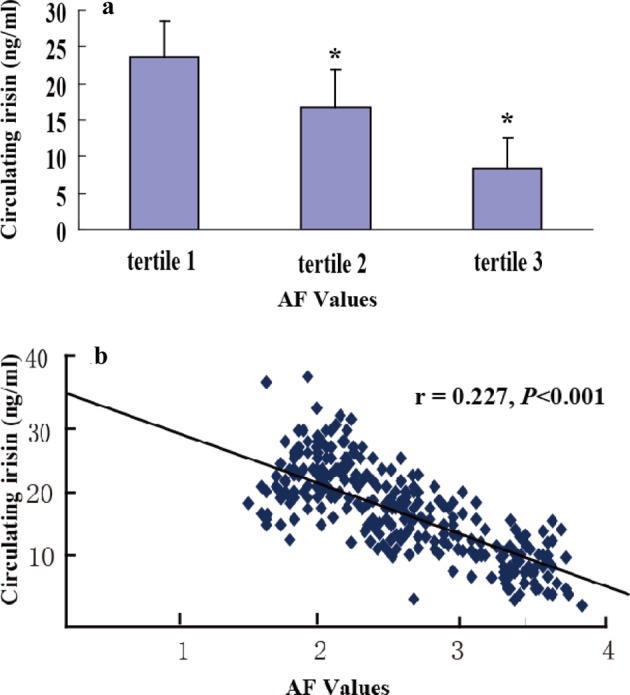
Advanced glycation end-products (AGEs), measured by skin autofluorescence (AF), are a factor in the development or worsening of many degenerative diseases, such as diabetes and atherosclerosis. Irisin levels have been associated with diabetes, endothelial dysfunction and atherosclerosis. The objective of the present study was to investigate whether circulating irisin levels are correlated with skin AF values in type 2 diabetes patients. A total of 362 Chinese type 2 diabetic patients and 100 age- and sex-matched healthy controls were recruited in the present study. Clinical characteristics, blood biochemistry and circulating irisin levels were measured. Skin AF was measured using an AGE reader. Circulating irisin levels were significantly lower, while skin AF values were increased in type 2 diabetes compared with controls (<0.05 respectively). By dividing the distribution of skin AF values into tertiles, serum irisin levels gradually lowered with increasing skin AF values (<0.05). After adjusting for covariates, multivariate stepwise regression analysis demonstrated that serum lower irisin levels were independently associated with skin AF (=0.009). Circulating irisin levels were lower in type 2 diabetes patients compared with healthy controls. Lower levels of irisin are independently associated with elevated skin AF values, indicating that circulating irisin levels could be associated with AGEs accumulation, which is one of the reasons causing vascular complications in diabetic patients.
通过皮肤自发荧光(AF)测量的晚期糖基化终产物(AGEs)是许多退行性疾病(如糖尿病和动脉粥样硬化)发生或恶化的一个因素。鸢尾素水平与糖尿病、内皮功能障碍和动脉粥样硬化有关。本研究的目的是调查2型糖尿病患者循环鸢尾素水平是否与皮肤AF值相关。本研究共招募了362名中国2型糖尿病患者和100名年龄及性别匹配的健康对照者。测量了临床特征、血液生化指标和循环鸢尾素水平。使用AGE阅读器测量皮肤AF。与对照组相比,2型糖尿病患者的循环鸢尾素水平显著降低,而皮肤AF值升高(分别<0.05)。通过将皮肤AF值的分布分为三分位数,血清鸢尾素水平随着皮肤AF值的增加而逐渐降低(<0.05)。在调整协变量后,多因素逐步回归分析表明,血清鸢尾素水平较低与皮肤AF独立相关(=0.009)。与健康对照者相比,2型糖尿病患者的循环鸢尾素水平较低。较低水平的鸢尾素与升高的皮肤AF值独立相关,表明循环鸢尾素水平可能与AGEs积累有关,这是糖尿病患者发生血管并发症的原因之一。