• 文献检索
  • 文档翻译
  • 深度研究
  • 学术资讯
  • Suppr Zotero 插件Zotero 插件
  • 邀请有礼
  • 套餐&价格
  • 历史记录
应用&插件
Suppr Zotero 插件Zotero 插件浏览器插件Mac 客户端Windows 客户端微信小程序
定价
高级版会员购买积分包购买API积分包
服务
文献检索文档翻译深度研究API 文档MCP 服务
关于我们
关于 Suppr公司介绍联系我们用户协议隐私条款
关注我们

Suppr 超能文献

核心技术专利:CN118964589B侵权必究
粤ICP备2023148730 号-1Suppr @ 2026

文献检索

告别复杂PubMed语法,用中文像聊天一样搜索,搜遍4000万医学文献。AI智能推荐,让科研检索更轻松。

立即免费搜索

文件翻译

保留排版,准确专业,支持PDF/Word/PPT等文件格式,支持 12+语言互译。

免费翻译文档

深度研究

AI帮你快速写综述,25分钟生成高质量综述,智能提取关键信息,辅助科研写作。

立即免费体验

局灶性海马癫痫患者的癫痫发作预测

Seizure prediction in patients with focal hippocampal epilepsy.

作者信息

Aarabi Ardalan, He Bin

机构信息

GRAMFC Inserm U1105, University Research Center, University of Picardie-Jules Verne, CHU AMIENS - SITE SUD, Avenue Laennec, 80054 Amiens, France; Faculty of Medicine, University of Picardie Jules Verne, Amiens 80036, France.

Department of Biomedical Engineering, University of Minnesota, Minneapolis, MN 55455, USA; Institute for Engineering in Medicine, University of Minnesota, Minneapolis, MN 55455, USA.

出版信息

Clin Neurophysiol. 2017 Jul;128(7):1299-1307. doi: 10.1016/j.clinph.2017.04.026. Epub 2017 May 12.

DOI:10.1016/j.clinph.2017.04.026
PMID:28554147
原文链接:https://pmc.ncbi.nlm.nih.gov/articles/PMC5513720/
Abstract

OBJECTIVE

We evaluated the performance of our previously developed seizure prediction approach on thirty eight seizures from ten patients with focal hippocampal epilepsy.

METHODS

The seizure prediction system was developed based on the extraction of correlation dimension, correlation entropy, noise level, Lempel-Ziv complexity, largest Lyapunov exponent, and nonlinear interdependence from segments of intracranial EEG.

RESULTS

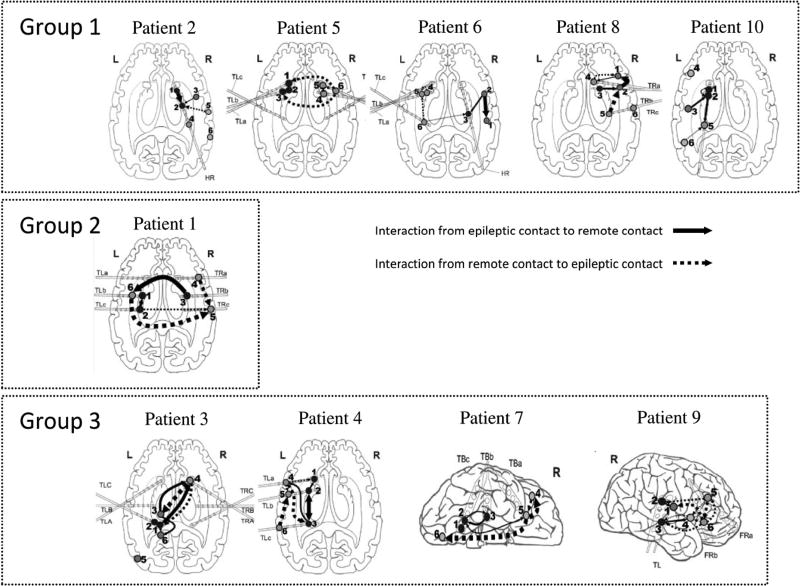
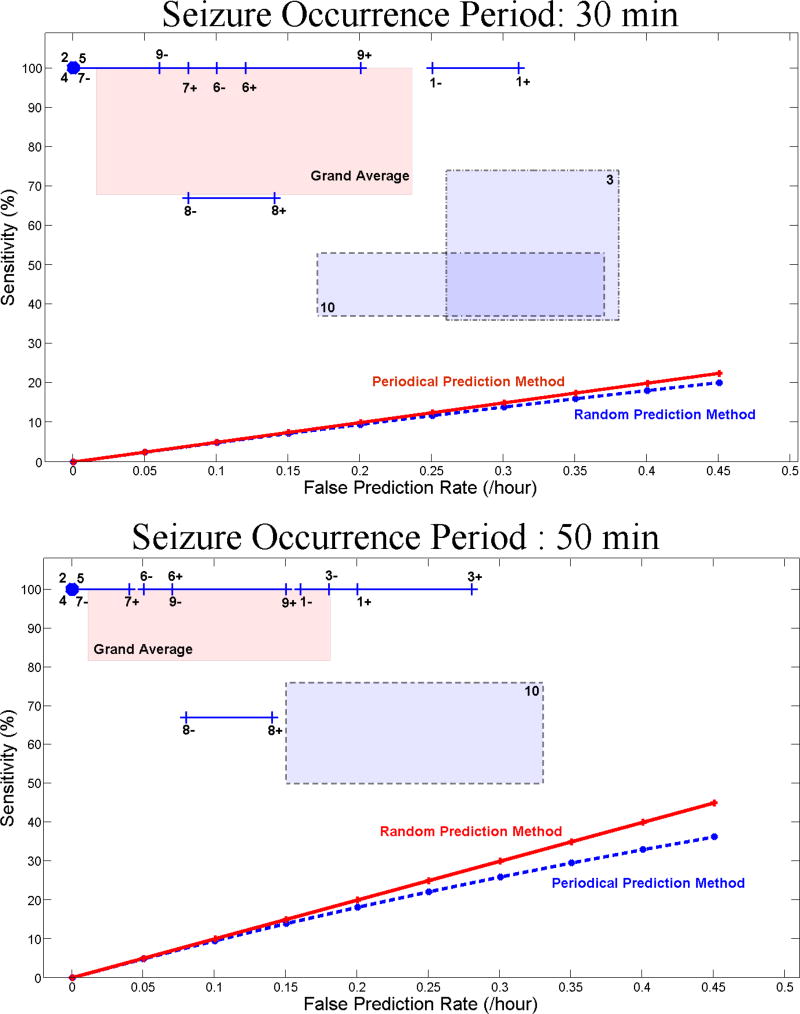
Our results showed an average sensitivity of 86.7% and 92.9%, an average false prediction rate of 0.126 and 0.096/h, and an average minimum prediction time of 14.3 and 33.3min, respectively, using seizure occurrence periods of 30 and 50min and a seizure prediction horizon of 10s. Two-third of the analyzed seizures showed significantly increased complexity in periods prior to the seizures in comparison with baseline. In four patients, strong bidirectional connectivities between epileptic contacts and the surrounding areas were observed. However, in five patients, unidirectional functional connectivities in preictal periods were observed from remote areas to epileptogenic zones.

CONCLUSIONS

Overall, preictal periods in patients with focal hippocampal epilepsy were characterized with patient-specific changes in univariate and bivariate nonlinear measures.

SIGNIFICANCE

The spatio-temporal characterization of preictal periods may help to better understand the mechanism underlying seizure generation in patients with focal hippocampal epilepsy.

摘要

目的

我们评估了我们之前开发的癫痫发作预测方法在10例局灶性海马癫痫患者的38次癫痫发作中的表现。

方法

癫痫发作预测系统基于从颅内脑电图片段中提取关联维数、关联熵、噪声水平、莱姆尔-齐夫复杂度、最大李雅普诺夫指数和非线性相互依存性而开发。

结果

我们的结果显示,使用30分钟和50分钟的癫痫发作发生期以及10秒的癫痫发作预测范围,平均灵敏度分别为86.7%和92.9%,平均误报率分别为0.126和0.096/小时,平均最小预测时间分别为14.3分钟和33.3分钟。三分之二的分析癫痫发作在发作前阶段与基线相比显示出复杂度显著增加。在4例患者中,观察到癫痫病灶与周围区域之间存在强双向连接。然而,在5例患者中,在发作前期观察到从远处区域到癫痫源区的单向功能连接。

结论

总体而言,局灶性海马癫痫患者的发作前期具有单变量和双变量非线性测量中特定于患者的变化特征。

意义

发作前期的时空特征可能有助于更好地理解局灶性海马癫痫患者癫痫发作产生的潜在机制。

https://cdn.ncbi.nlm.nih.gov/pmc/blobs/cacd/5513720/404940a0340b/nihms876394f3.jpg
https://cdn.ncbi.nlm.nih.gov/pmc/blobs/cacd/5513720/5ae574a850f0/nihms876394f1.jpg
https://cdn.ncbi.nlm.nih.gov/pmc/blobs/cacd/5513720/8ad53fc872c1/nihms876394f2.jpg
https://cdn.ncbi.nlm.nih.gov/pmc/blobs/cacd/5513720/404940a0340b/nihms876394f3.jpg
https://cdn.ncbi.nlm.nih.gov/pmc/blobs/cacd/5513720/5ae574a850f0/nihms876394f1.jpg
https://cdn.ncbi.nlm.nih.gov/pmc/blobs/cacd/5513720/8ad53fc872c1/nihms876394f2.jpg
https://cdn.ncbi.nlm.nih.gov/pmc/blobs/cacd/5513720/404940a0340b/nihms876394f3.jpg

相似文献

1
Seizure prediction in patients with focal hippocampal epilepsy.局灶性海马癫痫患者的癫痫发作预测
Clin Neurophysiol. 2017 Jul;128(7):1299-1307. doi: 10.1016/j.clinph.2017.04.026. Epub 2017 May 12.
2
Seizure prediction in hippocampal and neocortical epilepsy using a model-based approach.基于模型的方法在海马和新皮层癫痫中的发作预测。
Clin Neurophysiol. 2014 May;125(5):930-40. doi: 10.1016/j.clinph.2013.10.051. Epub 2013 Nov 28.
3
A rule-based seizure prediction method for focal neocortical epilepsy.基于规则的局灶性新皮层癫痫发作预测方法。
Clin Neurophysiol. 2012 Jun;123(6):1111-22. doi: 10.1016/j.clinph.2012.01.014. Epub 2012 Feb 22.
4
Epileptic Seizure Prediction Using Diffusion Distance and Bayesian Linear Discriminate Analysis on Intracranial EEG.基于颅内 EEG 的扩散距离和贝叶斯线性判别分析的癫痫发作预测。
Int J Neural Syst. 2018 Feb;28(1):1750043. doi: 10.1142/S0129065717500435. Epub 2017 Aug 16.
5
Correlating Resting-State Functional Magnetic Resonance Imaging Connectivity by Independent Component Analysis-Based Epileptogenic Zones with Intracranial Electroencephalogram Localized Seizure Onset Zones and Surgical Outcomes in Prospective Pediatric Intractable Epilepsy Study.基于独立成分分析的致痫区与颅内脑电图定位发作起始区的静息态功能磁共振成像连接相关性及其在前瞻性儿科难治性癫痫研究中的手术结果。
Brain Connect. 2017 Sep;7(7):424-442. doi: 10.1089/brain.2016.0479.
6
Discriminating preictal and interictal brain states in intracranial EEG by sample entropy and extreme learning machine.通过样本熵和极限学习机区分颅内脑电图中的发作前期和发作间期脑状态。
J Neurosci Methods. 2016 Jan 15;257:45-54. doi: 10.1016/j.jneumeth.2015.08.026. Epub 2015 Aug 31.
7
Transient seizure onset network for localization of epileptogenic zone: effective connectivity and graph theory-based analyses of ECoG data in temporal lobe epilepsy.短暂性发作起始网络用于致痫灶定位:基于 ECoG 数据的有效连通性和图论分析在颞叶癫痫中的应用。
J Neurol. 2019 Apr;266(4):844-859. doi: 10.1007/s00415-019-09204-4. Epub 2019 Jan 25.
8
Ensembling crowdsourced seizure prediction algorithms using long-term human intracranial EEG.使用长期的人类颅内 EEG 对众包癫痫预测算法进行集成。
Epilepsia. 2020 Feb;61(2):e7-e12. doi: 10.1111/epi.16418. Epub 2019 Dec 28.
9
Seizure Cycles in Focal Epilepsy.局灶性癫痫的发作周期。
JAMA Neurol. 2021 Apr 1;78(4):454-463. doi: 10.1001/jamaneurol.2020.5370.
10
Seizure onset predicts its type.发作起始可预测发作类型。
Epilepsia. 2018 Mar;59(3):650-660. doi: 10.1111/epi.13997. Epub 2018 Jan 11.

引用本文的文献

1
Automatic detection and prediction of epileptic EEG signals based on nonlinear dynamics and deep learning: a review.基于非线性动力学和深度学习的癫痫脑电信号自动检测与预测综述
Front Neurosci. 2025 Aug 18;19:1630664. doi: 10.3389/fnins.2025.1630664. eCollection 2025.
2
Time series segmentation for recognition of epileptiform patterns recorded via microelectrode arrays in vitro.用于识别通过体外微电极阵列记录的癫痫样模式的时间序列分割
PLoS One. 2025 Jan 24;20(1):e0309550. doi: 10.1371/journal.pone.0309550. eCollection 2025.
3
Research progress of epileptic seizure prediction methods based on EEG.基于脑电图的癫痫发作预测方法的研究进展
Cogn Neurodyn. 2024 Oct;18(5):2731-2750. doi: 10.1007/s11571-024-10109-w. Epub 2024 May 7.
4
[An autoencoder model based on one-dimensional neural network for epileptic EEG anomaly detection].[一种基于一维神经网络的自动编码器模型用于癫痫脑电异常检测]
Nan Fang Yi Ke Da Xue Xue Bao. 2024 Sep 20;44(9):1796-1804. doi: 10.12122/j.issn.1673-4254.2024.09.20.
5
Concept-drifts adaptation for machine learning EEG epilepsy seizure prediction.机器学习 EEG 癫痫发作预测中的概念漂移适应。
Sci Rep. 2024 Apr 8;14(1):8204. doi: 10.1038/s41598-024-57744-1.
6
Deep learning based source imaging provides strong sublobar localization of epileptogenic zone from MEG interictal spikes.基于深度学习的源成像技术可从 MEG 发作间期棘波中对致痫区进行强有力的亚区定位。
Neuroimage. 2023 Nov 1;281:120366. doi: 10.1016/j.neuroimage.2023.120366. Epub 2023 Sep 15.
7
An end-to-end seizure prediction approach using long short-term memory network.一种使用长短期记忆网络的端到端癫痫发作预测方法。
Front Hum Neurosci. 2023 May 18;17:1187794. doi: 10.3389/fnhum.2023.1187794. eCollection 2023.
8
Epileptic seizures detection and the analysis of optimal seizure prediction horizon based on frequency and phase analysis.基于频率和相位分析的癫痫发作检测及最佳发作预测时限分析
Front Neurosci. 2023 May 16;17:1191683. doi: 10.3389/fnins.2023.1191683. eCollection 2023.
9
Generalizable epileptic seizures prediction based on deep transfer learning.基于深度迁移学习的可推广癫痫发作预测
Cogn Neurodyn. 2023 Feb;17(1):119-131. doi: 10.1007/s11571-022-09809-y. Epub 2022 Apr 29.
10
The performance evaluation of the state-of-the-art EEG-based seizure prediction models.基于脑电图的最先进癫痫发作预测模型的性能评估。
Front Neurol. 2022 Nov 24;13:1016224. doi: 10.3389/fneur.2022.1016224. eCollection 2022.

本文引用的文献

1
Seizure prediction for therapeutic devices: A review.用于治疗设备的癫痫发作预测:综述。
J Neurosci Methods. 2016 Feb 15;260:270-82. doi: 10.1016/j.jneumeth.2015.06.010. Epub 2015 Jun 19.
2
Seizure detection, seizure prediction, and closed-loop warning systems in epilepsy.癫痫中的发作检测、发作预测及闭环预警系统
Epilepsy Behav. 2014 Aug;37:291-307. doi: 10.1016/j.yebeh.2014.06.023. Epub 2014 Aug 29.
3
Seizure prediction in hippocampal and neocortical epilepsy using a model-based approach.基于模型的方法在海马和新皮层癫痫中的发作预测。
Clin Neurophysiol. 2014 May;125(5):930-40. doi: 10.1016/j.clinph.2013.10.051. Epub 2013 Nov 28.
4
Seizure prediction in patients with mesial temporal lobe epilepsy using EEG measures of state similarity.使用 EEG 状态相似性测量对内侧颞叶癫痫患者进行癫痫发作预测。
Clin Neurophysiol. 2013 Sep;124(9):1745-54. doi: 10.1016/j.clinph.2013.04.006. Epub 2013 May 3.
5
Prediction of seizure likelihood with a long-term, implanted seizure advisory system in patients with drug-resistant epilepsy: a first-in-man study.耐药性癫痫患者的长期植入式癫痫预警系统预测癫痫发作的可能性:首例人体研究。
Lancet Neurol. 2013 Jun;12(6):563-71. doi: 10.1016/S1474-4422(13)70075-9. Epub 2013 May 2.
6
A rule-based seizure prediction method for focal neocortical epilepsy.基于规则的局灶性新皮层癫痫发作预测方法。
Clin Neurophysiol. 2012 Jun;123(6):1111-22. doi: 10.1016/j.clinph.2012.01.014. Epub 2012 Feb 22.
7
Joining the benefits: combining epileptic seizure prediction methods.联合优势:结合癫痫发作预测方法。
Epilepsia. 2010 Aug;51(8):1598-606. doi: 10.1111/j.1528-1167.2009.02497.x. Epub 2010 Jan 7.
8
Classification of patterns of EEG synchronization for seizure prediction.用于癫痫发作预测的脑电图同步模式分类。
Clin Neurophysiol. 2009 Nov;120(11):1927-1940. doi: 10.1016/j.clinph.2009.09.002. Epub 2009 Oct 17.
9
Do false predictions of seizures depend on the state of vigilance? A report from two seizure-prediction methods and proposed remedies.癫痫发作的错误预测是否取决于警觉状态?来自两种癫痫发作预测方法的报告及提出的补救措施。
Epilepsia. 2006 Dec;47(12):2058-70. doi: 10.1111/j.1528-1167.2006.00848.x.
10
Interpretation of the Lempel-Ziv complexity measure in the context of biomedical signal analysis.生物医学信号分析背景下的莱姆普尔-齐夫复杂度度量解读。
IEEE Trans Biomed Eng. 2006 Nov;53(11):2282-8. doi: 10.1109/TBME.2006.883696.