Chai Weiwen, Morimoto Yukiko, Cooney Robert V, Franke Adrian A, Shvetsov Yurii B, Le Marchand Loïc, Haiman Christopher A, Kolonel Laurence N, Goodman Marc T, Maskarinec Gertraud
a Nutrition and Health Sciences , University of Nebraska-Lincoln , Lincoln , Nebraska.
b Epidemiology Program , University of Hawaii Cancer Center , Honolulu , Hawaii.
J Am Coll Nutr. 2017 Jul;36(5):378-385. doi: 10.1080/07315724.2017.1318317. Epub 2017 Jun 19.
The potential influence of dietary factors on inflammation is important for cancer prevention. Utilizing data from control participants (312 men, 911 women) in 2 nested case-control studies of cancer within the Multiethnic Cohort, we examined the associations of red and processed meat intake with serum levels of leptin, adiponectin, C-reactive protein (CRP), tumor necrosis factor (TNF)-α, and interleukin (IL)-6 and the mediator effect of body mass index (BMI) on the above associations (if present).
Multivariable linear models were applied to assess the association between red and processed meat intake at cohort entry and serum biomarker levels measured 9.1 years later after adjusting for covariates and to determine the mediator effect of BMI.
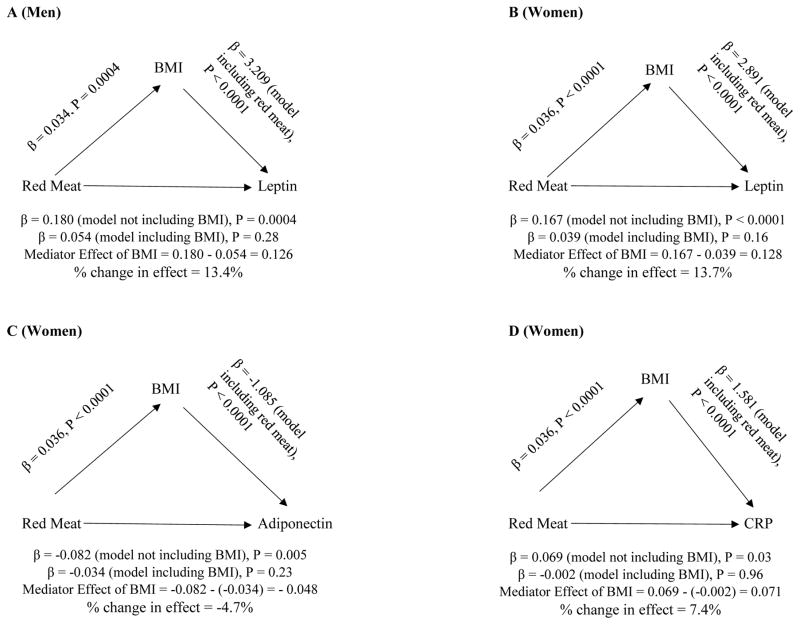
Overall red and processed meat intake was positively associated with serum leptin levels in men (β = 0.180, p = 0.0004) and women (β = 0.167, p < 0.0001). In women, higher red and processed meat consumption was significantly associated with higher CRP (β = 0.069, p = 0.03) and lower adiponectin levels (β = -0.082, p = 0.005). In mediation analyses with red and processed meat intake and BMI as predictors, the associations of red and processed meat with biomarkers decreased substantially (as indicated by percentage change in effect: leptin in men, 13.4%; leptin in women, 13.7%; adiponectin in women, -4.7%; CRP in women, 7.4%) and were no longer significant (p > 0.05), whereas BMI remained significantly associated with serum leptin (men: β = 3.209, p < 0.0001; women: β = 2.891, p < 0.0001), adiponectin (women: β = -1.085, p < 0.0001), and CRP (women: β = 1.581, p < 0.0001).
The current data suggest that the amount of excess body weight or the degree of adiposity may mediate the relations between dietary red and processed meat intake and serum biomarkers associated with obesity and inflammation.
饮食因素对炎症的潜在影响对于癌症预防至关重要。利用多民族队列中两项嵌套式癌症病例对照研究中对照参与者(312名男性,911名女性)的数据,我们研究了红肉和加工肉摄入量与血清瘦素、脂联素、C反应蛋白(CRP)、肿瘤坏死因子(TNF)-α和白细胞介素(IL)-6水平之间的关联,以及体重指数(BMI)对上述关联的中介作用(若存在)。
应用多变量线性模型评估队列入组时红肉和加工肉摄入量与9.1年后测量的血清生物标志物水平之间的关联(在调整协变量后),并确定BMI的中介作用。
总体而言,红肉和加工肉摄入量与男性(β = 0.180,p = 0.0004)和女性(β = 0.167,p < 0.0001)的血清瘦素水平呈正相关。在女性中,较高的红肉和加工肉消费量与较高的CRP(β = 0.069,p = 0.03)和较低的脂联素水平(β = -0.082,p = 0.005)显著相关。在以红肉和加工肉摄入量及BMI作为预测因素的中介分析中,红肉和加工肉与生物标志物之间的关联大幅降低(以效应变化百分比表示:男性瘦素为13.4%;女性瘦素为13.7%;女性脂联素为-4.7%;女性CRP为7.4%)且不再显著(p > 0.05),而BMI仍与血清瘦素(男性:β = 3.209,p < 0.0001;女性:β = 2.891,p < 0.0001)、脂联素(女性:β = -1.085,p < 0.0001)和CRP(女性:β = 1.581,p < 0.0001)显著相关。
当前数据表明,超重或肥胖程度可能介导了饮食中红肉和加工肉摄入量与肥胖及炎症相关血清生物标志物之间的关系。