Sharafi Azadeh, Xia Ding, Chang Gregory, Regatte Ravinder R
Bernard and Irene Schwartz Center for Biomedical Imaging, Department of Radiology, New York University School of Medicine, New York, New York, USA.
NMR Biomed. 2017 Oct;30(10). doi: 10.1002/nbm.3760. Epub 2017 Jun 20.
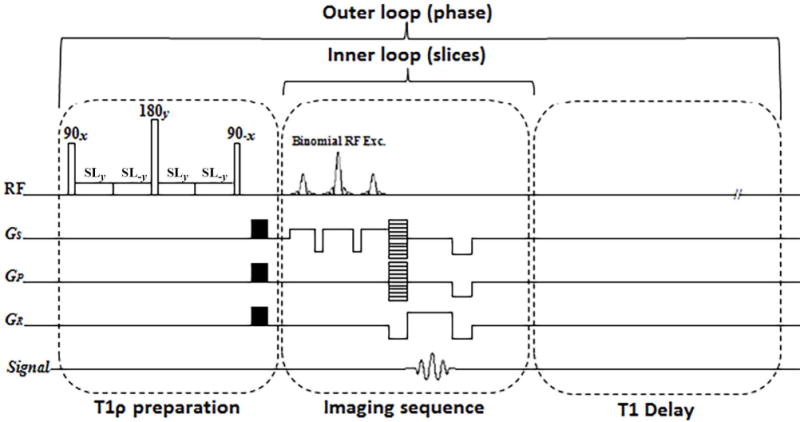
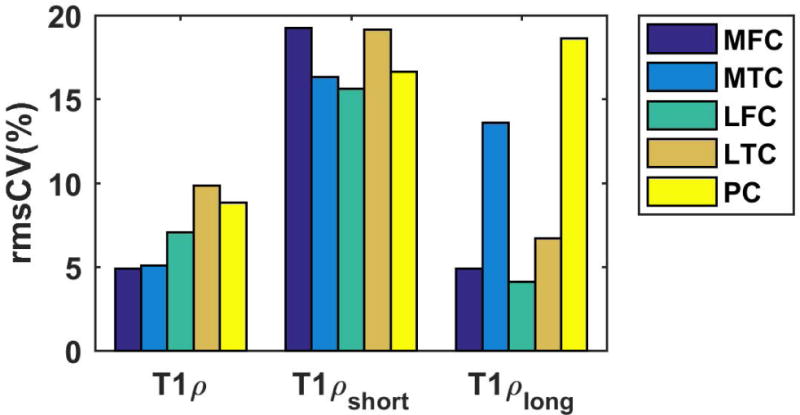
The purpose of this study was to demonstrate the feasibility of biexponential T relaxation mapping of human knee cartilage in vivo. A three-dimensional, customized, turbo-flash sequence was used to acquire T -weighted images from healthy volunteers employing a standard 3-T MRI clinical scanner. A series of T -weighted images was fitted using monoexponential and biexponential models with two- and four-parametric non-linear approaches, respectively. Non-parametric Kruskal-Wallis and Mann-Whitney U-statistical tests were used to evaluate the regional relaxation and gender differences, respectively, with a level of significance of P = 0.05. Biexponential relaxations were detected in the cartilage of all volunteers. The short and long relaxation components of T were estimated to be 6.9 and 51.0 ms, respectively. Similarly, the fractions of short and long T were 37.6% and 62.4%, respectively. The monoexponential relaxation of T was 32.6 ms. The experiments showed good repeatability with a coefficient of variation (CV) of less than 20%. A biexponential relaxation model showed a better fit than a monoexponential model to the T relaxation decay in knee cartilage. Biexponential T components could potentially be used to increase the specificity to detect early osteoarthritis by the measurement of different water compartments and their fractions.
本研究的目的是证明在体测量人膝关节软骨双指数T弛豫映射的可行性。使用三维定制的快速扰相梯度回波序列,通过标准的3T磁共振成像临床扫描仪从健康志愿者获取T加权图像。分别采用双参数和四参数非线性方法,用单指数和双指数模型拟合一系列T加权图像。采用非参数Kruskal-Wallis检验和Mann-Whitney U统计检验分别评估区域弛豫差异和性别差异,显著性水平为P = 0.05。在所有志愿者的软骨中均检测到双指数弛豫。T的短弛豫成分和长弛豫成分估计分别为6.9 ms和51.0 ms。同样,短T和长T的分数分别为37.6%和62.4%。T的单指数弛豫为32.6 ms。实验显示出良好的重复性,变异系数(CV)小于20%。双指数弛豫模型比单指数模型能更好地拟合膝关节软骨的T弛豫衰减。双指数T成分有可能通过测量不同水相及其分数来提高检测早期骨关节炎的特异性。