Kotaki Ryutaro, Koyama-Nasu Ryo, Yamakawa Natsuko, Kotani Ai
Department of Hematology and Oncology, Tokai University School of Medicine, Hiratsuka 259-1193, Japan.
Int J Mol Sci. 2017 Jul 11;18(7):1495. doi: 10.3390/ijms18071495.
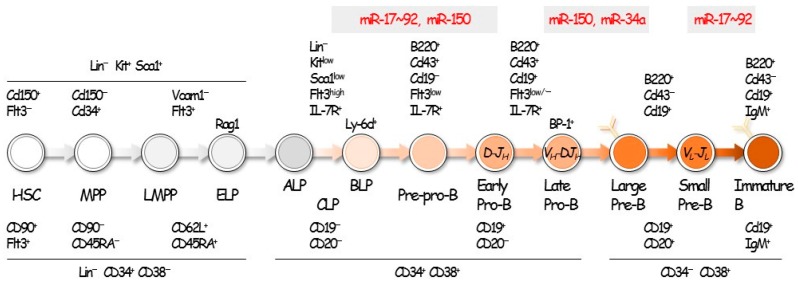
Lineage specification is primarily regulated at the transcriptional level and lineage-specific transcription factors determine cell fates. MicroRNAs (miRNAs) are 18-24 nucleotide-long non-coding RNAs that post-transcriptionally decrease the translation of target mRNAs and are essential for many cellular functions. miRNAs also regulate lineage specification during hematopoiesis. This review highlights the roles of miRNAs in B-cell development and malignancies, and discusses how miRNA expression profiles correlate with disease prognoses and phenotypes. We also discuss the potential for miRNAs as therapeutic targets and diagnostic tools for B-cell malignancies.
谱系特化主要在转录水平受到调控,谱系特异性转录因子决定细胞命运。微小RNA(miRNA)是长度为18 - 24个核苷酸的非编码RNA,它们在转录后水平降低靶mRNA的翻译,并且对许多细胞功能至关重要。miRNA在造血过程中也调节谱系特化。本综述重点介绍了miRNA在B细胞发育和恶性肿瘤中的作用,并讨论了miRNA表达谱如何与疾病预后和表型相关。我们还讨论了miRNA作为B细胞恶性肿瘤治疗靶点和诊断工具的潜力。