Hedegård Erik D, Ryde Ulf
Department of Chemistry, Chemical Centre, Lund University, Sölvegatan 39, Lund, Sweden.
J Biol Inorg Chem. 2017 Oct;22(7):1029-1037. doi: 10.1007/s00775-017-1480-1. Epub 2017 Jul 11.
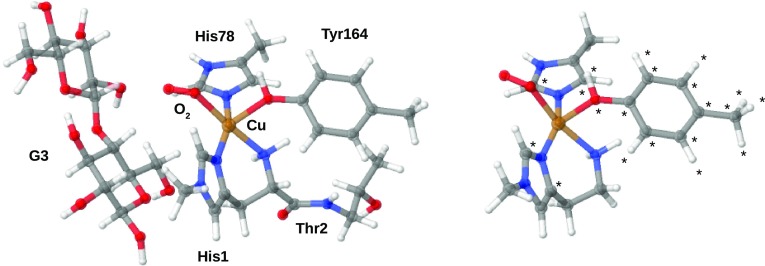
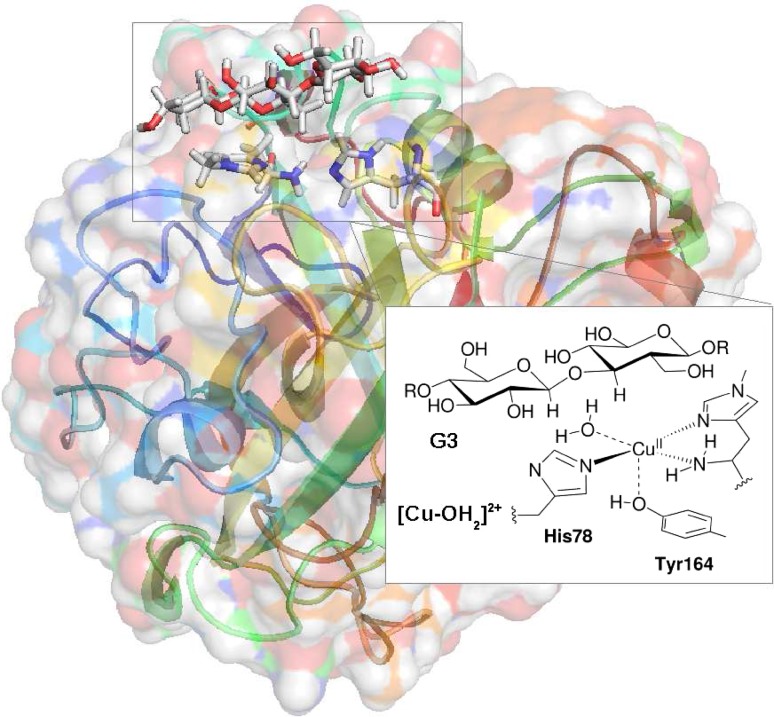
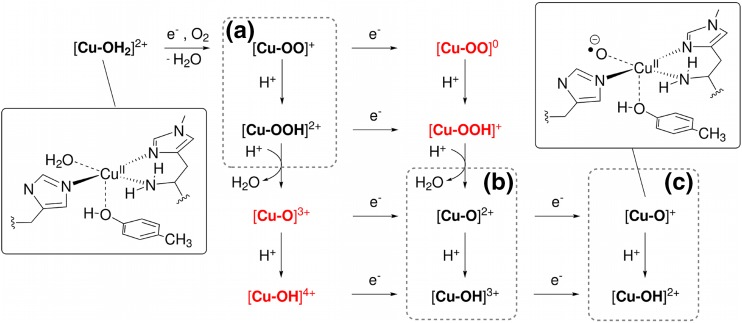
Lytic polysaccharide monooxygenases (LPMOs) are copper metalloenzymes that can enhance polysaccharide depolymerization through an oxidative mechanism, making them interesting for the production of biofuel from cellulose. However, the details of this activation are unknown; in particular, the nature of the intermediate that attacks the glycoside C-H bond in the polysaccharide is not known, and a number of different species have been suggested. The homolytic bond-dissociation energy (BDE) has often been used as a descriptor for the bond-activation power, especially for inorganic model complexes. We have employed quantum-chemical cluster calculations to estimate the BDE for a number of possible LPMO intermediates to bridge the gap between model complexes and the actual LPMO active site. The calculated BDEs suggest that the reactive intermediate is either a Cu(II)-oxyl, a Cu(III)-oxyl, or a Cu(III)-hydroxide, which indicate that O-O bond breaking occurs before the C-H activation step.
裂解多糖单加氧酶(LPMOs)是一种铜金属酶,可通过氧化机制增强多糖的解聚作用,这使得它们在从纤维素生产生物燃料方面具有吸引力。然而,这种活化的细节尚不清楚;特别是,攻击多糖中糖苷C-H键的中间体的性质尚不清楚,并且已经提出了许多不同的物种。均裂键离解能(BDE)经常被用作键活化能力的描述符,特别是对于无机模型配合物。我们采用量子化学簇计算来估计一些可能的LPMO中间体的BDE,以弥合模型配合物与实际LPMO活性位点之间的差距。计算出的BDE表明,反应中间体要么是Cu(II)-氧基、Cu(III)-氧基,要么是Cu(III)-氢氧化物,这表明O-O键断裂发生在C-H活化步骤之前。