Andersson Neil, Arostegui Jorge, Nava-Aguilera Elizabeth, Harris Eva, Ledogar Robert J
Centro de Investigación de Enfermedades Tropicales (CIET), Universidad Autónoma de Guerrero, Acapulco, Mexico.
Department of Family Medicine, McGill University, Montreal, Canada.
BMC Public Health. 2017 May 30;17(Suppl 1):407. doi: 10.1186/s12889-017-4289-5.
Since the Aedes aegypti mosquitoes that transmit dengue virus can breed in clean water, WHO-endorsed vector control strategies place sachets of organophosphate pesticide, temephos (Abate), in household water storage containers. These and other pesticide-dependent approaches have failed to curb the spread of dengue and multiple dengue virus serotypes continue to spread throughout tropical and subtropical regions worldwide. A feasibility study in Managua, Nicaragua, generated instruments, intervention protocols, training schedules and impact assessment tools for a cluster randomised controlled trial of community-based approaches to vector control comprising an alternative strategy for dengue prevention and control in Nicaragua and Mexico.
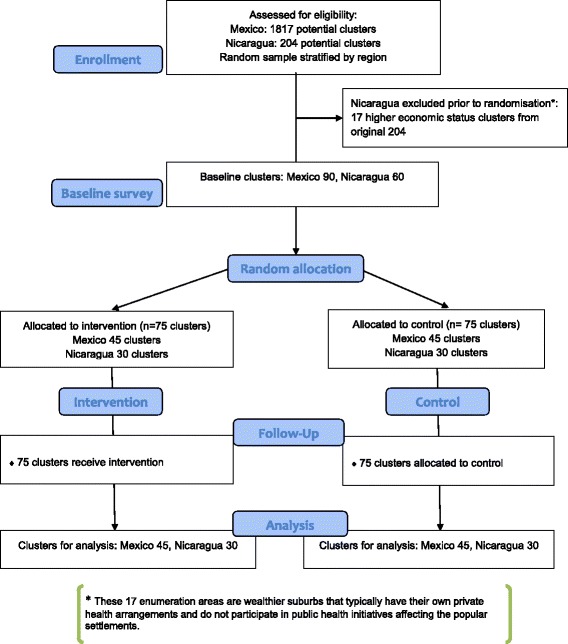
METHODS/DESIGN: The Camino Verde (Green Way) is a pragmatic parallel group trial of pesticide-free dengue vector control, adding effectiveness to the standard government dengue control. A random sample from the most recent census in three coastal regions of Guerrero state in Mexico will generate 90 study clusters and the equivalent sampling frame in Managua, Nicaragua will generate 60 clusters, making a total of 150 clusters each of 137-140 households. After a baseline study, computer-driven randomisation will allocate to intervention one half of the sites, stratified by country, evidence of recent dengue virus infection in children aged 3-9 years and, in Nicaragua, level of community organisation. Following a common evidence-based education protocol, each cluster will develop and implement its own collective interventions including house-to-house visits, school-based programmes and inter-community visits. After 18 months, a follow-up study will compare dengue history, serological evidence of recent dengue virus infection (via measurement of anti-dengue virus antibodies in saliva samples) and entomological indices between intervention and control sites.
Our hypothesis is that informed community mobilisation adds effectiveness in controlling dengue.
ISRCTN27581154 .
由于传播登革热病毒的埃及伊蚊可在清洁水中繁殖,世界卫生组织认可的病媒控制策略是在家庭储水容器中放置有机磷杀虫剂双硫磷(商品名:艾氏剂)药包。这些以及其他依赖杀虫剂的方法未能遏制登革热的传播,多种登革热病毒血清型仍在全球热带和亚热带地区继续传播。在尼加拉瓜马那瓜开展的一项可行性研究,为一项群组随机对照试验生成了相关工具、干预方案、培训计划和影响评估工具,该试验采用基于社区的病媒控制方法,是尼加拉瓜和墨西哥预防和控制登革热的替代策略。
方法/设计:“绿色之路”是一项实用的平行组试验,旨在进行无杀虫剂的登革热媒介控制,在标准的政府登革热控制措施基础上增加有效性。从墨西哥格雷罗州三个沿海地区最近一次人口普查的随机样本中将产生90个研究群组,尼加拉瓜马那瓜的同等抽样框架将产生60个群组,总共150个群组,每个群组有137 - 140户家庭。在基线研究之后,计算机驱动的随机化将按国家、3 - 9岁儿童近期登革热病毒感染证据以及在尼加拉瓜按社区组织水平进行分层,将一半的地点分配到干预组。遵循基于共同证据的教育方案,每个群组将制定并实施自己的集体干预措施,包括挨家挨户走访、校本项目和社区间走访。18个月后,一项随访研究将比较干预组和对照组地点之间的登革热病史、近期登革热病毒感染的血清学证据(通过测量唾液样本中的抗登革热病毒抗体)和昆虫学指标。
我们的假设是,明智的社区动员在控制登革热方面会增加有效性。
ISRCTN27581154 。