Stervbo Ulrik, Pohlmann Dominika, Baron Udo, Bozzetti Cecilia, Jürchott Karsten, Mälzer Julia Nora, Nienen Mikalai, Olek Sven, Roch Toralf, Schulz Axel Ronald, Warth Sarah, Neumann Avidan, Thiel Andreas, Grützkau Andreas, Babel Nina
Berlin-Brandenburg Center for Regenerative Therapies, Charité -Universitätsmedizin Berlin, Augustenburger Platz 1, Berlin, Germany.
Center for Translational Medicine, Medical Clinic I, Marien Hospital Herne, University Hospital of the Ruhr-University Bochum, Hölkeskampring 40, Herne, Germany.
PLoS One. 2017 Jul 11;12(7):e0181161. doi: 10.1371/journal.pone.0181161. eCollection 2017.
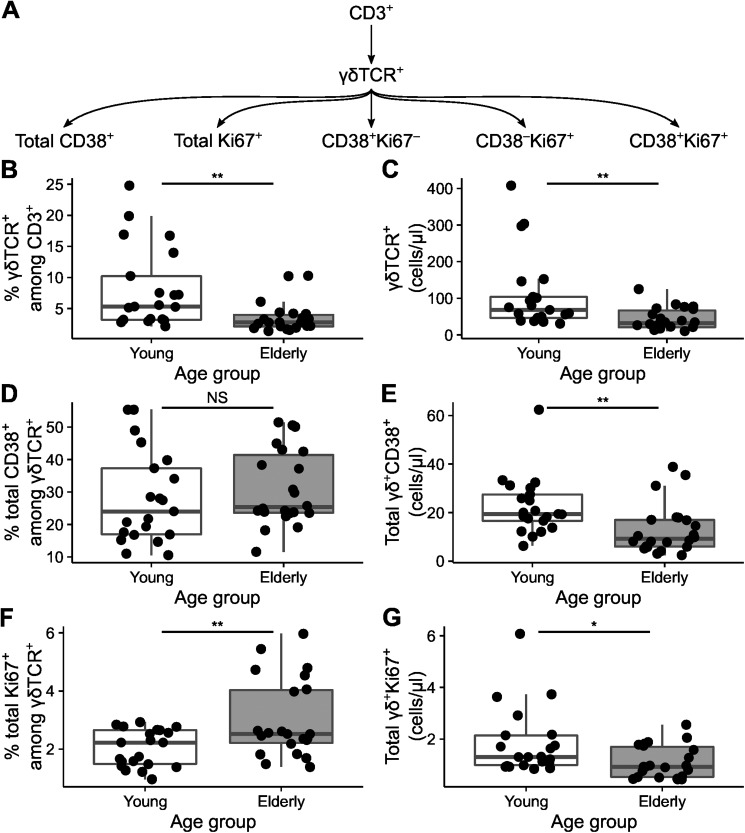
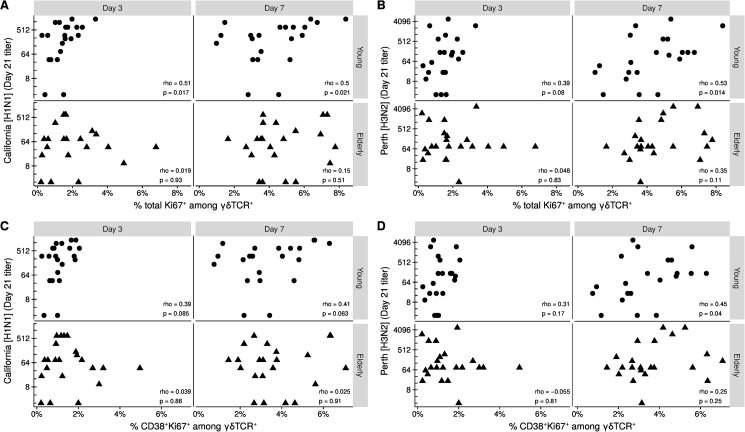
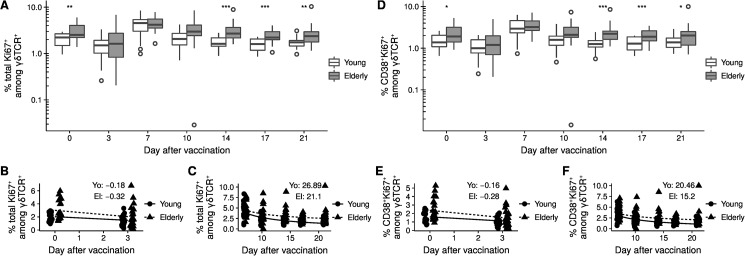
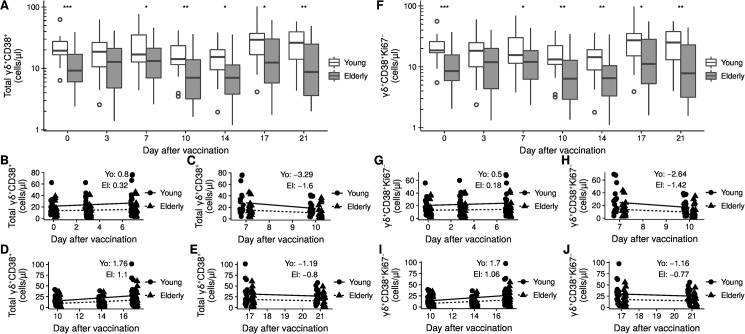
Immunosenescence is a hallmark of the aging immune system and is considered the main cause of a reduced vaccine efficacy in the elderly. Although γδ T cells can become activated by recombinant influenza hemagglutinin, their age-related immunocompetence during a virus-induced immune response has so far not been investigated. In this study we evaluate the kinetics of γδ T cells after vaccination with the trivalent 2011/2012 northern hemisphere seasonal influenza vaccine. We applied multi-parametric flow cytometry to a cohort of 21 young (19-30 years) and 23 elderly (53-67 years) healthy individuals. Activated and proliferating γδ T cells, as identified by CD38 and Ki67 expression, were quantified on the days 0, 3, 7, 10, 14, 17, and 21. We observed a significantly lower number of activated and proliferating γδ T cells at baseline and following vaccination in elderly as compared to young individuals. The kinetics changes of activated γδ T cells were much stronger in the young, while corresponding changes in the elderly occurred slower. In addition, we observed an association between day 21 HAI titers of influenza A and the frequencies of Ki67+ γδ T cells at day 7 in the young. In conclusion, aging induces alterations of the γδ T cell response that might have negative implications for vaccination efficacy.
免疫衰老乃衰老免疫系统的一个标志,被视为老年人疫苗效力降低的主要原因。尽管γδ T细胞可被重组流感血凝素激活,但迄今为止,尚未对其在病毒诱导的免疫反应过程中与年龄相关的免疫能力进行研究。在本研究中,我们评估了接种2011/2012年北半球三价季节性流感疫苗后γδ T细胞的动力学变化。我们对21名年轻(19 - 30岁)和23名老年(53 - 67岁)健康个体组成的队列应用了多参数流式细胞术。通过CD38和Ki67表达鉴定出的活化和增殖γδ T细胞,在第0、3、7、10、14、17和21天进行定量分析。我们观察到,与年轻个体相比,老年人在基线时以及接种疫苗后活化和增殖的γδ T细胞数量显著更低。年轻个体中活化γδ T细胞的动力学变化更为强烈,而老年人相应的变化则发生得较慢。此外,我们观察到年轻个体中甲型流感第21天的血凝抑制(HAI)滴度与第7天Ki67 + γδ T细胞频率之间存在关联。总之,衰老会引发γδ T细胞反应的改变,这可能对疫苗接种效力产生负面影响。