Nunes Michelle Darezzo Rodrigues, Jacob Eufemia, Bomfim Emiliana Omena, Lopes-Junior Luis Carlos, de Lima Regina Aparecida Garcia, Floria-Santos Milena, Nascimento Lucila Castanheira
School of Nursing at Rio de Janeiro State University, Boulevard 28 de Setembro, 157, Vila Isabel, Rio de Janeiro, RJ, Brazil.
University of California Los Angeles, School of Nursing, 700 Tiverton Avenue, Factor Building, Rm 5-942 Los Angeles, CA, USA.
Eur J Oncol Nurs. 2017 Aug;29:39-46. doi: 10.1016/j.ejon.2017.05.001. Epub 2017 May 13.
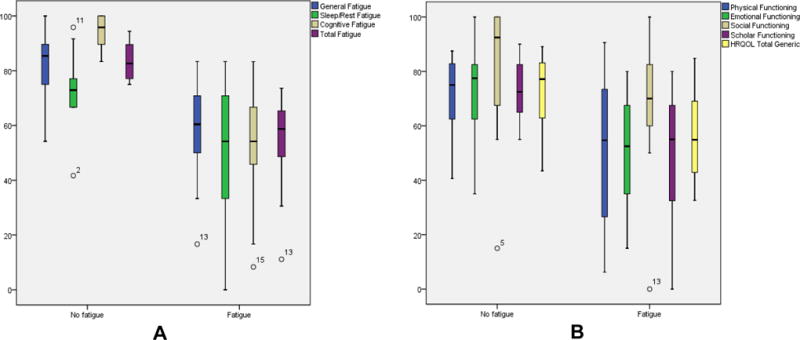
The study examined the different dimensions of fatigue (general, sleep/rest, cognitive), health related quality of life (HRQL) (physical, emotional, cognitive, social), and the relationships between fatigue and HRQL in hospitalized children and adolescents with cancer in Brazil.
Participants were recruited from a pediatric oncology inpatient unit in a comprehensive cancer care hospital in southeast Brazil. They completed the PedsQL Multidimensional Fatigue Scale and the PedsQL Inventory of Quality of Life (Generic and Cancer module) once during hospitalization.
The majority (66.7%) of the participants (n = 38; mean age 12.1 ± 2.9 years) had total fatigue scores < 75 on 0 to 100 scale; with the mean total fatigue score of 63.8 ± 18.5. The majority (72.2% generic; 83.3% cancer modules) had total PedsQL scores < 75 on 0 to 100 scale. The mean PedsQL score on generic module (61.1 ± 17.0) was similar to the mean PedsQL score cancer module (59.1 ± 16.7). Significant correlations were found between total fatigue and quality of life generic (r = 0.63, p = 0.000) and cancer module (r = 0.74, p = 0.000).
The study is the first to report fatigue and health related quality of life in hospitalized children and adolescents with cancer in Brazil. Similar to experiences of other children in the world, our findings indicate that children and adolescents with cancer had problems with fatigue that were associated with low HRQL. Future studies are recommended to examine interventions (exercise, leisurely activities) that may alleviate fatigue and improve HRQL in pediatric patients with cancer.
本研究调查了巴西住院癌症儿童和青少年疲劳的不同维度(一般疲劳、睡眠/休息疲劳、认知疲劳)、健康相关生活质量(HRQL)(身体、情感、认知、社会方面),以及疲劳与HRQL之间的关系。
参与者来自巴西东南部一家综合癌症护理医院的儿科肿瘤住院部。他们在住院期间完成了儿童生活质量多维疲劳量表和儿童生活质量量表(通用版和癌症模块)。
大多数参与者(66.7%,n = 38;平均年龄12.1±2.9岁)在0至100分的量表上总疲劳得分<75分;总疲劳平均得分为63.8±18.5分。大多数人(通用版72.2%;癌症模块83.3%)在0至100分的量表上儿童生活质量量表总得分<75分。通用模块的儿童生活质量量表平均得分(61.1±17.0)与癌症模块的平均得分(59.1±16.7)相似。在总疲劳与通用生活质量(r = 0.63,p = 0.000)和癌症模块(r = 0.74,p = 0.000)之间发现了显著相关性。
本研究首次报告了巴西住院癌症儿童和青少年的疲劳及健康相关生活质量。与世界其他儿童的情况类似,我们的研究结果表明,癌症儿童和青少年存在疲劳问题,且与低健康相关生活质量有关。建议未来的研究考察可能减轻儿科癌症患者疲劳并改善其健康相关生活质量的干预措施(运动、休闲活动)。