Feng Guoping, Cheng Yifan, Wang Shu-Yi, Borca-Tasciuc Diana A, Worobo Randy W, Moraru Carmen I
Department of Food Science, Cornell University, Ithaca, NY, USA.
Department of Mechanical, Aerospace and Nuclear Engineering, Rensselaer Polytechnic Institute, Troy, NY, USA.
NPJ Biofilms Microbiomes. 2015 Dec 2;1:15022. doi: 10.1038/npjbiofilms.2015.22. eCollection 2015.
BACKGROUND/OBJECTIVES: Prevention of biofilm formation by bacteria is of critical importance to areas that directly affect human health and life including medicine, dentistry, food processing and water treatment. This work showcases an effective and affordable solution for reducing attachment and biofilm formation by several pathogenic bacteria commonly associated with foodborne illnesses and medical infections.
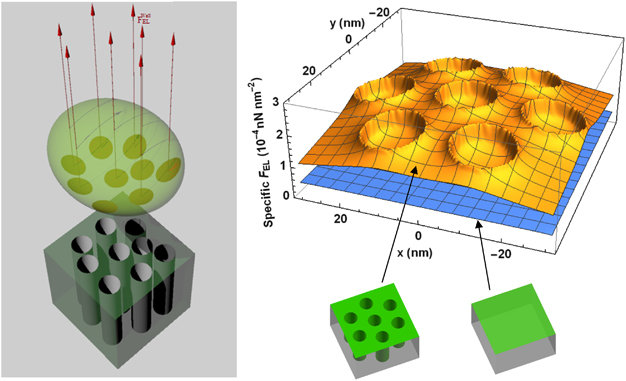
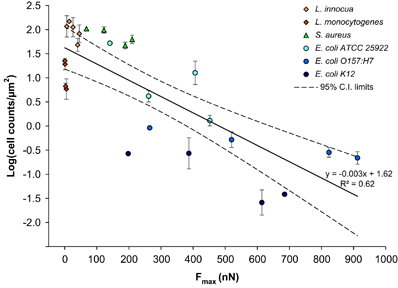
Our approach exploits anodisation to create alumina surfaces with cylindrical nanopores with diameters ranging from 15 to 100 nm, perpendicular to the surface. The anodic surfaces were evaluated for attachment by , , and . Cell-surface interaction forces were calculated and related to attachment.
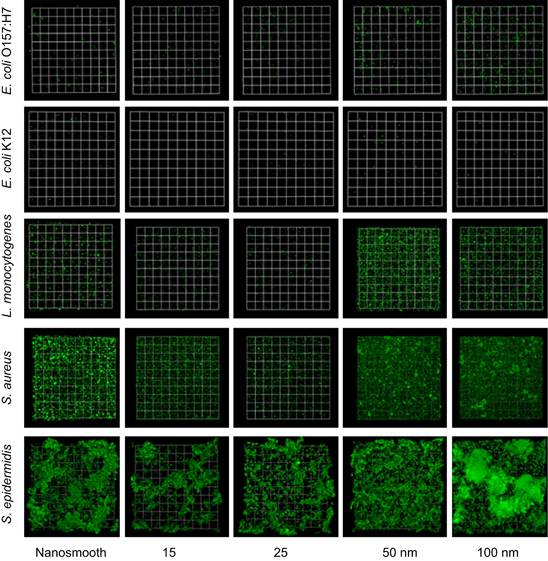
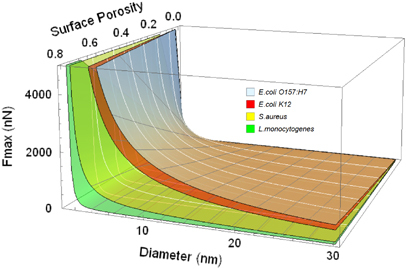
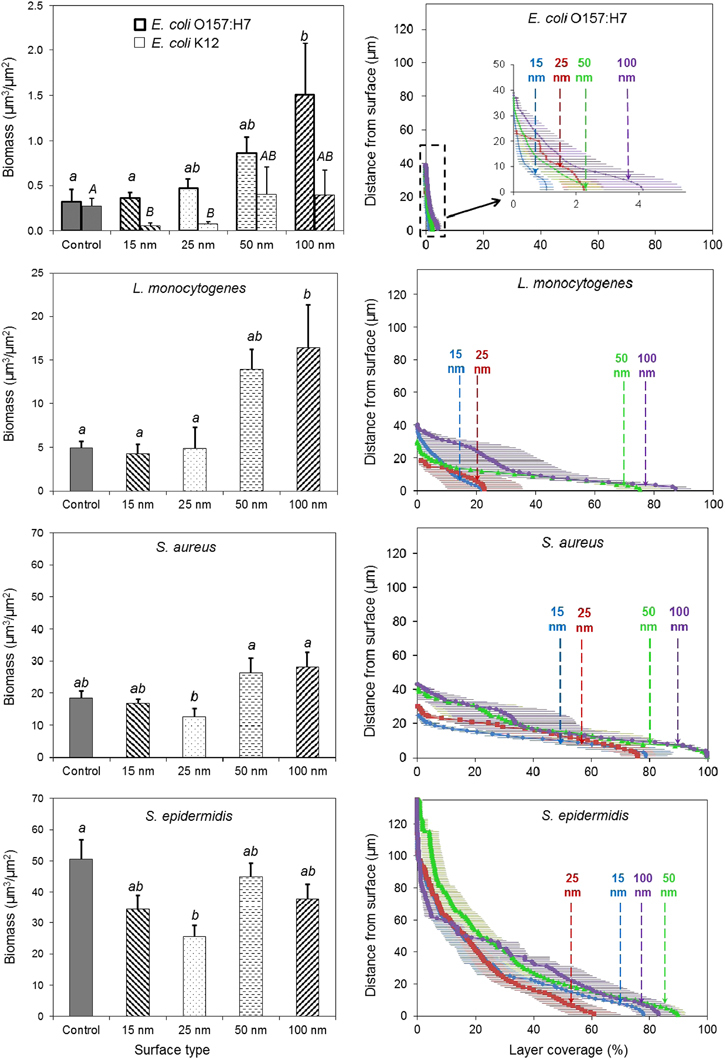
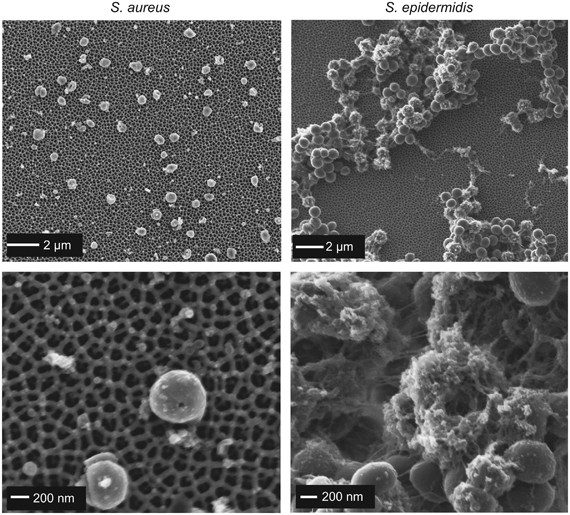
We found that anodic alumina surfaces with pore diameters of 15 and 25 nm were able to effectively minimise bacterial attachment or biofilm formation by all the microorganisms tested. Using a predictive physicochemical approach on the basis of the extended Derjaguin and Landau, Verwey and Overbeek (XDLVO) theory, we attributed the observed effects largely to the repulsive forces, primarily electrostatic and acid-base forces, which were greatly enhanced by the large surface area originating from the high density, small-diameter pores. We also demonstrate how this predictive approach could be used to optimise different elements of surface topography, particularly pore diameter and density, for further enhancing the observed bacteria-repelling effects.
We demonstrate that anodic nanoporous surfaces can effectively reduce bacterial attachment. These findings are expected to have immediate, far-reaching implications and commercial applications, primarily in health care and the food industry.
背景/目的:防止细菌形成生物膜对于直接影响人类健康和生活的领域至关重要,这些领域包括医学、牙科、食品加工和水处理。这项工作展示了一种有效且经济实惠的解决方案,可减少几种通常与食源性疾病和医学感染相关的致病细菌的附着和生物膜形成。
我们的方法利用阳极氧化来创建具有垂直于表面的圆柱形纳米孔的氧化铝表面,纳米孔直径范围为15至100纳米。通过[具体测试方法1]、[具体测试方法2]、[具体测试方法3]和[具体测试方法4]对阳极表面的附着情况进行评估。计算细胞与表面的相互作用力并将其与附着情况相关联。
我们发现,孔径为15和25纳米的阳极氧化铝表面能够有效减少所有测试微生物的细菌附着或生物膜形成。基于扩展的Derjaguin和Landau、Verwey和Overbeek(XDLVO)理论采用预测性物理化学方法,我们将观察到的效果主要归因于排斥力,主要是静电力和酸碱力,高密度、小直径孔隙产生的大表面积极大地增强了这些排斥力。我们还展示了如何使用这种预测方法来优化表面形貌中的不同元素,特别是孔径和密度,以进一步增强观察到的细菌排斥效果。
我们证明阳极纳米多孔表面可以有效减少细菌附着。这些发现预计将立即产生深远影响并具有商业应用,主要应用于医疗保健和食品行业。