Wang Bo, Cai Chun-Lin, Li Bei, Zhang Wei, Zhu Yan, Chen Wei-Hong, Zhuo Fei, Shi Zheng-Li, Yang Xing-Lou
CAS Key Laboratory of Special Pathogens, Wuhan Institute of Virology, Chinese Academy of Science, Wuhan, 430071, China.
Luohu Center for Disease Control and Prevention, Shenzhen, 518020, China.
Virol Sin. 2017 Aug;32(4):290-297. doi: 10.1007/s12250-017-3973-z. Epub 2017 Jul 17.
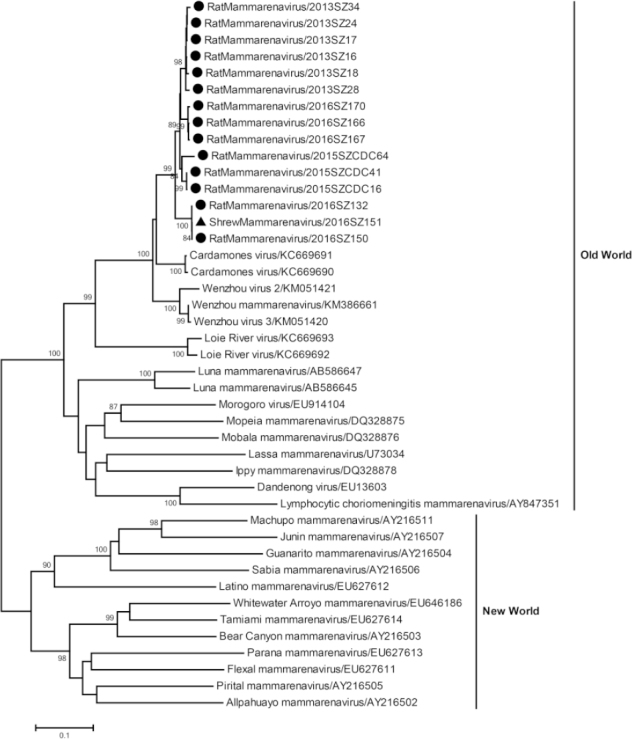
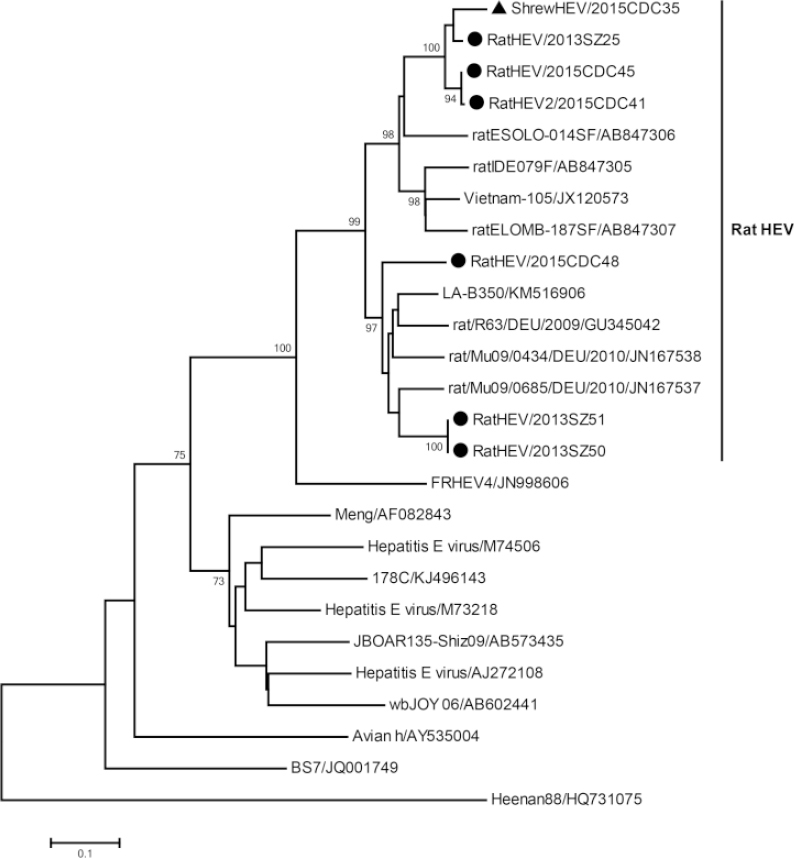
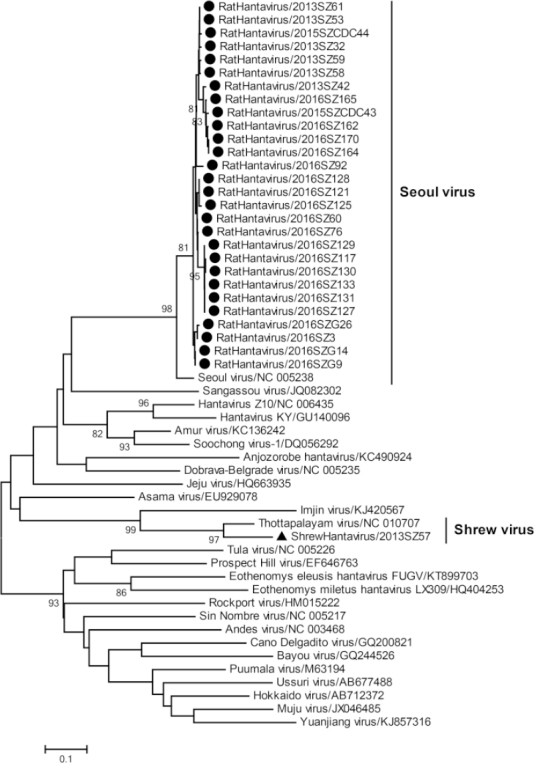
Diverse species of rodents and shrews, which are abundant worldwide, harbor a variety of viruses; some of these are closely related to human viruses and possess zoonotic potential. Previously studies have demonstrated that the mammarenavirus and hantavirus carried by rodents or shrews could cause diseases in human population. To determine the distribution of zoonotic viruses in Shenzhen city, the major city in southern China with a high population density, we analyzed 225 rodents (Rattus norvegicus and Rattus flavipectus) and 196 shrews (Suncus murinus) from urban and rural districts for the presence of mammarenavirus, hantavirus, and hepatitis E virus (HEV) by RT-PCR targeting the conserved regions. The infection rates for mammarenavirus, hantaviruses, and HEV in rodents and shrews were 3.56%, 6.89%, and 1.66%, respectively. Partial genome fragment analysis indicated that mammarenavirus and hantavirus strains had more than 90% and 99% nucleic acid identity with Cardamones virus and Seoul virus, respectively, which cause diseases in humans. Although the present HEV strains identified are typically found worldwide, phylogenetic analysis demonstrated a divergence of 16%. To our knowledge, the present work is the first report of the prevalence of mammarenavirus, hantaviruses, and rat HEV strains in rodents and shrews from Shenzhen city, China. Our findings highlight the zoonotic potential of rodent- and shrew-borne mammarenavirus and hantavirus, and the biodiversity of rat HEV isolates in Shenzhen city. The present work suggests that utilization of good hygiene habits is important to minimize the risk of zoonosis.
啮齿动物和鼩鼱种类多样,在全球分布广泛,携带多种病毒;其中一些与人类病毒密切相关,具有人畜共患病潜力。先前的研究表明,啮齿动物或鼩鼱携带的沙粒病毒和汉坦病毒可导致人类发病。为确定中国南方人口密集的主要城市深圳市人畜共患病病毒的分布情况,我们通过针对保守区域的逆转录聚合酶链反应(RT-PCR),分析了来自城乡地区的225只啮齿动物(褐家鼠和黄胸鼠)和196只鼩鼱(臭鼩),检测其中是否存在沙粒病毒、汉坦病毒和戊型肝炎病毒(HEV)。啮齿动物和鼩鼱中沙粒病毒、汉坦病毒和HEV的感染率分别为3.56%、6.89%和1.66%。部分基因组片段分析表明,沙粒病毒和汉坦病毒毒株分别与可导致人类发病的卡达莫内斯病毒和汉城病毒具有90%以上和99%的核酸同一性。尽管目前鉴定出的HEV毒株在全球普遍存在,但系统发育分析显示其有16%的差异。据我们所知,本研究是中国深圳市啮齿动物和鼩鼱中沙粒病毒、汉坦病毒和大鼠HEV毒株流行情况的首次报道。我们的研究结果突出了啮齿动物和鼩鼱传播的沙粒病毒和汉坦病毒的人畜共患病潜力,以及深圳市大鼠HEV分离株的生物多样性。本研究表明,养成良好的卫生习惯对于将人畜共患病风险降至最低很重要。