Miles Fayth L, Navarro Sandi L, Schwarz Yvonne, Gu Haiwei, Djukovic Danijel, Randolph Timothy W, Shojaie Ali, Kratz Mario, Hullar Meredith A J, Lampe Paul D, Neuhouser Marian L, Raftery Daniel, Lampe Johanna W
Division of Public Health Sciences Fred Hutchinson Cancer Research Center, Seattle, WA, USA.
Food Funct. 2017 Sep 20;8(9):3209-3218. doi: 10.1039/c7fo00684e.
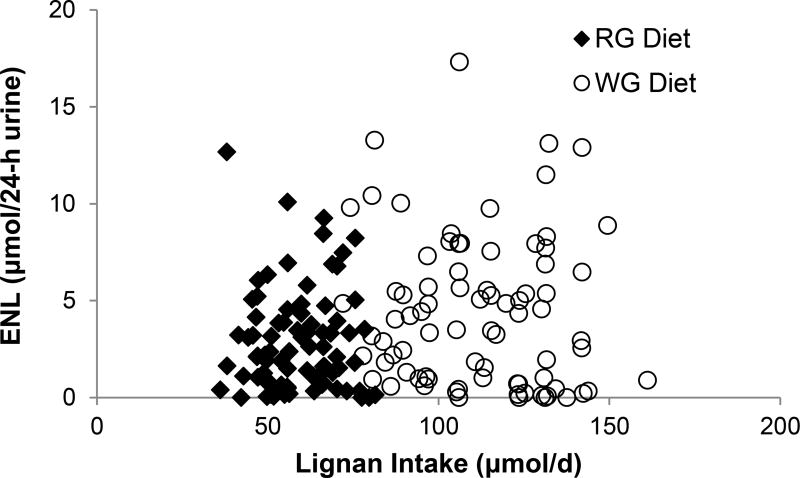
Enterolignans, products of gut bacterial metabolism of plant lignans, have been associated with reduced risk of chronic diseases, but their association with other plasma metabolites is unknown. We examined plasma metabolite profiles according to urinary enterolignan excretion in a cross-sectional analysis using data from a randomized crossover, controlled feeding study. Eighty healthy adult males and females completed two 28-day feeding periods differing by glycemic load, refined carbohydrate, and fiber content. Lignan intake was calculated from food records using a polyphenol database. Targeted metabolomics was performed by LC-MS on plasma from fasting blood samples collected at the end of each feeding period. Enterolactone (ENL) and enterodiol, were measured in 24 h urine samples collected on the penultimate day of each study period using GC-MS. Linear mixed models were used to test the association between enterolignan excretion and metabolite abundances. Pathway analyses were conducted using the Global Test. Benjamini-Hochberg false discovery rate (FDR) was used to control for multiple testing. Of the metabolites assayed, 121 were detected in all samples. ENL excretion was associated positively with plasma hippuric acid and melatonin, and inversely with epinephrine, creatine, glycochenodeoxycholate, and glyceraldehyde (P < 0.05). Hippuric acid only satisfied the FDR of q < 0.1. END excretion was associated with myristic acid and glycine (q < 0.5). Two of 57 pathways tested were associated significantly with ENL, ubiquinone and terpenoid-quinone biosynthesis, and inositol phosphate metabolism. These results suggest a potential role for ENL or ENL-metabolizing gut bacteria in regulating plasma metabolites.
肠内木脂素是植物木脂素经肠道细菌代谢产生的产物,与慢性疾病风险降低有关,但其与其他血浆代谢物的关联尚不清楚。我们在一项横断面分析中,根据尿肠内木脂素排泄情况,利用一项随机交叉对照喂养研究的数据,检查了血浆代谢物谱。80名健康成年男性和女性完成了两个为期28天的喂养期,这两个喂养期在血糖负荷、精制碳水化合物和纤维含量方面有所不同。使用多酚数据库根据食物记录计算木脂素摄入量。在每个喂养期结束时采集的空腹血样血浆上,通过液相色谱 - 质谱联用仪进行靶向代谢组学分析。在每个研究期倒数第二天采集的24小时尿液样本中,使用气相色谱 - 质谱联用仪测量肠内酯(ENL)和肠二醇。使用线性混合模型测试肠内木脂素排泄与代谢物丰度之间的关联。使用全局检验进行通路分析。采用本雅明尼 - 霍赫贝格错误发现率(FDR)来控制多重检验。在所检测的代谢物中,所有样本均检测到121种。ENL排泄与血浆马尿酸和褪黑素呈正相关,与肾上腺素、肌酸、甘氨鹅脱氧胆酸盐和甘油醛呈负相关(P < 0.05)。马尿酸仅满足FDR的q < 0.1。END排泄与肉豆蔻酸和甘氨酸相关(q < 0.5)。在测试的57条通路中,有两条与ENL、泛醌和萜类醌生物合成以及肌醇磷酸代谢显著相关。这些结果表明ENL或代谢ENL的肠道细菌在调节血浆代谢物方面可能发挥作用。