Nassan Feiby L, Coull Brent A, Gaskins Audrey J, Williams Michelle A, Skakkebaek Niels E, Ford Jennifer B, Ye Xiaoyun, Calafat Antonia M, Braun Joseph M, Hauser Russ
Department of Environmental Health, Harvard T.H. Chan School of Public Health , Boston, Massachusetts, USA.
Department of Biostatistics, Harvard T.H. Chan School of Public Health , Boston, Massachusetts, USA.
Environ Health Perspect. 2017 Aug 18;125(8):087012. doi: 10.1289/EHP1374.
Personal care products (PCPs) are exposure sources to phthalates and parabens; however, their contribution to men's exposure is understudied.
We examined the association between PCP use and urinary concentrations of phthalate metabolites and parabens in men.
In a prospective cohort, at multiple study visits, men self-reported their use of 14 PCPs and provided a urine sample (2004-2015, Boston, MA). We measured urinary concentrations of 9 phthalate metabolites and methylparaben, propylparaben, and butylparaben. We estimated the covariate-adjusted percent change in urinary concentrations associated with PCP use using linear mixed and Tobit mixed regressions. We also estimated weights for each PCP in a weighted binary score regression and modeled the resulting composite weighted PCP use.
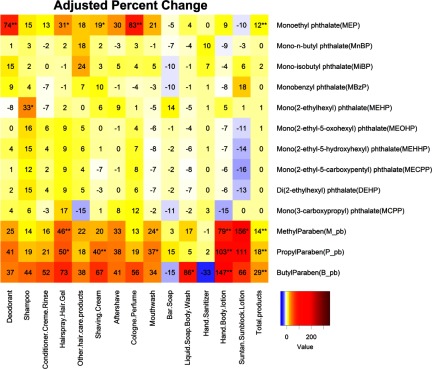
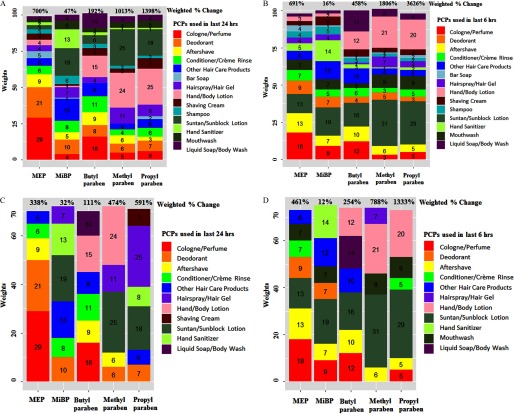
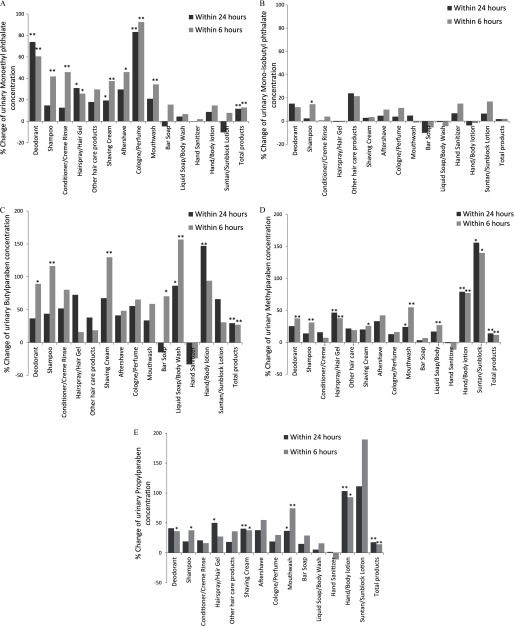
Four hundred men contributed 1,037 urine samples (mean of 3/man). The largest percent increase in monoethyl phthalate (MEP) was associated with use of cologne/perfume (83%, -value<0.01) and deodorant (74%, -value<0.01). In contrast, the largest percent increase for parabens was associated with the use of suntan/sunblock lotion (66-156%) and hand/body lotion (79-147%). Increases in MEP and parabens were generally greater with PCP use within 6 h of urine collection. A subset of 10 PCPs that were used within 6 h of urine collection contributed to at least 70% of the weighted score and predicted a 254-1,333% increase in MEP and parabens concentrations. Associations between PCP use and concentrations of the other phthalate metabolites were not statistically significant.
We identified 10 PCPs of relevance and demonstrated that their use within 6 h of urine collection strongly predicted MEP and paraben urinary concentrations. https://doi.org/10.1289/EHP1374.
个人护理产品(PCP)是邻苯二甲酸盐和对羟基苯甲酸酯的暴露源;然而,它们对男性暴露的贡献尚未得到充分研究。
我们研究了男性使用个人护理产品与尿中邻苯二甲酸酯代谢物和对羟基苯甲酸酯浓度之间的关联。
在一个前瞻性队列中,在多次研究访视时,男性自我报告他们对14种个人护理产品的使用情况,并提供一份尿液样本(2004 - 2015年,马萨诸塞州波士顿)。我们测量了尿中9种邻苯二甲酸酯代谢物以及甲基对羟基苯甲酸酯、丙基对羟基苯甲酸酯和丁基对羟基苯甲酸酯的浓度。我们使用线性混合回归和托比特混合回归估计与个人护理产品使用相关的尿中浓度的协变量调整百分比变化。我们还在加权二元评分回归中估计了每种个人护理产品的权重,并对由此产生的综合加权个人护理产品使用情况进行建模。
400名男性提供了1037份尿液样本(平均每人3份)。邻苯二甲酸单乙酯(MEP)百分比增加最大的情况与使用古龙水/香水(83%,P值<0.01)和除臭剂(74%,P值<0.01)有关。相比之下,对羟基苯甲酸酯百分比增加最大的情况与使用防晒/防晒霜(66 - 156%)和手部/身体乳液(79 - 147%)有关。在尿液收集前6小时内使用个人护理产品时,MEP和对羟基苯甲酸酯的增加通常更大。在尿液收集前6小时内使用的10种个人护理产品的一个子集对加权评分的贡献至少为70%,并预测MEP和对羟基苯甲酸酯浓度增加254 - 1333%。个人护理产品使用与其他邻苯二甲酸酯代谢物浓度之间的关联无统计学意义。
我们确定了10种相关的个人护理产品,并证明在尿液收集前6小时内使用这些产品能强烈预测尿中MEP和对羟基苯甲酸酯的浓度。https://doi.org/10.1289/EHP1374 。