School of Computer Science & Software Engineering, Tianjin Polytechnics University, Tianjin, China.
J Healthc Eng. 2017;2017:8314740. doi: 10.1155/2017/8314740. Epub 2017 Aug 9.
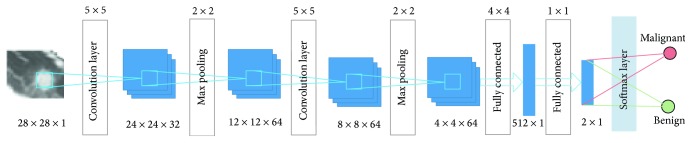
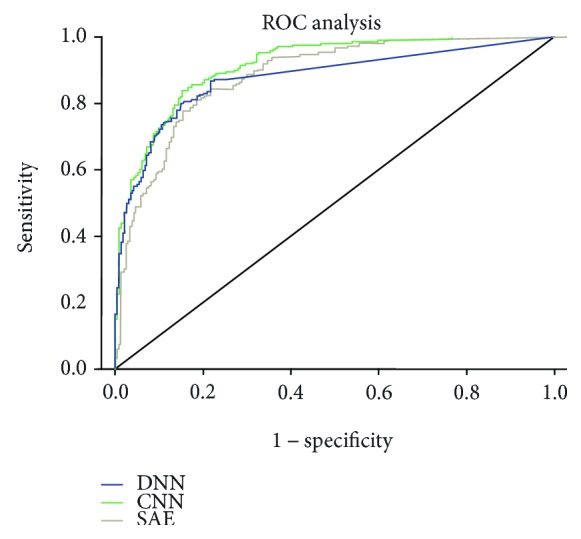
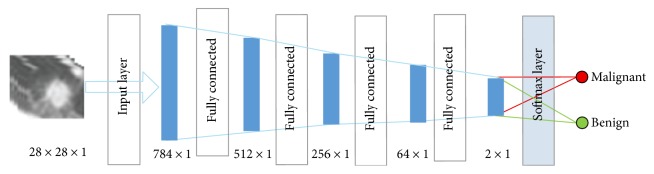
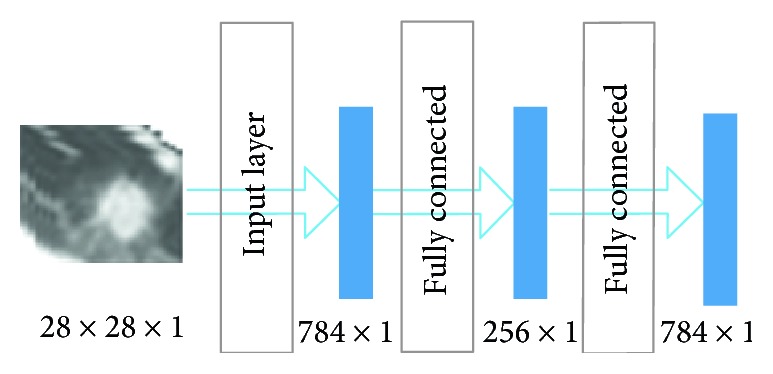
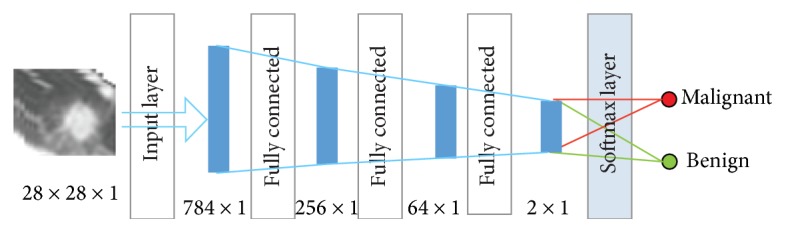
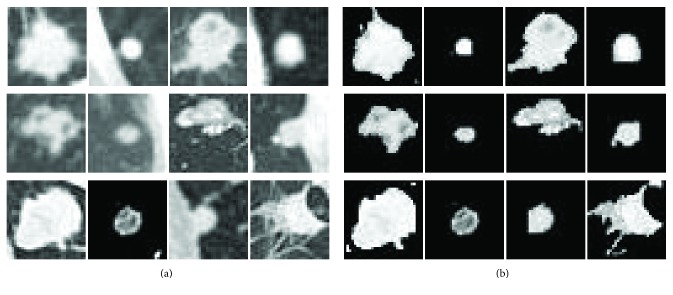
Lung cancer is the most common cancer that cannot be ignored and cause death with late health care. Currently, CT can be used to help doctors detect the lung cancer in the early stages. In many cases, the diagnosis of identifying the lung cancer depends on the experience of doctors, which may ignore some patients and cause some problems. Deep learning has been proved as a popular and powerful method in many medical imaging diagnosis areas. In this paper, three types of deep neural networks (e.g., CNN, DNN, and SAE) are designed for lung cancer calcification. Those networks are applied to the CT image classification task with some modification for the benign and malignant lung nodules. Those networks were evaluated on the LIDC-IDRI database. The experimental results show that the CNN network archived the best performance with an accuracy of 84.15%, sensitivity of 83.96%, and specificity of 84.32%, which has the best result among the three networks.
肺癌是最常见的癌症之一,如果治疗不及时,会导致死亡。目前,CT 可以帮助医生在早期发现肺癌。在许多情况下,肺癌的诊断取决于医生的经验,这可能会忽略一些患者并导致一些问题。深度学习已被证明是许多医学影像诊断领域中一种流行且强大的方法。在本文中,设计了三种类型的深度神经网络(例如 CNN、DNN 和 SAE)来进行肺癌钙化的检测。这些网络应用于 CT 图像分类任务,对良性和恶性肺结节进行了一些修改。这些网络在 LIDC-IDRI 数据库上进行了评估。实验结果表明,CNN 网络的性能最佳,准确率为 84.15%,灵敏度为 83.96%,特异性为 84.32%,在这三种网络中表现最好。