Wang Pan, Krasavin Alexey V, Nasir Mazhar E, Dickson Wayne, Zayats Anatoly V
Department of Physics, King's College London, London, WC2R 2LS, UK.
Nat Nanotechnol. 2018 Feb;13(2):159-164. doi: 10.1038/s41565-017-0017-7. Epub 2017 Dec 11.
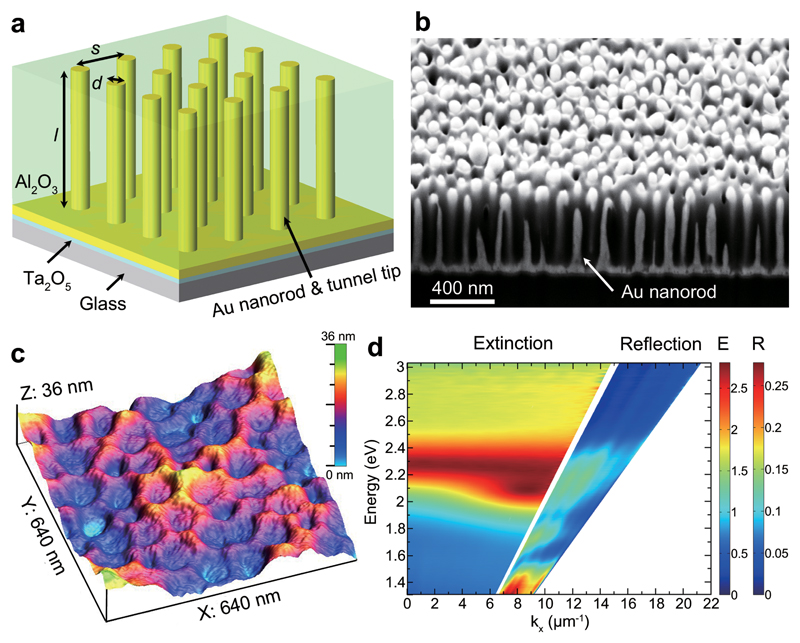
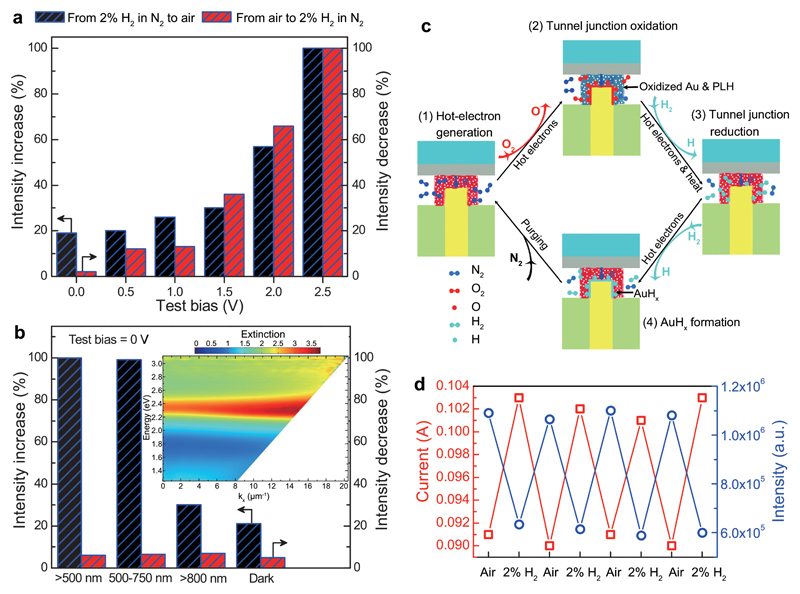
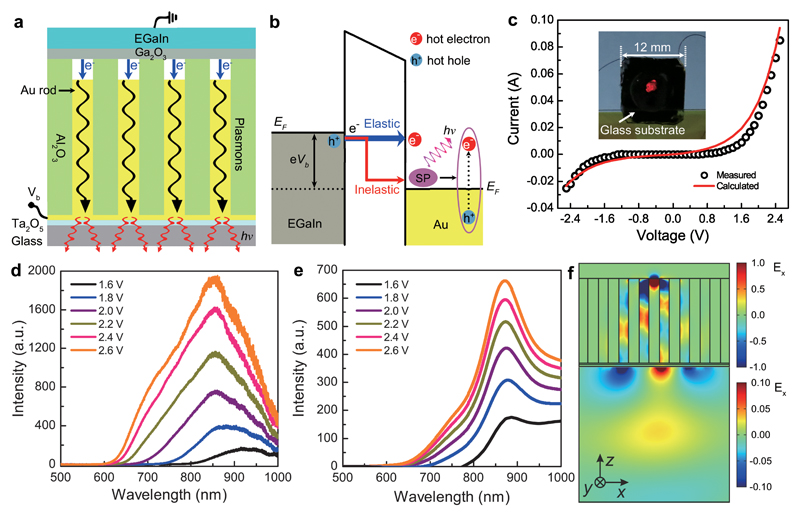
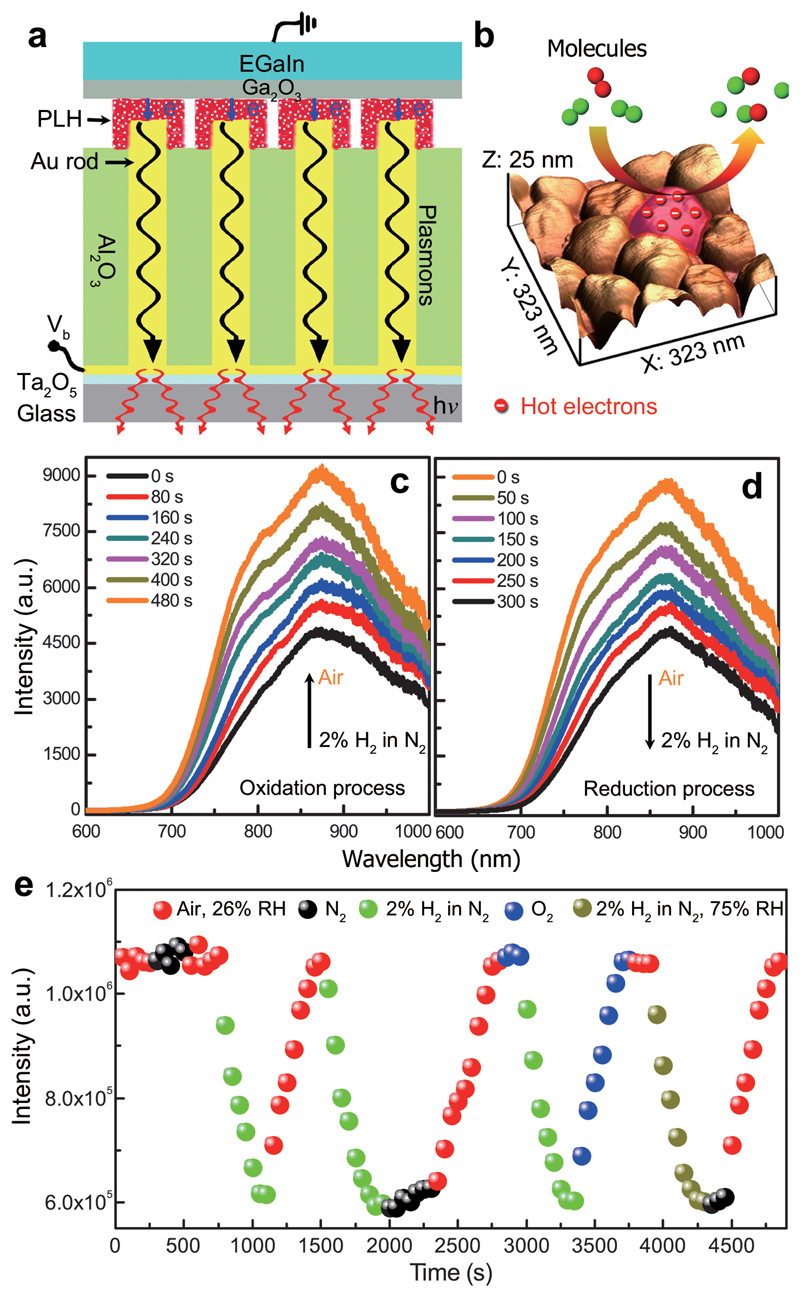
Non-equilibrium hot carriers formed near the interfaces of semiconductors or metals play a crucial role in chemical catalysis and optoelectronic processes. In addition to optical illumination, an efficient way to generate hot carriers is by excitation with tunnelling electrons. Here, we show that the generation of hot electrons makes the nanoscale tunnel junctions highly reactive and facilitates strongly confined chemical reactions that can, in turn, modulate the tunnelling processes. We designed a device containing an array of electrically driven plasmonic nanorods with up to 10 tunnel junctions per square centimetre, which demonstrates hot-electron activation of oxidation and reduction reactions in the junctions, induced by the presence of O and H molecules, respectively. The kinetics of the reactions can be monitored in situ following the radiative decay of tunnelling-induced surface plasmons. This electrically driven plasmonic nanorod metamaterial platform can be useful for the development of nanoscale chemical and optoelectronic devices based on electron tunnelling.
在半导体或金属界面附近形成的非平衡热载流子在化学催化和光电过程中起着至关重要的作用。除了光照射外,产生热载流子的一种有效方法是通过隧穿电子激发。在这里,我们表明热电子的产生使纳米级隧道结具有高反应性,并促进了强受限化学反应,而这些反应反过来又可以调节隧穿过程。我们设计了一种器件,其中包含每平方厘米多达10个隧道结的电驱动等离子体纳米棒阵列,该器件分别展示了由O和H分子的存在引起的结中氧化和还原反应的热电子激活。反应动力学可以在隧穿诱导的表面等离子体的辐射衰减之后进行原位监测。这种电驱动的等离子体纳米棒超材料平台可用于开发基于电子隧穿的纳米级化学和光电器件。