Naveca Felipe Gomes, Nascimento Valdinete Alves, Souza Victor Costa, de Figueiredo Regina M P
Laboratório de Ecologia de Doenças Transmissíveis na Amazônia, Instituto Leônidas e Maria Deane - Fiocruz Amazônia, Manaus, Amazonas, Brazil.
Gerência de Virologia, Fundação de Medicina Tropical Doutor Heitor Vieira Dourado, Manaus, Amazonas, Brazil.
PLoS Curr. 2018 Mar 22;10:ecurrents.outbreaks.7d65e5eb6ef75664da68905c5582f7f7. doi: 10.1371/currents.outbreaks.7d65e5eb6ef75664da68905c5582f7f7.
Several orthobunyaviruses are important arthropod-borne pathogens, responsible for a variety of diseases in humans, from acute febrile illness to encephalitis.
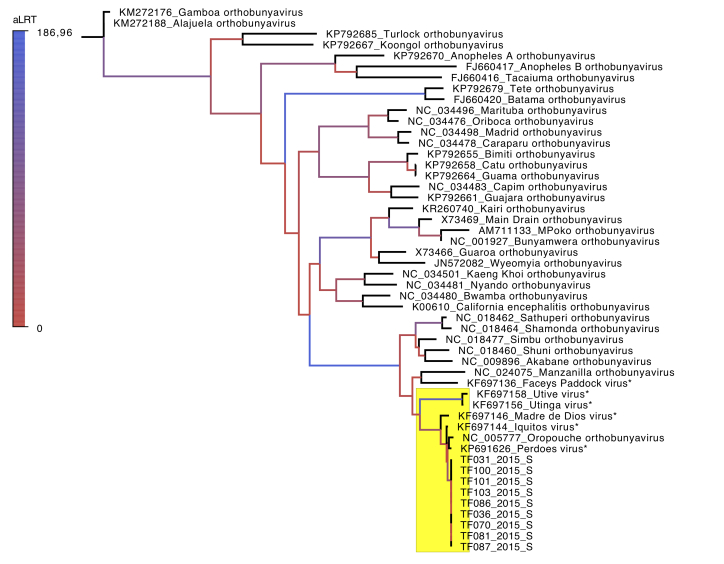
We collected serum samples from a series of dengue suspected cases in Tefé, a mid-size city located in the interior of the Amazonas state, Brazil. Viral RNA extraction was performed, and specimens were tested for dengue virus using RT-PCR. Thirty dengue negative samples were further tested for Mayaro virus (MAYV) and Oropouche virus (OROV) using an RT-qPCR protocol previously described. Positive samples were characterized by MegaBLAST analysis over the entire nucleotide collection of the main public databases, and also by maximum likelihood phylogenetic reconstruction of the S genome segment.
We detected nine OROV or OROV-like positive cases among 30 patients reporting fever and headache, as the most common symptoms. The closest nucleotide sequence returned from the MegaBLAST analysis belongs to an OROV isolated in Peru 2008. Moreover, all Tefé samples grouped in the same clade with the OROV reference sequence and other closely-related OROV-like viruses.
Dengue viruses are still the most important arbovirus worldwide, causing hundreds of millions of infections every year. Nonetheless, other arboviruses like chikungunya virus, Zika virus, and yellow fever virus have emerged in the last few years and are now a public health concern in several countries. OROV is believed to have caused more than 500,000 febrile infections in Brazil over recent decades. Therefore, the results described in this study strengthen that this arbovirus, and its closely-related recombinants, should be under continuous surveillance, at least in the endemic countries of Latin America.
几种正布尼亚病毒是重要的节肢动物传播病原体,可导致人类多种疾病,从急性发热性疾病到脑炎。
我们从巴西亚马孙州内陆的一个中等城市特费的一系列登革热疑似病例中收集了血清样本。进行了病毒RNA提取,并使用RT-PCR对样本进行登革热病毒检测。使用先前描述的RT-qPCR方案对30份登革热阴性样本进一步检测马亚罗病毒(MAYV)和奥罗普切病毒(OROV)。阳性样本通过在主要公共数据库的整个核苷酸集合上进行MegaBLAST分析以及S基因组片段的最大似然系统发育重建来进行特征描述。
在30名报告发热和头痛为最常见症状的患者中,我们检测到9例OROV或OROV样阳性病例。MegaBLAST分析返回的最接近核苷酸序列属于2008年在秘鲁分离的一种OROV。此外,所有特费样本与OROV参考序列和其他密切相关的OROV样病毒归为同一进化枝。
登革热病毒仍然是全球最重要的虫媒病毒,每年导致数亿人感染。尽管如此,其他虫媒病毒,如基孔肯雅病毒、寨卡病毒和黄热病病毒在过去几年中出现,现在是几个国家的公共卫生问题。据信,近几十年来OROV在巴西已导致超过50万例发热性感染。因此,本研究中描述的结果强化了这种虫媒病毒及其密切相关的重组体应受到持续监测,至少在拉丁美洲的流行国家是这样。