Kuss Daria J, Pontes Halley M, Griffiths Mark D
International Gaming Research Unit, Psychology Department, Nottingham Trent University, Nottingham, United Kingdom.
Front Psychiatry. 2018 May 8;9:166. doi: 10.3389/fpsyt.2018.00166. eCollection 2018.
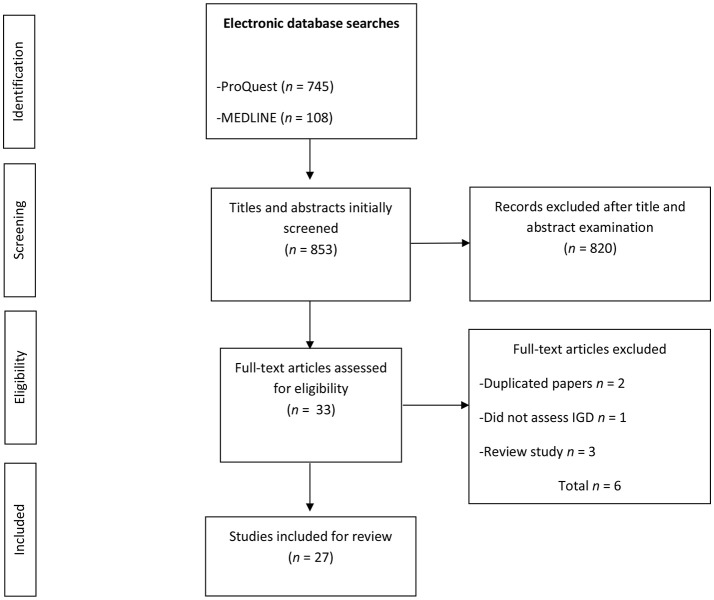
Internet Gaming Disorder (IGD) is a potential mental disorder currently included in the third section of the latest (fifth) edition of the Diagnostic and Statistical Manual for Mental Disorders (DSM-5) as a condition that requires additional research to be included in the main manual. Although research efforts in the area have increased, there is a continuing debate about the respective criteria to use as well as the status of the condition as mental health concern. Rather than using diagnostic criteria which are based on subjective symptom experience, the National Institute of Mental Health advocates the use of Research Domain Criteria (RDoC) which may support classifying mental disorders based on dimensions of observable behavior and neurobiological measures because mental disorders are viewed as biological disorders that involve brain circuits that implicate specific domains of cognition, emotion, and behavior. Consequently, IGD should be classified on its underlying neurobiology, as well as its subjective symptom experience. Therefore, the aim of this paper is to review the neurobiological correlates involved in IGD based on the current literature base. Altogether, 853 studies on the neurobiological correlates were identified on ProQuest (in the following scholarly databases: ProQuest Psychology Journals, PsycARTICLES, PsycINFO, Applied Social Sciences Index and Abstracts, and ERIC) and on MEDLINE, with the application of the exclusion criteria resulting in reviewing a total of 27 studies, using fMRI, rsfMRI, VBM, PET, and EEG methods. The results indicate there are significant neurobiological differences between healthy controls and individuals with IGD. The included studies suggest that compared to healthy controls, gaming addicts have poorer response-inhibition and emotion regulation, impaired prefrontal cortex (PFC) functioning and cognitive control, poorer working memory and decision-making capabilities, decreased visual and auditory functioning, and a deficiency in their neuronal reward system, similar to those found in individuals with substance-related addictions. This suggests both substance-related addictions and behavioral addictions share common predisposing factors and may be part of an addiction syndrome. Future research should focus on replicating the reported findings in different cultural contexts, in support of a neurobiological basis of classifying IGD and related disorders.
网络成瘾障碍(IGD)是一种潜在的精神障碍,目前被纳入最新(第五版)《精神疾病诊断与统计手册》(DSM - 5)的第三部分,作为一种需要进一步研究才能纳入主手册的病症。尽管该领域的研究工作有所增加,但对于应采用的各自标准以及该病症作为心理健康问题的地位仍存在持续的争论。美国国立精神卫生研究所主张使用研究领域标准(RDoC),而不是基于主观症状体验的诊断标准,因为精神障碍被视为涉及特定认知、情感和行为领域的脑回路的生物障碍,RDoC可能支持基于可观察行为维度和神经生物学测量对精神障碍进行分类。因此,IGD应根据其潜在的神经生物学以及主观症状体验进行分类。所以,本文的目的是基于当前的文献基础,综述与IGD相关的神经生物学关联。在ProQuest(在以下学术数据库中:ProQuest心理学期刊、PsycARTICLES、PsycINFO、应用社会科学索引与摘要以及教育资源信息中心)和MEDLINE上,共识别出853项关于神经生物学关联的研究,应用排除标准后,共审查了27项使用功能磁共振成像(fMRI)、静息态功能磁共振成像(rsfMRI)、体素形态学分析(VBM)、正电子发射断层扫描(PET)和脑电图(EEG)方法的研究。结果表明,健康对照组与患有IGD的个体之间存在显著的神经生物学差异。纳入的研究表明,与健康对照组相比,游戏成瘾者的反应抑制和情绪调节能力较差,前额叶皮质(PFC)功能和认知控制受损,工作记忆和决策能力较差,视觉和听觉功能下降,以及神经元奖励系统存在缺陷,这与物质相关成瘾者的情况类似。这表明物质相关成瘾和行为成瘾具有共同的易感因素,可能是成瘾综合征的一部分。未来的研究应专注于在不同文化背景下重复所报道的研究结果,以支持对IGD及相关障碍进行分类的神经生物学基础。