Arik Yilmaz Ebru, Cavkaytar Ozlem, Buyuktiryaki Betul, Soyer Ozge, Sahiner Umit M, Sekerel Bulent E, DunnGalvin Audrey, Karabulut Erdem, Sackesen Cansin
Department of Pediatric Allergy, Hacettepe University School of Medicine, Ankara, Turkey.
Department of Paediatrics and Child Health, Cork University Hospital, Wilton, Cork, Ireland.
Allergy Asthma Immunol Res. 2018 Jul;10(4):379-386. doi: 10.4168/aair.2018.10.4.379.
Food allergy (FA) affects the daily lives of children and parents in varying degrees. The Food Allergy Quality of Life Questionnaire-Parent Form (FAQLQ-PF) is a valid and reliable instrument to assess the quality of life (QoL) of children from parents' perception. The aim of this study was to validate and determine the reliability of the Turkish FAQLQ-PF and to assess QoL in food-allergic children.
Children aged between 0 and 12 years and diagnosed with immunoglobulin E (IgE)-mediated FA for at least 1 month were enrolled. The English FAQLQ-PF was translated into Turkish according to the World Health Organization guidelines. The Food Allergy Independent Measure and the Turkish Child Health Questionnaire-Parent Form 50 were used for construct validity.
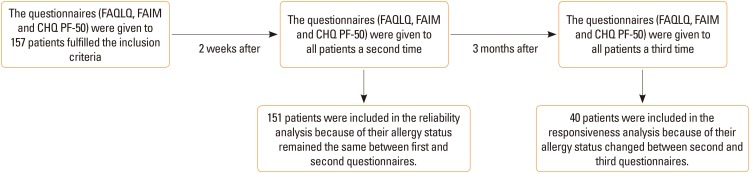
One hundred and fifty-seven patients participated. The median age of patients and FA duration were 2.4 years (1.2-5.2 years, interquartile-ranges) and 2 years (0.8-5.1), respectively. Ninety-six (61.1%) patients had anaphylaxis. The Cronbach's alpha coefficient and intra-class correlation coefficient for test-retest reliability was good for all age groups of children (<4, 4-6, and 7-12 years). Patients with either asthma or anaphylaxis had worse scores than others. Total scores of FAQLQ-PF tended to increase with age. Patients aged 7-12 had the highest total scores among all patients (2.2±0.1, 3.0±0.2, and 3.3±0.3 for <4, 4-6, and 7-12 years, respectively, P<0.001, P for trend <0.001). Other factors causing the poor QoL were cow's milk allergy, sibling allergy, mother's age over 30 years, mother's high education level and lower number of persons in household.
The Turkish FAQLQ-PF is a valid and reliable scale. FA-related QoL was significantly worse with age. Coexistent asthma, anaphylaxis regardless of its severity, cow's milk allergy, sibling allergy and the older and educated mothers seem to poorly affect QoL.
食物过敏(FA)在不同程度上影响着儿童及其父母的日常生活。食物过敏生活质量问卷家长版(FAQLQ-PF)是一种有效且可靠的工具,用于从家长的认知角度评估儿童的生活质量(QoL)。本研究的目的是验证并确定土耳其语版FAQLQ-PF的可靠性,并评估食物过敏儿童的生活质量。
纳入年龄在0至12岁之间、被诊断为免疫球蛋白E(IgE)介导的食物过敏至少1个月的儿童。根据世界卫生组织的指南,将英文FAQLQ-PF翻译成土耳其语。使用食物过敏独立测量工具和土耳其儿童健康问卷家长版50进行结构效度验证。
157名患者参与了研究。患者的中位年龄和食物过敏持续时间分别为2.4岁(四分位间距为1.2 - 5.2岁)和2年(0.8 - 5.1年)。96名(61.1%)患者发生过过敏反应。所有年龄组儿童(<4岁、4 - 6岁和7 - 12岁)的重测信度的Cronbach's α系数和组内相关系数均良好。患有哮喘或过敏反应的患者得分比其他患者差。FAQLQ-PF的总分倾向于随年龄增加。7 - 12岁患者在所有患者中总分最高(<4岁、4 - 6岁和7 - 12岁患者的总分分别为2.2±0.1、3.0±0.2和3.3±0.3,P<0.001,趋势P<0.001)。导致生活质量差的其他因素包括牛奶过敏、兄弟姐妹过敏、母亲年龄超过30岁、母亲高学历以及家庭人口较少。
土耳其语版FAQLQ-PF是一个有效且可靠的量表。与食物过敏相关的生活质量随年龄增长显著变差。并存哮喘、无论严重程度如何的过敏反应、牛奶过敏、兄弟姐妹过敏以及年龄较大且受过教育的母亲似乎对生活质量有不良影响。