Houston Methodist Research Institute, Houston, TX, USA.
Department of Surgery, Houston Methodist Hospital, Houston, TX, USA.
Biomech Model Mechanobiol. 2019 Feb;18(1):29-44. doi: 10.1007/s10237-018-1065-0. Epub 2018 Aug 9.
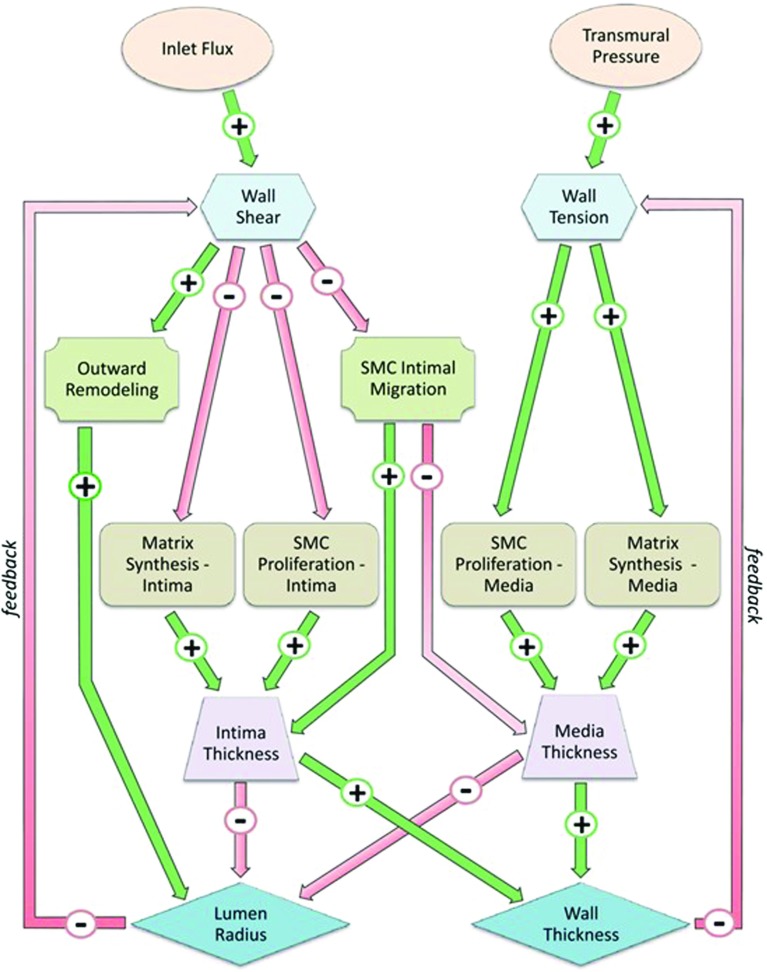
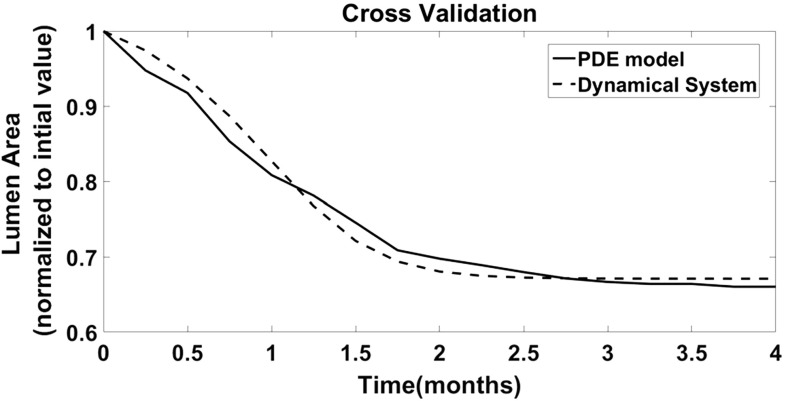
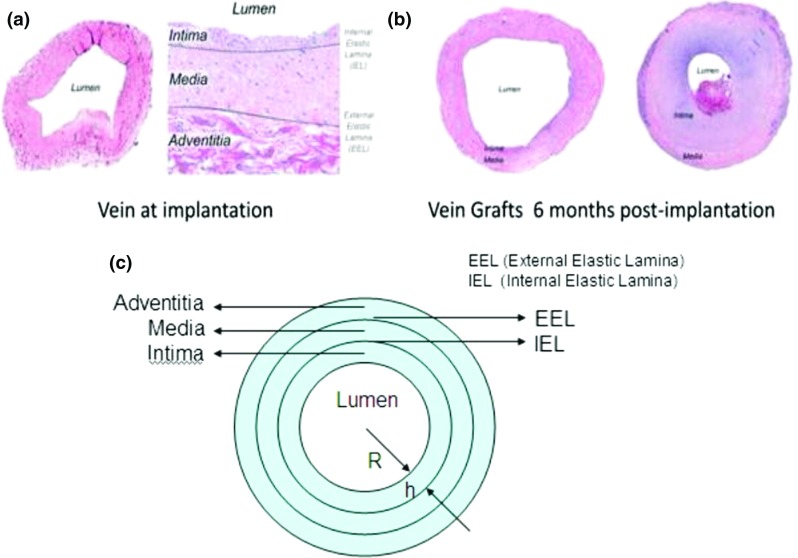
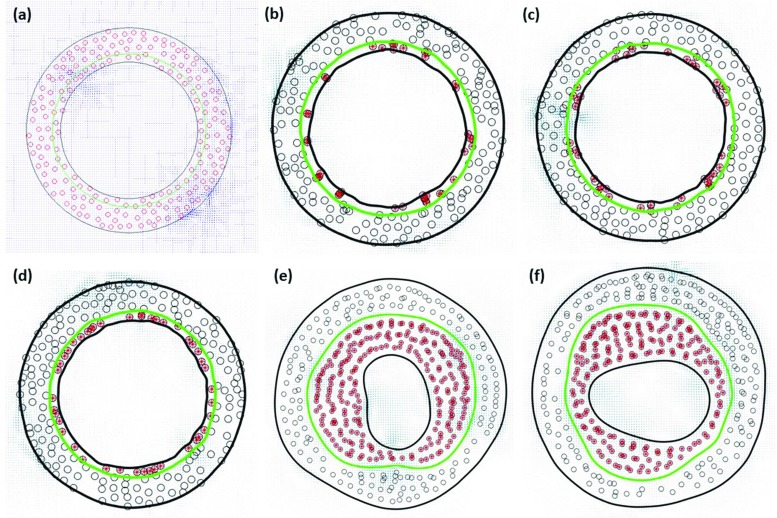
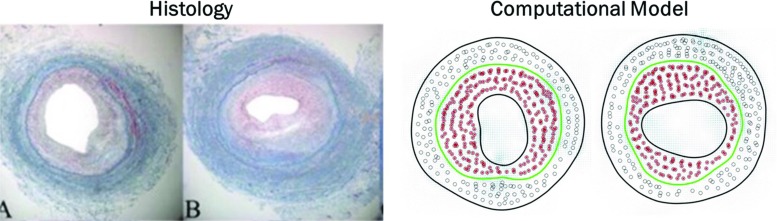
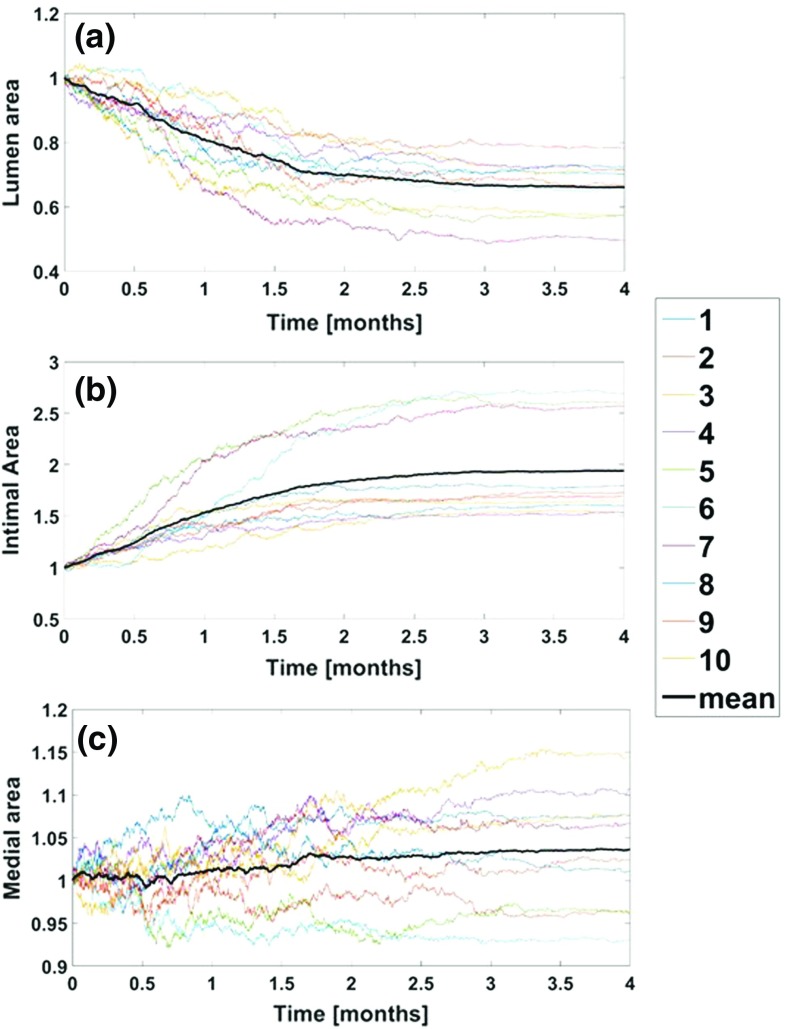
Peripheral arterial occlusive disease is a chronic pathology affecting at least 8-12 million people in the USA, typically treated with a vein graft bypass or through the deployment of a stent in order to restore the physiological circulation. Failure of peripheral endovascular interventions occurs at the intersection of vascular biology, biomechanics, and clinical decision making. It is our hypothesis that the majority of endovascular treatment approaches share the same driving mechanisms and that a deep understanding of the adaptation process is pivotal in order to improve the current outcome of the procedure. The postsurgical adaptation of vein graft bypasses offers the perfect example of how the balance between intimal hyperplasia and wall remodeling determines the failure or the success of the intervention. Accordingly, this work presents a versatile computational model able to capture the feedback loop that describes the interaction between events at cellular/tissue level and mechano-environmental conditions. The work here presented is a generalization and an improvement of a previous work by our group of investigators, where an agent-based model uses a cellular automata principle on a fixed hexagonal grid to reproduce the leading events of the graft's restenosis. The new hybrid model here presented allows a more realistic simulation both of the biological laws that drive the cellular behavior and of the active role of the membranes that separate the various layers of the vein. The novel feature is to use an immersed boundary implementation of a highly viscous flow to represent SMC motility and matrix reorganization in response to graft adaptation. Our implementation is modular, and this makes us able to choose the right compromise between closeness to the physiological reality and complexity of the model. The focus of this paper is to offer a new modular implementation that combines the best features of an agent-based model, continuum mechanics, and particle-tracking methods to cope with the multiscale nature of the adaptation phenomena. This hybrid method allows us to quickly test various hypotheses with a particular attention to cellular motility, a process that we demonstrated should be driven by mechanical homeostasis in order to maintain the right balance between cells and extracellular matrix in order to reproduce a distribution similar to histological experimental data from vein grafts.
外周动脉阻塞性疾病是一种影响美国至少 800 万至 1200 万人的慢性病理,通常通过静脉移植旁路或放置支架来治疗,以恢复生理循环。外周血管腔内介入治疗的失败发生在血管生物学、生物力学和临床决策的交叉点上。我们的假设是,大多数血管内治疗方法具有相同的驱动机制,而深入了解适应过程对于提高该手术的现有效果至关重要。静脉移植旁路手术后的适应提供了一个完美的例子,说明内膜增生和壁重塑之间的平衡如何决定干预的成败。因此,这项工作提出了一个通用的计算模型,能够捕捉描述细胞/组织水平事件与机械环境条件之间相互作用的反馈回路。这里提出的工作是我们研究小组以前工作的推广和改进,其中基于代理的模型使用细胞自动机原理在固定的六边形网格上复制移植物再狭窄的主要事件。这里提出的新混合模型允许更真实地模拟驱动细胞行为的生物学规律,以及分隔静脉各层的膜的主动作用。新的特点是使用高度粘性流的浸入边界实现来表示平滑肌细胞的运动和基质重组,以响应移植物的适应。我们的实现是模块化的,这使我们能够在模型的接近生理现实的程度和复杂性之间做出正确的折衷。本文的重点是提供一种新的模块化实现,该实现结合了基于代理的模型、连续力学和粒子跟踪方法的最佳特点,以应对适应现象的多尺度性质。这种混合方法使我们能够快速测试各种假设,特别关注细胞运动,我们证明这个过程应该由机械内稳态驱动,以维持细胞和细胞外基质之间的正确平衡,从而再现静脉移植物组织学实验数据的分布。