Beugelsdijk Sjoerd, Welzel Chris
University of Groningen, The Netherlands.
Leuphana University of Lüneburg, Germany.
J Cross Cult Psychol. 2018 Nov;49(10):1469-1505. doi: 10.1177/0022022118798505. Epub 2018 Oct 2.
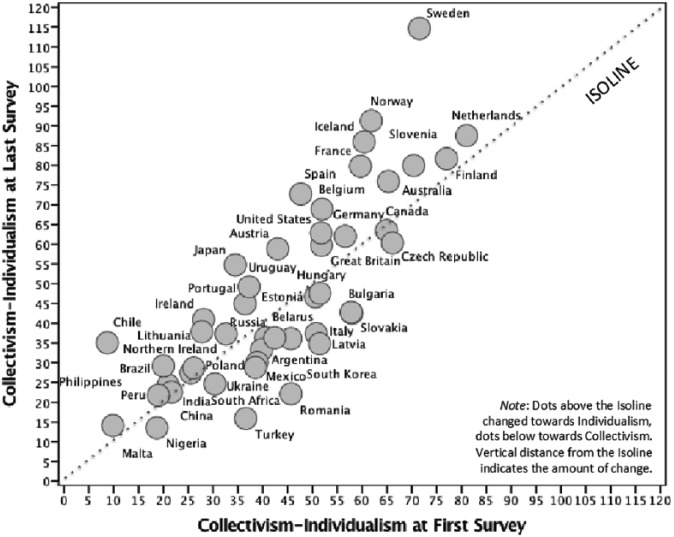
Cross-national research on cultural differences across space and time intersects multiple disciplines but the prominence of concepts varies by academic fields. Hofstede's concept of culture, to begin with, dominates in cross-cultural psychology and international management. Inglehart's concept of culture, by contrast, prevails in sociology and political science. We argue that this disciplinary division is unfortunate because the two concepts are complementary, for which reason a synthesis rectifies their mutual weaknesses. Indeed, while Hofstede's concept neglects cultural dynamics, Inglehart's concept is dimensionally reductionist. We demonstrate empirically that combining these two concepts leads to an improved understanding of cultural differences. Inspired by Hofstede's cultural dimensions, we use data from the European Value Studies and World Values Surveys for 495,011 individuals born between 1900 and 1999 in 110 countries and then show that change on these dimensions proceeds as Inglehart and his collaborators suggest. Most notably, younger generations have become more individualistic and more joyous. But even though economic development and generational replacement drive this cultural change, roughly half of the variation in national cultural orientations is unique to each country, due to lasting intercept differences in developmental trajectories that trace back to remote historic drivers. We discuss the implications for cross-national cultural research.
关于不同时空文化差异的跨国研究涉及多个学科,但概念的突出程度因学术领域而异。首先,霍夫斯泰德的文化概念在跨文化心理学和国际管理领域占据主导地位。相比之下,英格尔哈特的文化概念在社会学和政治学中更为流行。我们认为这种学科划分是不幸的,因为这两个概念是互补的,因此综合可以纠正它们各自的弱点。事实上,虽然霍夫斯泰德的概念忽视了文化动态,但英格尔哈特的概念在维度上是简化论的。我们通过实证证明,将这两个概念结合起来可以增进对文化差异的理解。受霍夫斯泰德文化维度的启发,我们使用了来自欧洲价值观研究和世界价值观调查的数据,这些数据涉及110个国家中1900年至1999年出生的495,011个人,然后表明这些维度上的变化正如英格尔哈特及其合作者所建议的那样进行。最值得注意的是,年轻一代变得更加个人主义和更加快乐。但是,尽管经济发展和代际更替推动了这种文化变化,但由于可追溯到遥远历史驱动因素的发展轨迹中存在持久的截距差异,每个国家在国家文化取向方面大约一半的差异是独特的。我们讨论了对跨国文化研究的影响。