Heikura Ida Aliisa, Stellingwerff Trent, Burke Louise Mary
Mary MacKillop Institute for Health Research, Australian Catholic University, Melbourne, VIC, Australia.
Sports Nutrition, Australian Institute of Sport, Canberra, ACT, Australia.
Front Physiol. 2018 Dec 3;9:1732. doi: 10.3389/fphys.2018.01732. eCollection 2018.
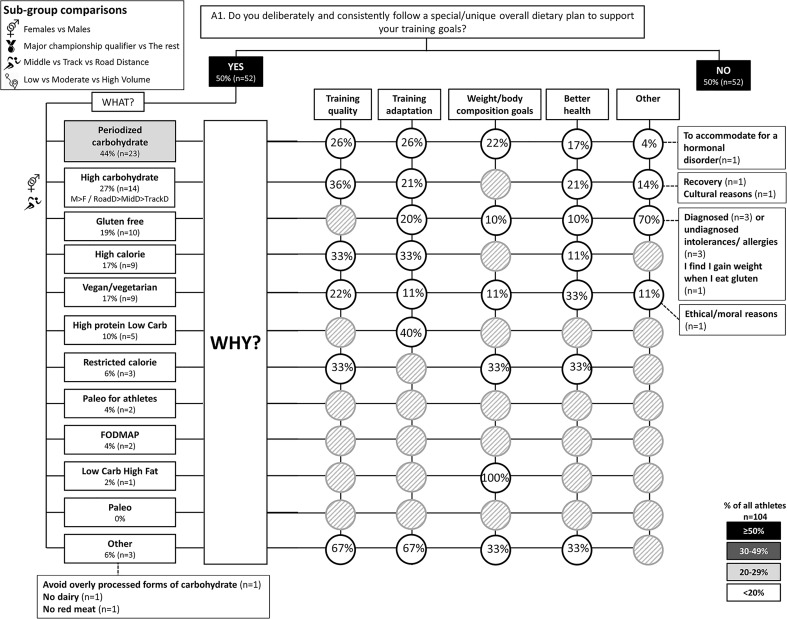
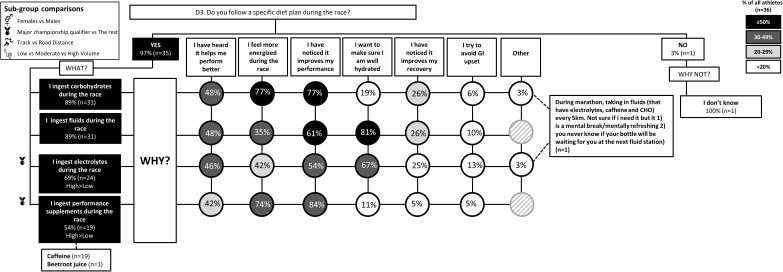
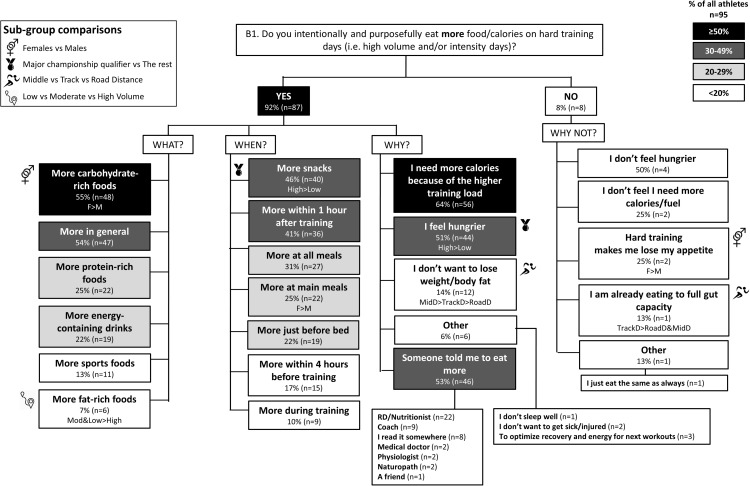
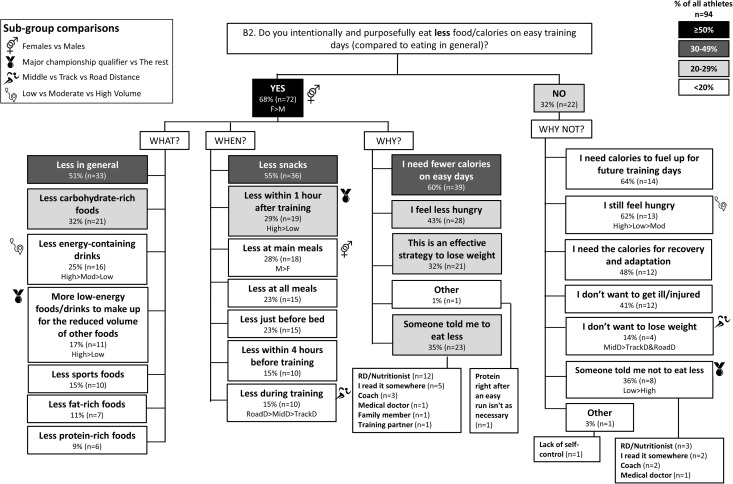
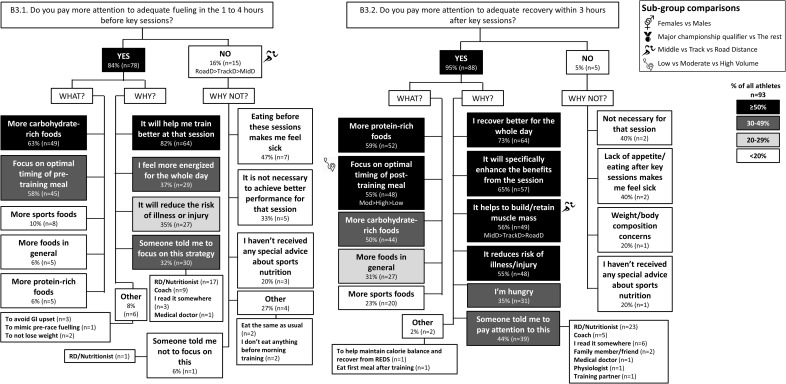
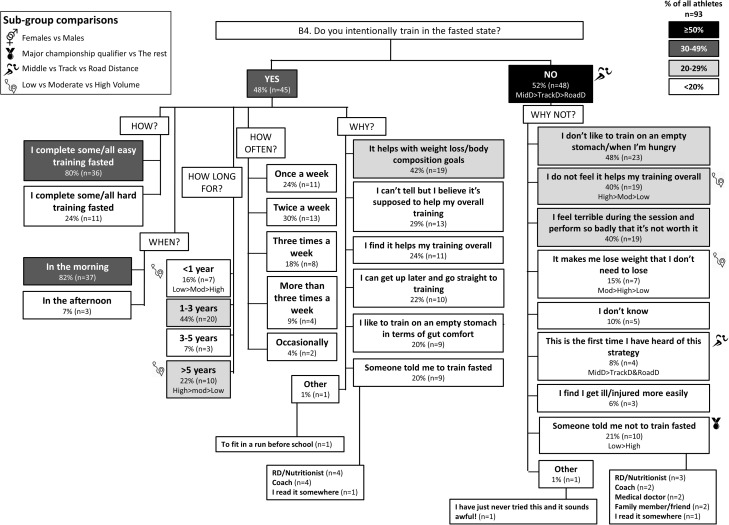
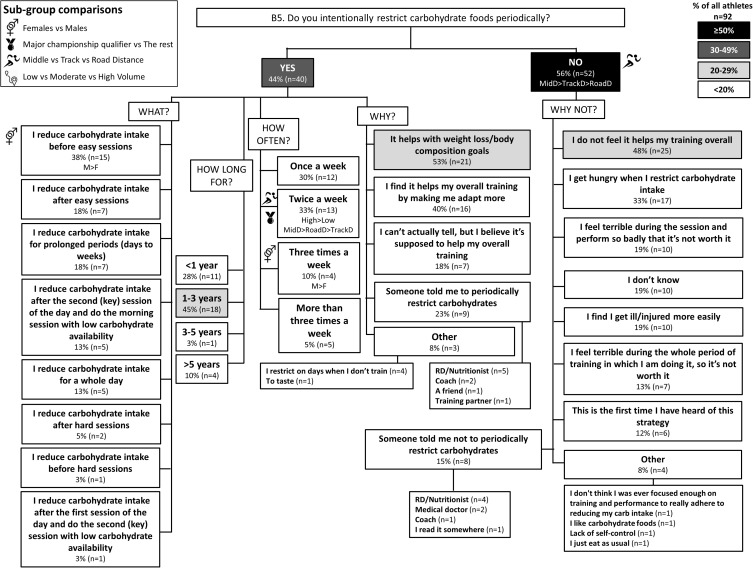
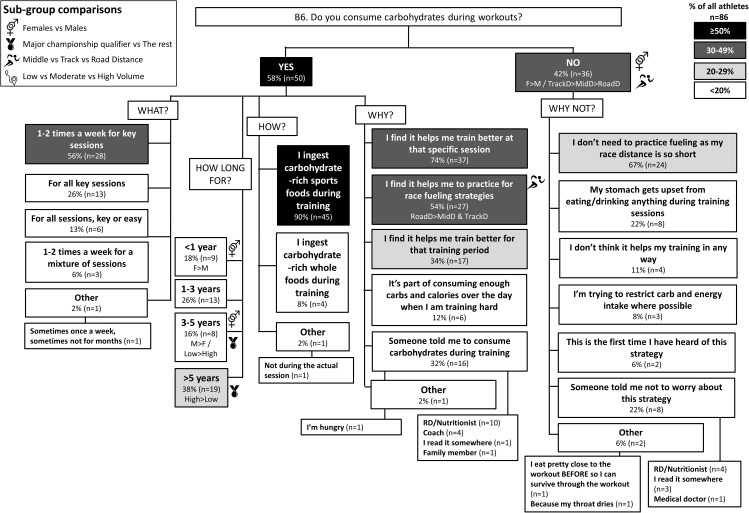
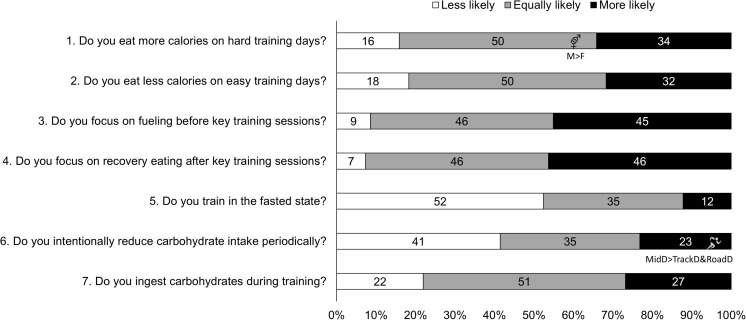
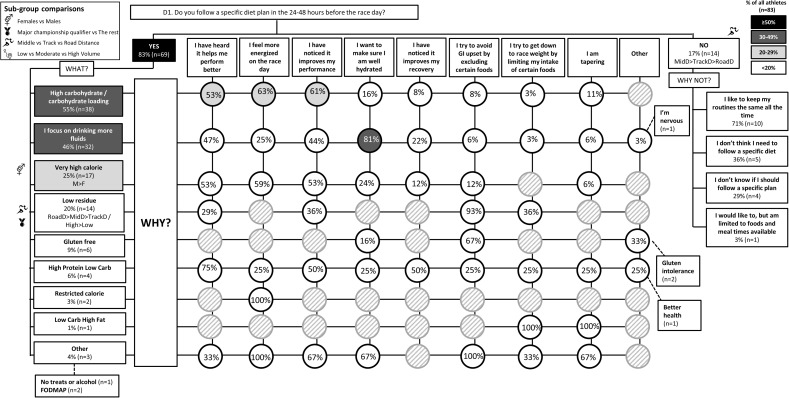
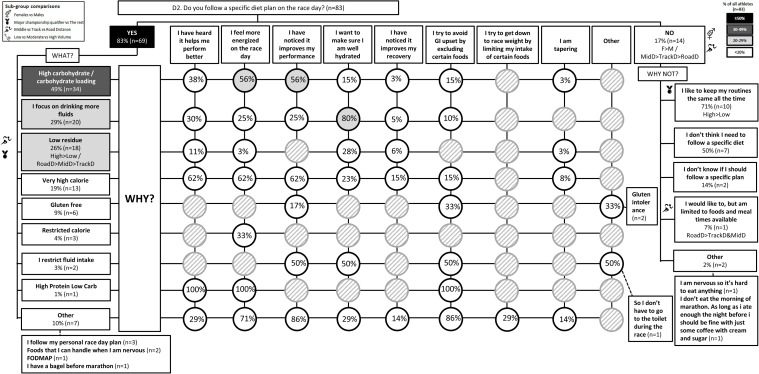
Athletes should achieve event-specific physiological requirements through careful periodization of training, underpinned by individualized and targeted nutrition strategies. However, evidence of whether, and how, elite endurance athletes periodize nutrition is scarce. Accordingly, elite international female ( = 67) and male ( = 37) middle/long-distance athletes (IAAF score: 1129 ± 54, corresponds to 13:22.49 [males] and 15:17.93 [females] in the 5000 m) completed an online survey (February-May 2018) examining self-reported practices of dietary periodization for micro (within/between-days), meso (weeks/months) and macro (across the year) contexts. Data are shown as the percentage of all athletes practicing a given strategy followed by the % of athletes reporting various beliefs or practices within this strategy. Differences according to sex, event (middle-distance [800 m/1500 m] vs. track-distance [3000 m-10000 m] vs. road-distance [marathon/race walks]), caliber (high [major championship qualifier] vs. lower), and training volume (low/moderate/high male and female tertiles) were analyzed using Chi-square test or Kruskal-Wallis Test and indicated statistically different when ≤ 0.05. Most athletes reported eating more on hard training days (92%) and focusing on nutrition before (84%; carbohydrate intake [63%] and timing [58%]) and after (95%; protein goals [59%], timing [55%], carbohydrate goals [50%]) key sessions. Road-distance were the most (62 and 57%), and middle-distance the least (30 and 30%) likely to train fasted ( = 0.037) or restrict carbohydrates periodically ( = 0.050), respectively. Carbohydrate intake during training (58% of total) was more common in males (79%; = 0.004) and road-distance (90%; < 0.001) than females (53%) or middle/track-distance (48 and 37%). Most athletes (83%) reported following a specific diet before and during race day, with half of the athletes focusing on carbohydrates. Nearly all (97%) road-distance athletes reported following a during-race nutrition plan (carbohydrates/fluids:89%). Only 32% reported taking advice from a dietitian/nutritionist. Based on our analysis: (1) Road-distance athletes periodize carbohydrate availability while track/middle-distance avoid low carbohydrate availability; (2) Middle-distance runners emphasize physique goals to guide their nutrition strategies; (3) Females seem to be more cautious of increasing energy/carbohydrate intake; (4) Among all athletes, nutrition strategies are chosen primarily to improve performance, followed by reasons related to physique, adaptation and health outcomes. Overall, these athletes appear to possess good knowledge of nutrition for supporting training and competition performance.
运动员应通过精心安排训练周期,并辅以个性化和有针对性的营养策略,来满足特定项目的生理需求。然而,关于精英耐力运动员如何安排营养周期以及是否这样做的证据却很少。因此,国际精英女子(n = 67)和男子(n = 37)中长跑运动员(国际田联评分:1129 ± 54,相当于男子5000米成绩为13:22.49,女子为15:17.93)完成了一项在线调查(2018年2月至5月),调查自我报告的在微观(日内/日间)、中观(周/月)和宏观(全年)层面的饮食周期安排做法。数据以采用特定策略的所有运动员的百分比呈现,其后是报告该策略内各种信念或做法的运动员的百分比。根据性别、项目(中距离[800米/1500米]与径赛距离[3000米 - 10000米]与公路距离[马拉松/竞走])、水平(高水平[大赛资格赛选手]与低水平)以及训练量(低/中/高男性和女性三分位数)的差异,使用卡方检验或克鲁斯卡尔 - 沃利斯检验进行分析,当p≤0.05时表明存在统计学差异。大多数运动员报告在高强度训练日吃得更多(92%),并在关键训练课之前(84%;碳水化合物摄入[63%]和时间安排[58%])和之后(95%;蛋白质目标[59%]、时间安排[55%]、碳水化合物目标[50%])关注营养。公路距离项目的运动员最有可能(分别为62%和57%)进行空腹训练(p = 0.037)或定期限制碳水化合物摄入(p = 0.050),而中距离项目的运动员可能性最小(分别为30%和30%)。男性(79%;p = 0.004)和公路距离项目的运动员(90%;p < 0.001)在训练期间摄入碳水化合物(占总量的58%)比女性(53%)或中距离/径赛距离项目的运动员(48%和37%)更常见。大多数运动员(83%)报告在比赛日之前和期间遵循特定饮食,其中一半的运动员关注碳水化合物。几乎所有(97%)公路距离项目的运动员报告遵循比赛期间的营养计划(碳水化合物/液体:89%)。只有32%的人报告接受过营养师/营养学家的建议。根据我们的分析:(1)公路距离项目的运动员安排碳水化合物供应周期,而径赛/中距离项目的运动员避免低碳水化合物供应;(2)中距离跑者强调体型目标以指导他们的营养策略;(3)女性似乎在增加能量/碳水化合物摄入方面更为谨慎;(4)在所有运动员中,选择营养策略主要是为了提高成绩,其次是与体型、适应和健康结果相关的原因。总体而言,这些运动员似乎对支持训练和比赛成绩的营养知识掌握得很好。