Cronie Doug, Rijnders Marlies, Jans Suze, Verhoeven Corine J, de Vries Raymond
Department of Midwifery, OLVG (West) Hospital, Amsterdam, The Netherlands,
Department of Midwifery Science, Faculty of Public Health and Primary Care, University of Maastricht, Maastricht, The Netherlands,
J Multidiscip Healthc. 2018 Dec 24;12:21-30. doi: 10.2147/JMDH.S179811. eCollection 2019.
To examine the experiences of inter-professional collaboration of maternity service providers in the Netherlands and to identify potential enhancing and inhibiting factors for inter-professional collaboration within maternity care in the Netherlands.
Good collaboration between health care professionals is a key element of safe, effective care, but creating a collaborative culture can be challenging. Good collaboration requires, among other things, negotiating different professional orientations and the organizational constraints of hierarchies and scheduling. Good collaboration is especially important in maternity care. In the Netherlands, suboptimal collaboration has been cited as a significant factor in maternal deaths and in adverse incidents occurring in hospitals during evenings, nights, and weekends. In spite of its importance for effective maternity care, little is known about the nature and quality of collaboration between maternity care professionals. In order to fill this gap, we examined the inter-professional collaboration within multi-disciplinary teams (MDTs) providing maternity services in the Netherlands.
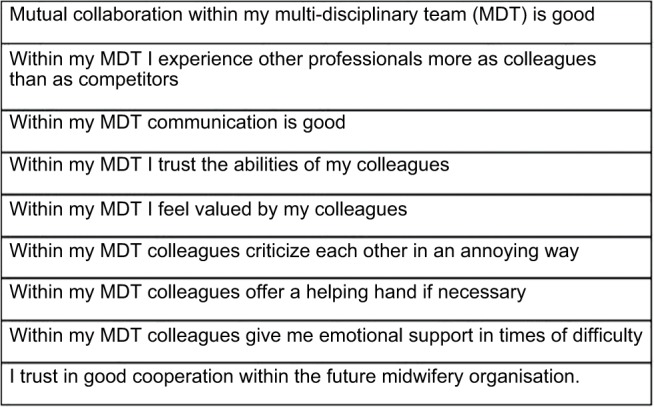
Online survey of MDTs (consisting of hospital and PCMs, doctors, and carers) involved in the provision of maternity services in the Netherlands. We used a validated measure of collaboration (the Leiden Quality of Work Questionnaire) to analyze the attitudes of those involved in the provision of maternity services about multi-disciplinary collaboration in their work. We used descriptive and inferential statistics to assess differences between the groups.
40% of all respondents were not satisfied with collaboration within their MDT. Overall, mean collaboration scores (MCS) were low. We found significant differences in MCS between professional groups. Midwives - community and hospital based - were pessimistic about collaboration in future models of maternity care.
In the Netherlands, collaboration in maternity care is less than optimal. Poor collaboration is associated with negative consequences for patient safety and quality of care. Strategies to address suboptimal collaboration exist; however, no one-size-fits-all approach is identified in the literature.
Suboptimal collaboration exists within the midwifery model of care in the Netherlands and the relationship between care providers is under pressure. This could affect patient safety and quality of care, according to the literature.
PRÉCIS: This paper presents an in-depth examination of the nature of, and attitudes about, collaboration between members of the MDT involved in the provision of maternity services in the Netherlands.
考察荷兰产科服务提供者的跨专业协作经历,并确定荷兰产科护理中跨专业协作的潜在促进因素和抑制因素。
医疗保健专业人员之间的良好协作是安全、有效护理的关键要素,但营造协作文化可能具有挑战性。良好的协作除其他外,需要协商不同的专业方向以及层级和排班的组织限制。良好的协作在产科护理中尤为重要。在荷兰,协作欠佳被认为是孕产妇死亡以及医院在傍晚、夜间和周末发生不良事件的一个重要因素。尽管其对有效的产科护理很重要,但对于产科护理专业人员之间协作的性质和质量却知之甚少。为了填补这一空白,我们考察了荷兰提供产科服务的多学科团队(MDT)内部的跨专业协作。
对参与荷兰产科服务提供的多学科团队(由医院和初级保健机构、医生及护理人员组成)进行在线调查。我们使用一种经过验证的协作度量工具(莱顿工作质量问卷)来分析参与产科服务提供的人员对其工作中多学科协作的态度。我们使用描述性和推断性统计来评估各群体之间的差异。
所有受访者中有40%对其所在多学科团队内部的协作不满意。总体而言,平均协作得分(MCS)较低。我们发现专业群体之间的平均协作得分存在显著差异。社区和医院的助产士对未来产科护理模式中的协作持悲观态度。
在荷兰,产科护理中的协作不尽如人意。协作不佳会对患者安全和护理质量产生负面影响。存在解决协作欠佳问题的策略;然而,文献中未发现一种适用于所有情况的方法。
荷兰助产护理模式中存在协作欠佳的情况,护理提供者之间的关系面临压力。根据文献,这可能会影响患者安全和护理质量。
本文深入考察了荷兰参与产科服务提供的多学科团队成员之间协作的性质和态度。