Department of International Health, Johns Hopkins Bloomberg School of Public Health, Baltimore, Maryland.
Department of International Health, Johns Hopkins School of Public Health, Baltimore, Maryland.
J Infect Dis. 2019 Jun 5;220(1):151-162. doi: 10.1093/infdis/jiz072.
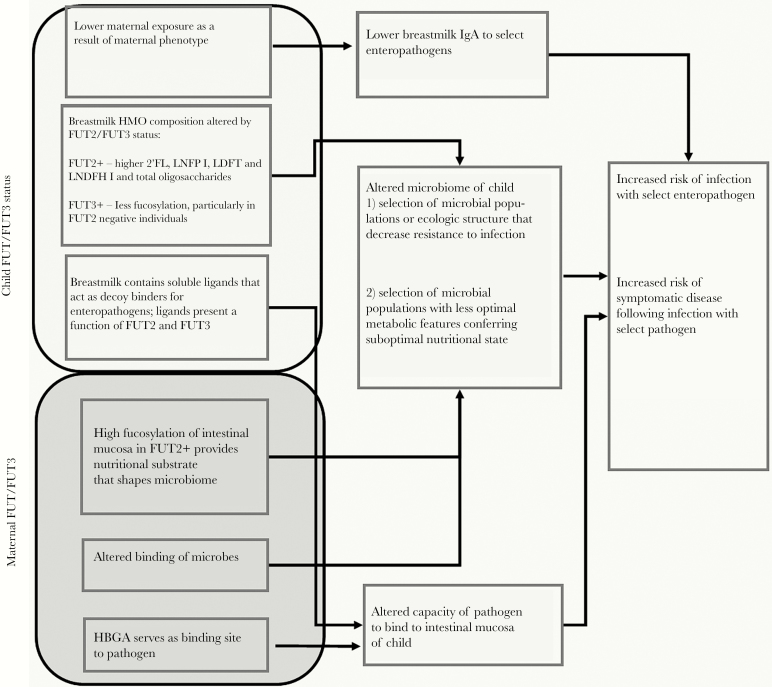
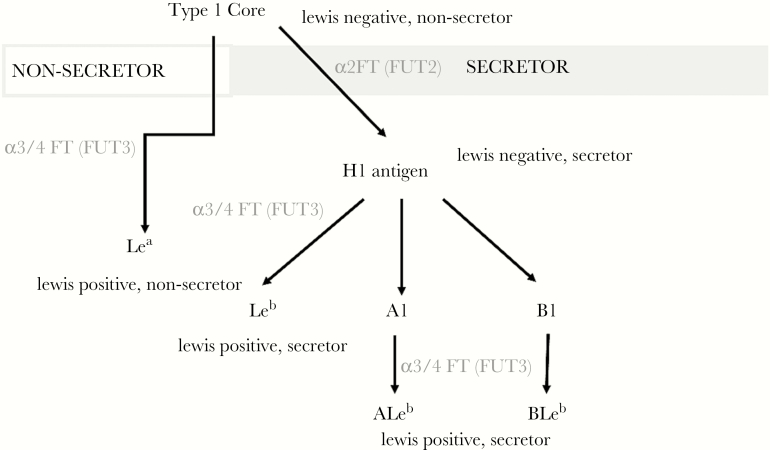
Histo-blood group antigens (HBGAs) such as fucosyltransferase (FUT)2 and 3 may act as innate host factors that differentially influence susceptibility of individuals and their offspring to pediatric enteric infections.
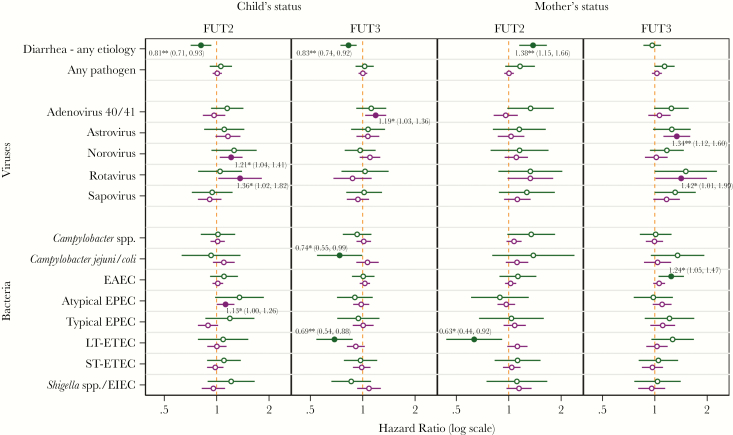
In 3 community-based birth cohorts, FUT2 and FUT3 statuses were ascertained for mother-child dyads. Quantitative polymerase chain reaction panels tested 3663 diarrheal and 18 148 asymptomatic stool samples for 29 enteropathogens. Cumulative diarrhea and infection incidence were compared by child (n = 520) and mothers' (n = 519) HBGA status and hazard ratios (HRs) derived for all-cause diarrhea and specific enteropathogens.
Children of secretor (FUT2 positive) mothers had a 38% increased adjusted risk of all-cause diarrhea (HR = 1.38; 95% confidence interval (CI), 1.15-1.66) and significantly reduced time to first diarrheal episode. Child FUT2 and FUT3 positivity reduced the risk for all-cause diarrhea by 29% (HR = 0.81; 95% CI, 0.71-0.93) and 27% (HR = 0.83; 95% CI, 0.74-0.92), respectively. Strong associations between HBGAs and pathogen-specific infection and diarrhea were observed, particularly for noroviruses, rotaviruses, enterotoxigenic Escherichia coli, and Campylobacter jejuni/coli.
Histo-blood group antigens affect incidence of all-cause diarrhea and enteric infections at magnitudes comparable to many common disease control interventions. Studies measuring impacts of interventions on childhood enteric disease should account for both child and mothers' HBGA status.
组织血型抗原(HBGAs),如岩藻糖基转移酶(FUT)2 和 3,可能作为先天宿主因素,以不同的方式影响个体及其后代对小儿肠道感染的易感性。
在 3 个基于社区的出生队列中,确定母婴对子的 FUT2 和 FUT3 状态。定量聚合酶链反应(PCR)检测 3663 份腹泻和 18148 份无症状粪便样本中的 29 种肠道病原体。通过儿童(n=520)和母亲(n=519)HBGA 状态比较累积腹泻和感染发生率,并为所有病因腹泻和特定肠道病原体计算危险比(HR)。
分泌型(FUT2 阳性)母亲的子女患所有病因腹泻的调整后风险增加 38%(HR=1.38;95%置信区间(CI),1.15-1.66),且首次腹泻发作的时间显著缩短。儿童 FUT2 和 FUT3 阳性使所有病因腹泻的风险分别降低 29%(HR=0.81;95%CI,0.71-0.93)和 27%(HR=0.83;95%CI,0.74-0.92)。HBGAs 与病原体特异性感染和腹泻之间存在很强的关联,特别是诺如病毒、轮状病毒、肠产毒性大肠杆菌和空肠弯曲菌/结肠弯曲菌。
组织血型抗原对所有病因腹泻和肠道感染的发生率有影响,其程度可与许多常见的疾病控制干预措施相媲美。评估干预措施对儿童肠道疾病影响的研究应考虑儿童和母亲的 HBGA 状态。