Nanotechnology & Integrated Bio-Engineering Centre (NIBEC), Ulster University, Shore Road, Newtownabbey, BT37 0QB, United Kingdom.
Institute for Experimental and Applied Physics, Christian-Albrechts-Universität zu Kiel, Leibnizstraße 17, 24118, Kiel, Germany.
Nat Commun. 2019 Feb 18;10(1):817. doi: 10.1038/s41467-019-08661-9.
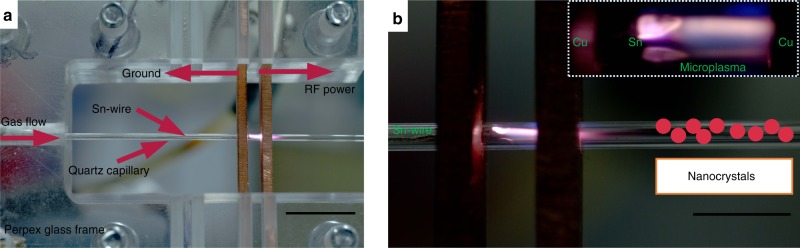
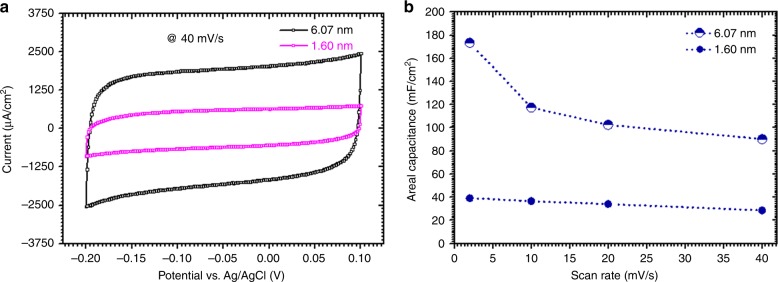
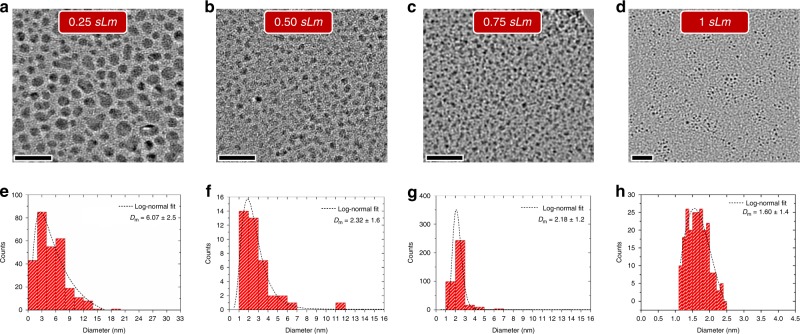
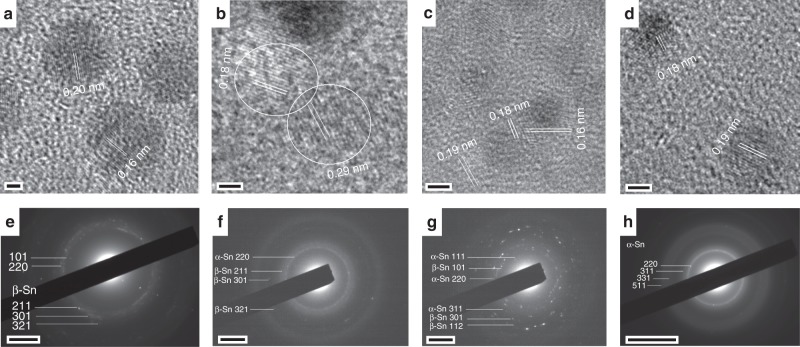
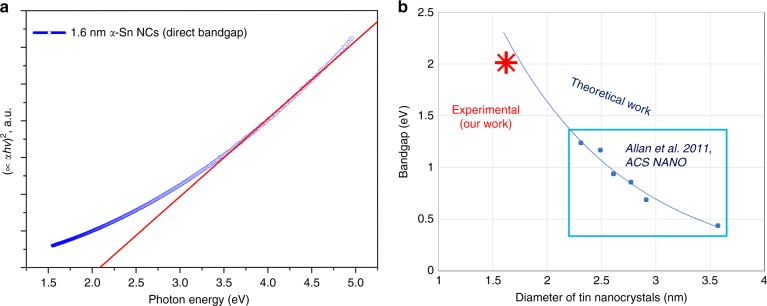
Nanocrystals sometimes adopt unusual crystal structure configurations in order to maintain structural stability with increasingly large surface-to-volume ratios. The understanding of these transformations is of great scientific interest and represents an opportunity to achieve beneficial materials properties resulting from different crystal arrangements. Here, the phase transformation from α to β phases of tin (Sn) nanocrystals is investigated in nanocrystals with diameters ranging from 6.1 to 1.6 nm. Ultra-small Sn nanocrystals are achieved through our highly non-equilibrium plasma process operated at atmospheric pressures. Larger nanocrystals adopt the β-Sn tetragonal structure, while smaller nanocrystals show stability with the α-Sn diamond cubic structure. Synthesis at other conditions produce nanocrystals with mean diameters within the range 2-3 nm, which exhibit mixed phases. This work represents an important contribution to understand structural stability at the nanoscale and the possibility of achieving phases of relevance for many applications.
纳米晶体为了保持结构稳定性,有时会采用不寻常的晶体结构构型,因为其比表面积与体积比越来越大。理解这些转变具有重要的科学意义,并且为获得不同晶体排列产生的有益材料性能提供了机会。在这里,研究了直径为 6.1 至 1.6nm 的纳米晶体中锡(Sn)纳米晶体从α相到β相的相转变。通过在大气压下运行的高度非平衡等离子体工艺实现了超小 Sn 纳米晶体。较大的纳米晶体采用β-Sn 四方结构,而较小的纳米晶体则表现出与α-Sn 金刚石立方结构的稳定性。在其他条件下合成的纳米晶体平均直径在 2-3nm 范围内,表现出混合相。这项工作对于理解纳米尺度的结构稳定性以及实现对许多应用具有重要意义的相具有重要贡献。