Yim Hyun-Jin, Lim Hyun-Chang, Hong Ji-Youn, Shin Seung-Il, Chung Jong-Hyuk, Herr Yeek, Shin Seung-Yun
Department of Periodontology, Periodontal-Implant Clinical Research Institute, Kyung Hee University School of Dentistry, Seoul, Korea.
J Periodontal Implant Sci. 2019 Feb 26;49(1):39-46. doi: 10.5051/jpis.2019.49.1.39. eCollection 2019 Feb.
This study aimed to evaluate the effects of i) the extent of peri-implant bone defects and ii) the application of bone cement on implant stability with respect to the measurement direction.
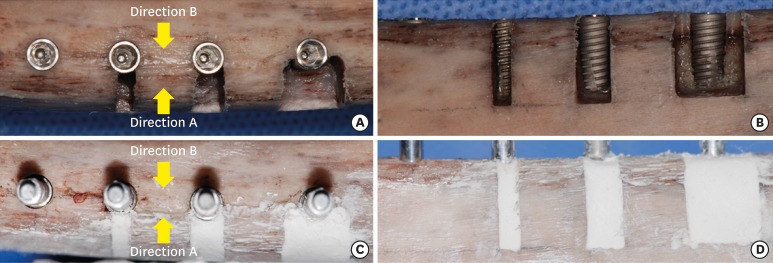
In 10 bovine rib bones, 4 implant osteotomies with peri-implant bone defects of various widths were prepared: i) no defect (D0), ii) a 2-mm-wide defect (D2), iii) a 4-mm-wide defect (D4), and iv) a 8-mm-wide defect (D8). The height of all defects was 10 mm. Implant stability quotient (ISQ) values and Periotest values (PTVs) were measured after implant placement and bone cement application.
With increasing defect width, decreased ISQs and increased PTVs were observed. Statistically significant differences were found between groups D0 and D8, D0 and D4, and D2 and D8. Prior to bone cement application, inconsistent PTVs were found in group D8 depending on the measurement direction. Bone cement increased the implant stability.
Peri-implant bone deficits measuring around 50% of the implant surface compromised implant stability. Clinically, PTVs should be cautiously interpreted in implants with large peri-implant defects due to inconsistent recordings with respect to the measurement direction.
本研究旨在评估以下两方面的影响:i)种植体周围骨缺损的程度;ii)骨水泥的应用对种植体稳定性的影响(涉及测量方向)。
在10根牛肋骨上制备4个种植体截骨术,形成不同宽度的种植体周围骨缺损:i)无缺损(D0);ii)2毫米宽的缺损(D2);iii)4毫米宽的缺损(D4);iv)8毫米宽的缺损(D8)。所有缺损的高度均为10毫米。种植体植入并应用骨水泥后,测量种植体稳定性商数(ISQ)值和牙周探针值(PTV)。
随着缺损宽度增加,观察到ISQ值降低,PTV值升高。在D0组与D8组、D0组与D4组以及D2组与D8组之间发现了统计学上的显著差异。在应用骨水泥之前,D8组中根据测量方向发现PTV值不一致。骨水泥提高了种植体稳定性。
种植体周围骨缺损面积约占种植体表面的50%时会损害种植体稳定性。临床上,对于种植体周围有大缺损的种植体,由于测量方向记录不一致,应谨慎解读PTV值。