Department of Earth System Science, Stanford University, Stanford, CA 94305;
Woods Institute for the Environment, Stanford University, Stanford, CA 94305.
Proc Natl Acad Sci U S A. 2019 May 14;116(20):9808-9813. doi: 10.1073/pnas.1816020116. Epub 2019 Apr 22.
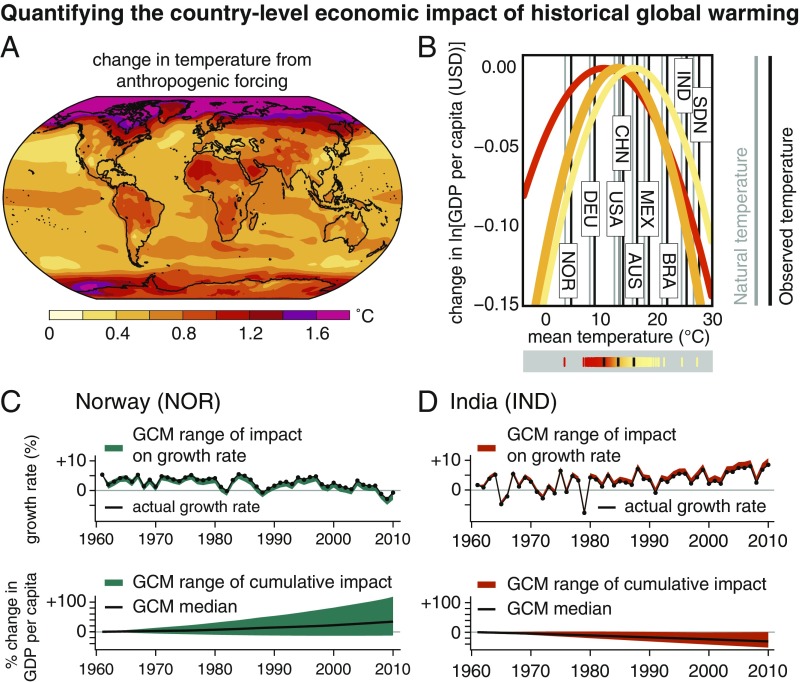
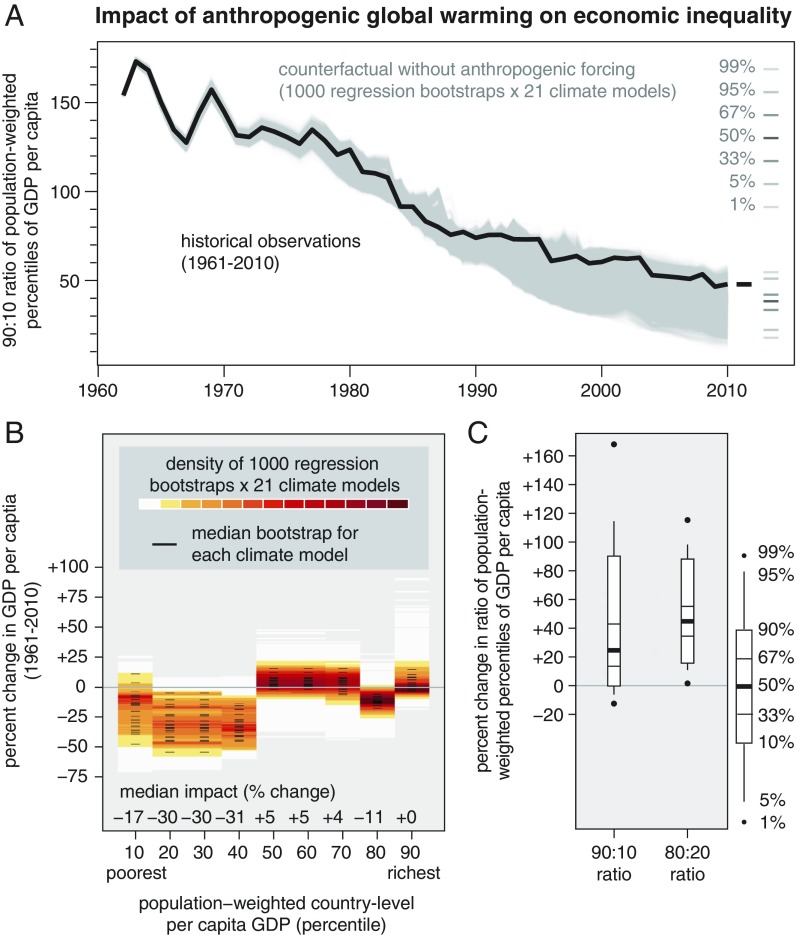
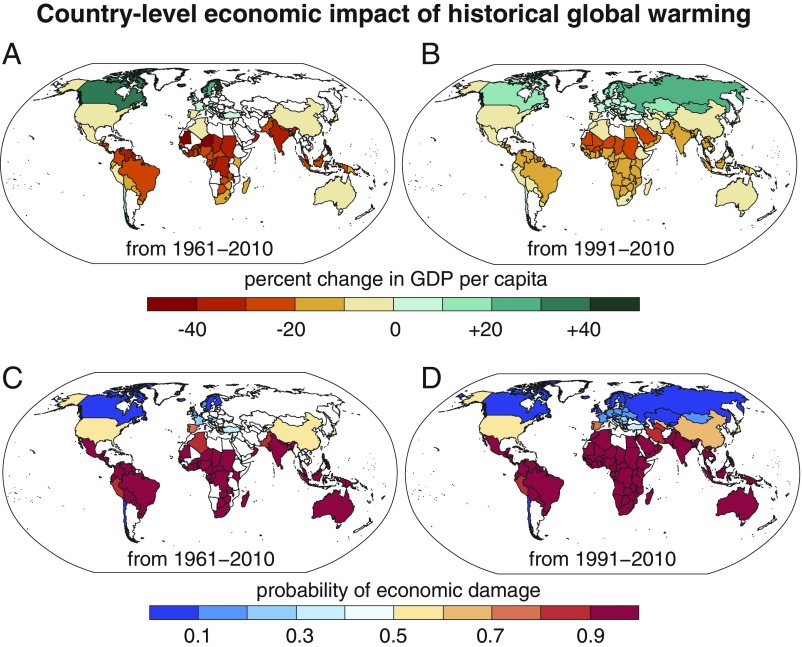
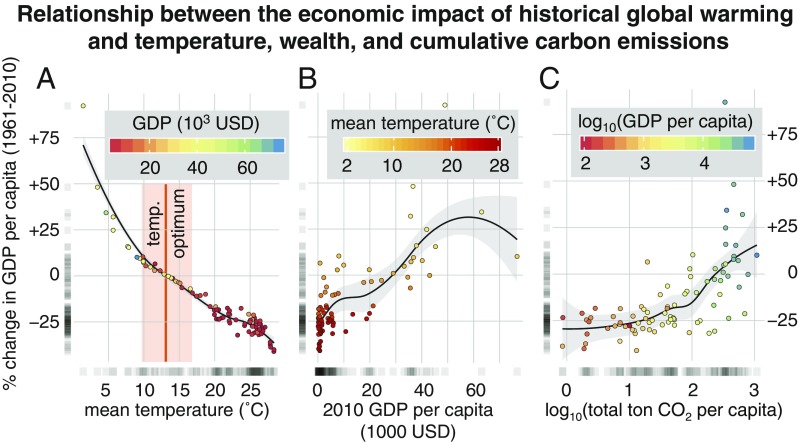
Understanding the causes of economic inequality is critical for achieving equitable economic development. To investigate whether global warming has affected the recent evolution of inequality, we combine counterfactual historical temperature trajectories from a suite of global climate models with extensively replicated empirical evidence of the relationship between historical temperature fluctuations and economic growth. Together, these allow us to generate probabilistic country-level estimates of the influence of anthropogenic climate forcing on historical economic output. We find very high likelihood that anthropogenic climate forcing has increased economic inequality between countries. For example, per capita gross domestic product (GDP) has been reduced 17-31% at the poorest four deciles of the population-weighted country-level per capita GDP distribution, yielding a ratio between the top and bottom deciles that is 25% larger than in a world without global warming. As a result, although between-country inequality has decreased over the past half century, there is ∼90% likelihood that global warming has slowed that decrease. The primary driver is the parabolic relationship between temperature and economic growth, with warming increasing growth in cool countries and decreasing growth in warm countries. Although there is uncertainty in whether historical warming has benefited some temperate, rich countries, for most poor countries there is >90% likelihood that per capita GDP is lower today than if global warming had not occurred. Thus, our results show that, in addition to not sharing equally in the direct benefits of fossil fuel use, many poor countries have been significantly harmed by the warming arising from wealthy countries' energy consumption.
了解经济不平等的原因对于实现公平的经济发展至关重要。为了研究全球变暖是否影响了最近不平等的演变,我们结合了一系列全球气候模型的反事实历史温度轨迹,以及历史温度波动与经济增长之间关系的广泛复制的经验证据。这些使我们能够生成关于人为气候强迫对历史经济产出影响的概率国家层面的估计。我们非常有把握地认为,人为气候强迫增加了国家之间的经济不平等。例如,在人口加权的国家层面人均 GDP 分布的最贫穷的四个十分位数中,人均 GDP 减少了 17-31%,这使得贫富差距的比值比没有全球变暖的情况下大 25%。因此,尽管过去半个世纪以来国家间的不平等有所减少,但全球变暖很可能减缓了这种减少。主要驱动因素是温度与经济增长之间的抛物线关系,变暖会增加寒冷国家的增长,减少温暖国家的增长。尽管对于历史变暖是否使一些温带富裕国家受益存在不确定性,但对于大多数贫穷国家来说,全球变暖没有发生的情况下,今天的人均 GDP 低于过去的可能性大于 90%。因此,我们的研究结果表明,除了不能平等地分享化石燃料使用的直接好处外,许多贫穷国家还因富裕国家的能源消耗导致的变暖而受到严重损害。