Cui Mengkui, Qi Qi, Gurry Thomas, Zhao Tianxin, An Bolin, Pu Jiahua, Gui Xinrui, Cheng Allen A, Zhang Siyu, Xun Dongmin, Becce Michele, Briatico-Vangosa Francesco, Liu Cong, Lu Timothy K, Zhong Chao
School of Physical Science and Technology , ShanghaiTech University , Shanghai 200120 , China . Email:
University of Chinese Academy of Sciences , Beijing 100049 , China.
Chem Sci. 2019 Feb 15;10(14):4004-4014. doi: 10.1039/c9sc00208a. eCollection 2019 Apr 14.
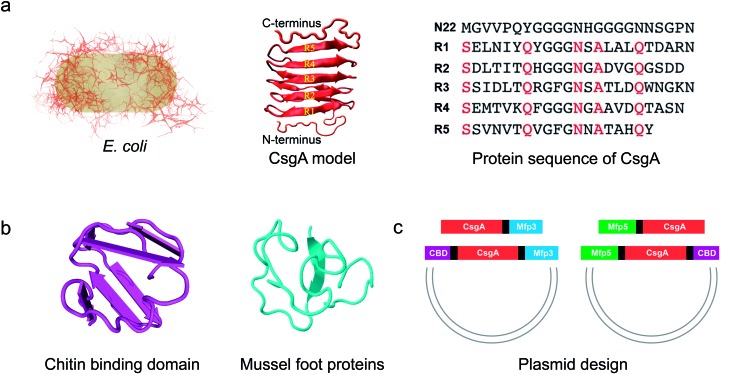
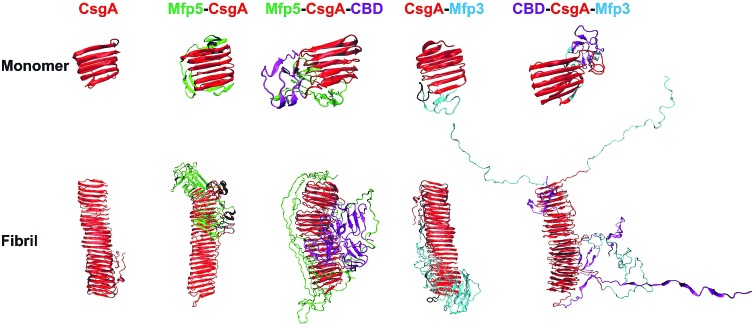
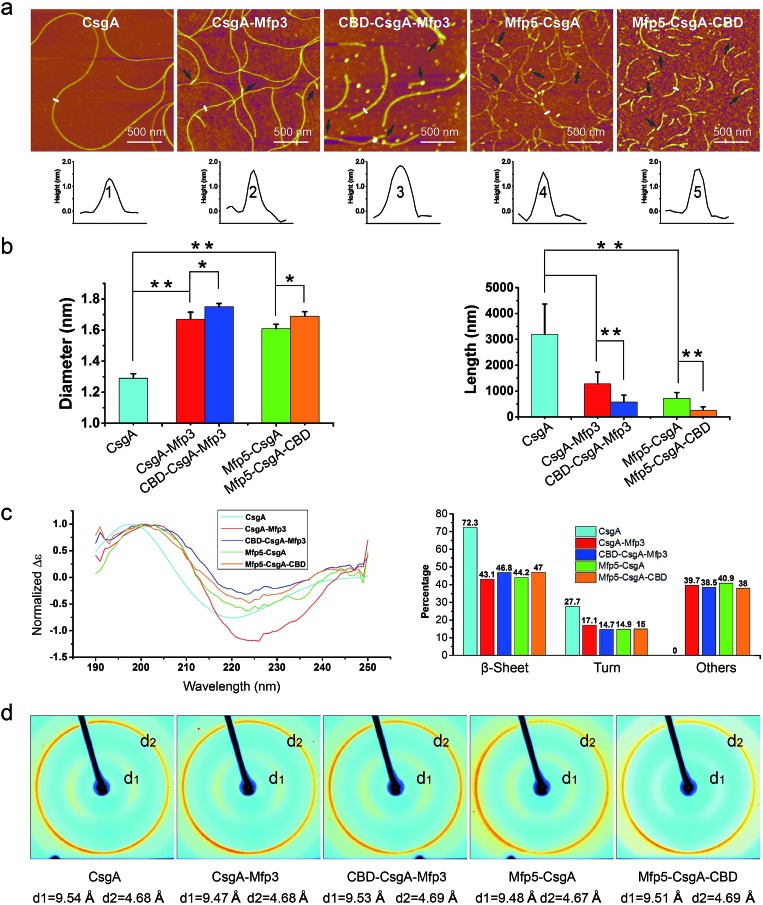
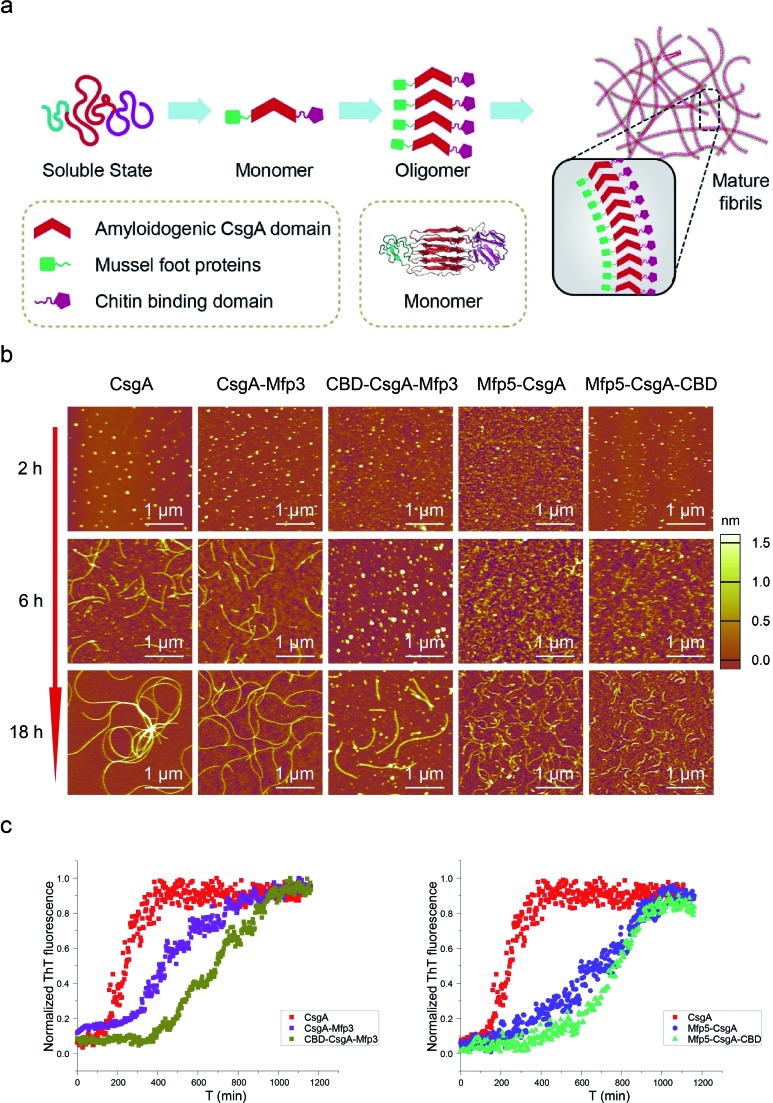
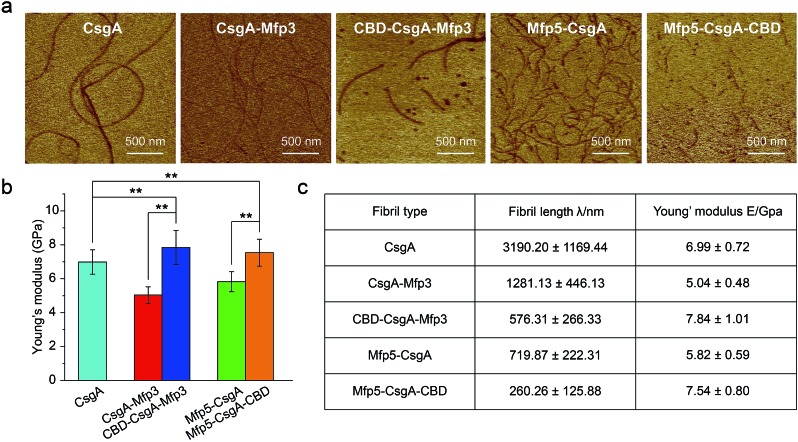
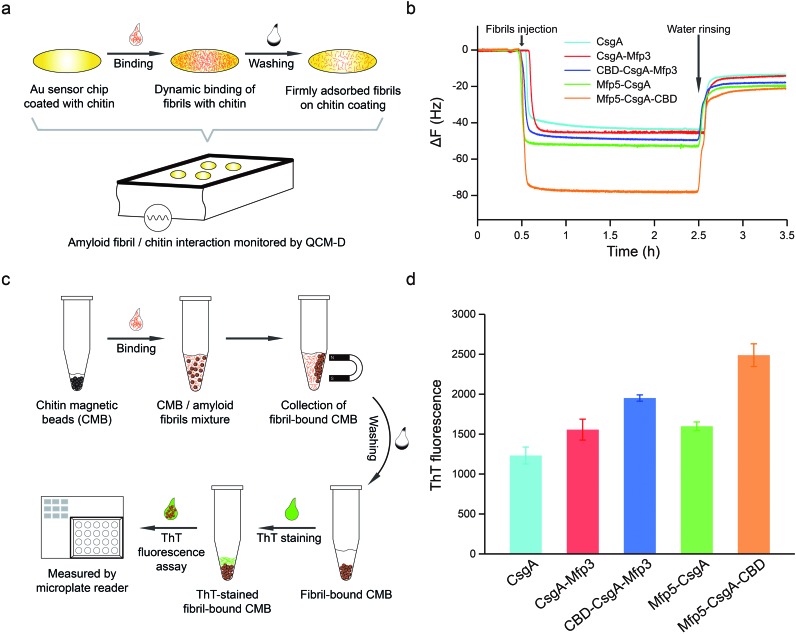
Engineering functional amyloids through a modular genetic strategy represents new opportunities for creating multifunctional molecular materials with tailored structures and performance. Despite important advances, how fusion modules affect the self-assembly and functional properties of amyloids remains elusive. Here, using curli as a model system, we systematically studied the effect of flanking domains on the structures, assembly kinetics and functions of amyloids. The designed amyloids were composed of biofilm protein CsgA (as amyloidogenic cores) and one or two flanking domains, consisting of chitin-binding domains (CBDs) from chitinase, and/or mussel foot proteins (Mfps). Incorporation of fusion domains did not disrupt the typical β-sheet structures, but indeed affected assembly rate, morphology, and stiffness of resultant fibrils. Consequently, the CsgA-fusion fibrils, particularly those containing three domains, were much shorter than the CsgA-only fibrils. Furthermore, the stiffness of the resultant fibrils was heavily affected by the structural feature of fusion domains, with β-sheet-containing domains tending to increase the Young's modulus while random coil domains decreasing the Young's modulus. In addition, fibrils containing CBD domains showed higher chitin-binding activity compared to their CBD-free counterparts. The CBD-CsgA-Mfp3 construct exhibited significantly lower binding activity than Mfp5-CsgA-CBD due to inappropriate folding of the CBD domain in the former construct, in agreement with results based upon molecular dynamics modeling. Our study provides new insights into the assembly and functional properties of designer amyloid proteins with increasing complex domain structures and lays the foundation for the future design of functional amyloid-based structures and molecular materials.
通过模块化遗传策略构建功能性淀粉样蛋白为创造具有定制结构和性能的多功能分子材料带来了新机遇。尽管取得了重要进展,但融合模块如何影响淀粉样蛋白的自组装和功能特性仍不清楚。在这里,我们以卷曲纤维(curli)为模型系统,系统地研究了侧翼结构域对淀粉样蛋白的结构、组装动力学和功能的影响。设计的淀粉样蛋白由生物膜蛋白CsgA(作为淀粉样生成核心)和一个或两个侧翼结构域组成,侧翼结构域包括来自几丁质酶的几丁质结合结构域(CBD)和/或贻贝足蛋白(Mfp)。融合结构域的掺入并没有破坏典型的β-折叠结构,但确实影响了所得纤维的组装速率、形态和硬度。因此,CsgA融合纤维,特别是那些包含三个结构域的纤维,比仅含CsgA的纤维短得多。此外,所得纤维的硬度受到融合结构域结构特征的严重影响,含β-折叠的结构域倾向于增加杨氏模量,而无规卷曲结构域则降低杨氏模量。此外,与不含CBD的对应物相比,含有CBD结构域的纤维表现出更高的几丁质结合活性。由于前一种构建体中CBD结构域折叠不当,CBD-CsgA-Mfp3构建体的结合活性明显低于Mfp5-CsgA-CBD,这与基于分子动力学建模的结果一致。我们的研究为具有日益复杂结构域结构的设计淀粉样蛋白的组装和功能特性提供了新见解,并为未来基于功能性淀粉样蛋白的结构和分子材料的设计奠定了基础。