Suppr超能文献

高分辨率 ENDOR 光谱学结合量子化学计算揭示氮酶 Janus 中间体 E(4H)的结构。

High-Resolution ENDOR Spectroscopy Combined with Quantum Chemical Calculations Reveals the Structure of Nitrogenase Janus Intermediate E(4H).

机构信息

Department of Chemistry , Northwestern University , Evanston , Illinois 60208 , United States.

Department of Chemistry , University of Chicago , Chicago , Illinois 60637 , United States.

出版信息

J Am Chem Soc. 2019 Jul 31;141(30):11984-11996. doi: 10.1021/jacs.9b04474. Epub 2019 Jul 16.

Abstract

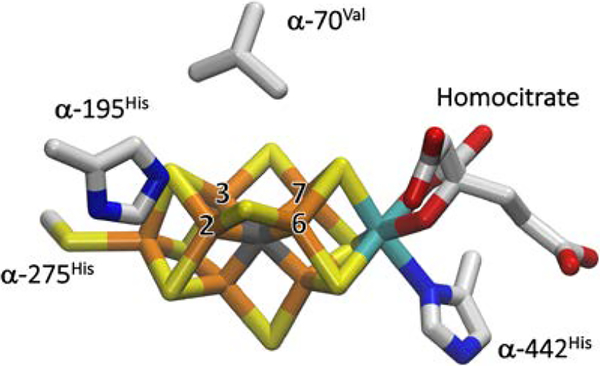
We have shown that the key state in N reduction to two NH molecules by the enzyme nitrogenase is E(4H), the "Janus" intermediate, which has accumulated four [e/H] and is poised to undergo reductive elimination of H coupled to N binding and activation. Initial H and Mo ENDOR studies of freeze-trapped E(4H) revealed that the catalytic multimetallic cluster (FeMo-co) binds two Fe-bridging hydrides, [Fe-H-Fe]. However, the analysis failed to provide a satisfactory picture of the relative spatial relationships of the two [Fe-H-Fe]. Our recent density functional theory (DFT) study yielded a lowest-energy form, denoted as E(4H), with two parallel Fe-H-Fe planes bridging pairs of "anchor" Fe on the Fe2,3,6,7 face of FeMo-co. However, the relative energies of structures E(4H), with one bridging and one terminal hydride, and E(4H), with one pair of anchor Fe supporting two bridging hydrides, were not beyond the uncertainties in the calculation. Moreover, a structure of V-dependent nitrogenase resulted in a proposed structure analogous to E(4H), and additional structures have been proposed in the DFT studies of others. To resolve the nature of hydride binding to the Janus intermediate, we performed exhaustive, high-resolution CW-stochastic H-ENDOR experiments using improved instrumentation, Mims H ENDOR, and a recently developed pulsed-ENDOR protocol ("PESTRE") to obtain absolute hyperfine interaction signs. These measurements are coupled to DFT structural models through an analytical point-dipole Hamiltonian for the hydride electron-nuclear dipolar coupling to its "anchoring" Fe ions, an approach that overcomes limitations inherent in both experimental interpretation and computational accuracy. The result is the freeze-trapped, lowest-energy Janus intermediate structure, E(4H).

摘要

我们已经表明,酶氮还原酶将 N 还原为两个 NH 分子的关键状态是 E(4H),即“两面神”中间体,它已经积累了四个 [e/H],并准备好进行与 N 结合和活化相关的 H 还原消除。最初对冷冻捕获的 E(4H)进行的 H 和 Mo ENDOR 研究表明,催化多金属簇 (FeMo-co) 结合了两个 Fe 桥接氢化物,[Fe-H-Fe]。然而,该分析未能提供两个 [Fe-H-Fe] 相对空间关系的令人满意的图像。我们最近的密度泛函理论 (DFT) 研究产生了一种最低能量形式,记为 E(4H),其中两个平行的 Fe-H-Fe 平面桥接 FeMo-co 的 Fe2、3、6、7 面上的两对“锚”Fe。然而,具有一个桥接和一个末端氢化物的结构 E(4H)和具有一对锚定 Fe 支撑两个桥接氢化物的结构 E(4H)的相对能量并没有超出计算中的不确定性。此外,V 依赖性氮还原酶的结构导致提出了类似于 E(4H)的结构,并且在其他人的 DFT 研究中还提出了其他结构。为了解决 Janus 中间体与氢化物结合的性质,我们使用改进的仪器、Mims H ENDOR 和最近开发的脉冲 ENDOR 协议("PESTRE")进行了详尽的高分辨率 CW 随机 H-ENDOR 实验,以获得绝对超精细相互作用符号。这些测量通过分析点偶极子哈密顿量耦合到 DFT 结构模型,用于氢化物电子-核偶极子偶极子与其“锚定”Fe 离子的偶极子相互作用,该方法克服了实验解释和计算准确性固有的局限性。结果是冷冻捕获的、最低能量的 Janus 中间体结构 E(4H)。
相似文献

4
Reversible Photoinduced Reductive Elimination of H2 from the Nitrogenase Dihydride State, the E(4)(4H) Janus Intermediate.
J Am Chem Soc. 2016 Feb 3;138(4):1320-7. doi: 10.1021/jacs.5b11650. Epub 2016 Jan 20.
5
ENDOR Characterization of (N)Fe(μ-H)Fe(N): A Spectroscopic Model for N Binding by the Di-μ-hydrido Nitrogenase Janus Intermediate.
Inorg Chem. 2018 Oct 1;57(19):12323-12330. doi: 10.1021/acs.inorgchem.8b02021. Epub 2018 Sep 17.
7
Time-Resolved EPR Study of H Reductive Elimination from the Photoexcited Nitrogenase Janus E(4H) Intermediate.
J Phys Chem B. 2019 Oct 17;123(41):8823-8828. doi: 10.1021/acs.jpcb.9b07776. Epub 2019 Oct 8.
9
Photoinduced Reductive Elimination of H from the Nitrogenase Dihydride (Janus) State Involves a FeMo-cofactor-H Intermediate.
Inorg Chem. 2017 Feb 20;56(4):2233-2240. doi: 10.1021/acs.inorgchem.6b02899. Epub 2017 Feb 8.
10
Kinetic Understanding of N Reduction versus H Evolution at the E(4H) Janus State in the Three Nitrogenases.
Biochemistry. 2018 Oct 2;57(39):5706-5714. doi: 10.1021/acs.biochem.8b00784. Epub 2018 Sep 19.

引用本文的文献

2
Investigating the Molybdenum Nitrogenase Mechanistic Cycle Using Spectroelectrochemistry.
J Am Chem Soc. 2025 Jan 15;147(2):2099-2114. doi: 10.1021/jacs.4c16047. Epub 2025 Jan 2.
3
Terminal Hydride Complex of High-Spin Mn.
J Am Chem Soc. 2024 Jul 10;146(27):18370-18378. doi: 10.1021/jacs.4c03310. Epub 2024 Jun 28.
4
Analysis of early intermediate states of the nitrogenase reaction by regularization of EPR spectra.
Nat Commun. 2024 May 13;15(1):4041. doi: 10.1038/s41467-024-48271-8.
5
Evaluating Diazene to N Interconversion at Iron-Sulfur Complexes.
Chemistry. 2024 Apr 25;30(24):e202304072. doi: 10.1002/chem.202304072. Epub 2024 Mar 26.
7
Protonation of Homocitrate and the E State of Fe-Nitrogenase Studied by QM/MM Calculations.
Inorg Chem. 2023 Dec 4;62(48):19433-19445. doi: 10.1021/acs.inorgchem.3c02329. Epub 2023 Nov 21.
8
Multireference Protonation Energetics of a Dimeric Model of Nitrogenase Iron-Sulfur Clusters.
J Phys Chem A. 2023 Nov 30;127(47):9974-9984. doi: 10.1021/acs.jpca.3c06142. Epub 2023 Nov 15.
9
Near ambient N fixation on solid electrodes versus enzymes and homogeneous catalysts.
Nat Rev Chem. 2023 Mar;7(3):184-201. doi: 10.1038/s41570-023-00462-5. Epub 2023 Feb 1.
10
Understanding the Electronic Structure Basis for N Binding to FeMoco: A Systematic Quantum Mechanics/Molecular Mechanics Investigation.
Inorg Chem. 2023 Apr 10;62(14):5357-5375. doi: 10.1021/acs.inorgchem.2c03967. Epub 2023 Mar 29.

本文引用的文献

1
Extremely large differences in DFT energies for nitrogenase models.
Phys Chem Chem Phys. 2019 Jan 30;21(5):2480-2488. doi: 10.1039/c8cp06930a.
2
Critical computational analysis illuminates the reductive-elimination mechanism that activates nitrogenase for N reduction.
Proc Natl Acad Sci U S A. 2018 Nov 6;115(45):E10521-E10530. doi: 10.1073/pnas.1810211115. Epub 2018 Oct 24.
3
Protonation and Reduction of the FeMo Cluster in Nitrogenase Studied by Quantum Mechanics/Molecular Mechanics (QM/MM) Calculations.
J Chem Theory Comput. 2018 Dec 11;14(12):6653-6678. doi: 10.1021/acs.jctc.8b00778. Epub 2018 Nov 13.
4
ENDOR Characterization of (N)Fe(μ-H)Fe(N): A Spectroscopic Model for N Binding by the Di-μ-hydrido Nitrogenase Janus Intermediate.
Inorg Chem. 2018 Oct 1;57(19):12323-12330. doi: 10.1021/acs.inorgchem.8b02021. Epub 2018 Sep 17.
5
The Critical E State of Nitrogenase Catalysis.
Biochemistry. 2018 Sep 25;57(38):5497-5504. doi: 10.1021/acs.biochem.8b00509. Epub 2018 Jul 17.
6
A bound reaction intermediate sheds light on the mechanism of nitrogenase.
Science. 2018 Mar 30;359(6383):1484-1489. doi: 10.1126/science.aar2765.
8
Is there computational support for an unprotonated carbon in the E state of nitrogenase?
J Comput Chem. 2018 May 5;39(12):743-747. doi: 10.1002/jcc.25145. Epub 2017 Dec 18.
9
The structure of vanadium nitrogenase reveals an unusual bridging ligand.
Nat Chem Biol. 2017 Sep;13(9):956-960. doi: 10.1038/nchembio.2428. Epub 2017 Jul 10.
10
Photoinduced Reductive Elimination of H from the Nitrogenase Dihydride (Janus) State Involves a FeMo-cofactor-H Intermediate.
Inorg Chem. 2017 Feb 20;56(4):2233-2240. doi: 10.1021/acs.inorgchem.6b02899. Epub 2017 Feb 8.

文献AI研究员

20分钟写一篇综述,助力文献阅读效率提升50倍。

立即体验

用中文搜PubMed

大模型驱动的PubMed中文搜索引擎

马上搜索

文档翻译

学术文献翻译模型,支持多种主流文档格式。

立即体验