Department of Physical Therapy, Faculty of Health Science, Eulji University, 553 Sanseongdae Ro, Sujeong-gu, Seongnam, Gyeonggi-do 13135, Republic of Korea.
Department of Physical Therapy, Samsung Seoul Hospital, 81 Irwon Ro, Gangnam-gu, Seoul 06351, Republic of Korea.
Biomed Res Int. 2019 Jun 18;2019:7595639. doi: 10.1155/2019/7595639. eCollection 2019.
The aim of this study was to perform a meta-analysis to examine whether virtual reality (VR) training is effective for lower limb function as well as upper limb and overall function in chronic stroke patients.
Three databases, OVID, PubMed, and EMBASE, were used to collect articles. The search terms used were "cerebrovascular accident (CVA)," "stroke", and "virtual reality". Consequently, twenty-one studies were selected in the second screening of meta-analyses. The PEDro scale was used to assess the quality of the selected studies.
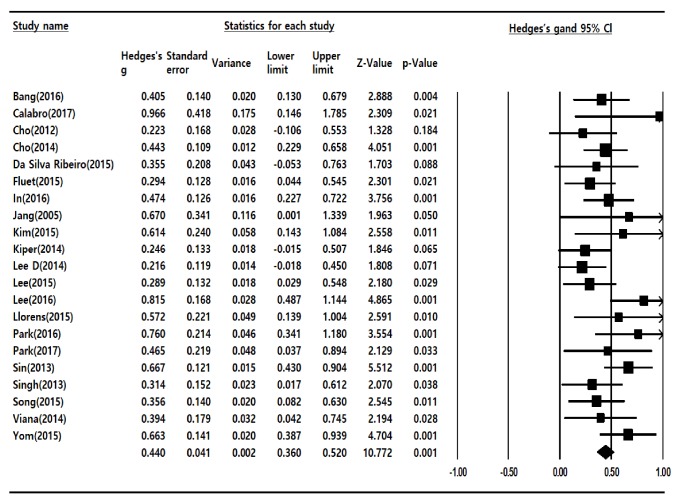
The total effect size for VR rehabilitation programs was 0.440. The effect size for upper limb function was 0.431, for lower limb function it was 0.424, and for overall function it was 0.545. The effects of VR programs on specific outcomes were most effective for improving muscle tension, followed by muscle strength, activities of daily living (ADL), joint range of motion, gait, balance, and kinematics.
The VR training was effective in improving the function in chronic stroke patients, corresponding to a moderate effect size. Moreover, VR training showed a similar effect for improving lower limb function as it did for upper limb function.
本研究旨在进行荟萃分析,以检验虚拟现实(VR)训练是否对慢性脑卒中患者的下肢功能以及上肢和整体功能有效。
使用 OVID、PubMed 和 EMBASE 三个数据库收集文章。使用的搜索词是“脑血管意外(CVA)”、“中风”和“虚拟现实”。因此,在第二次荟萃分析筛选中选择了 21 项研究。使用 PEDro 量表评估所选研究的质量。
VR 康复计划的总效应量为 0.440。上肢功能的效应量为 0.431,下肢功能为 0.424,整体功能为 0.545。VR 计划对特定结果的影响在改善肌张力方面最为有效,其次是肌肉力量、日常生活活动(ADL)、关节活动度、步态、平衡和运动学。
VR 训练在改善慢性脑卒中患者的功能方面是有效的,对应于中等的效应量。此外,VR 训练在改善下肢功能方面与上肢功能的效果相似。