Lei Zhouyue, Wu Peiyi
State Key Laboratory for Modification of Chemical Fibers and Polymer Materials, College of Chemistry, Chemical Engineering and Biotechnology, Center for Advanced Low-Dimension Materials, Donghua University, Shanghai, 201620, China.
State Key Laboratory of Molecular Engineering of Polymers, Department of Macromolecular Science and Laboratory for Advanced Materials, Fudan University, Shanghai, 200433, China.
Nat Commun. 2019 Jul 31;10(1):3429. doi: 10.1038/s41467-019-11364-w.
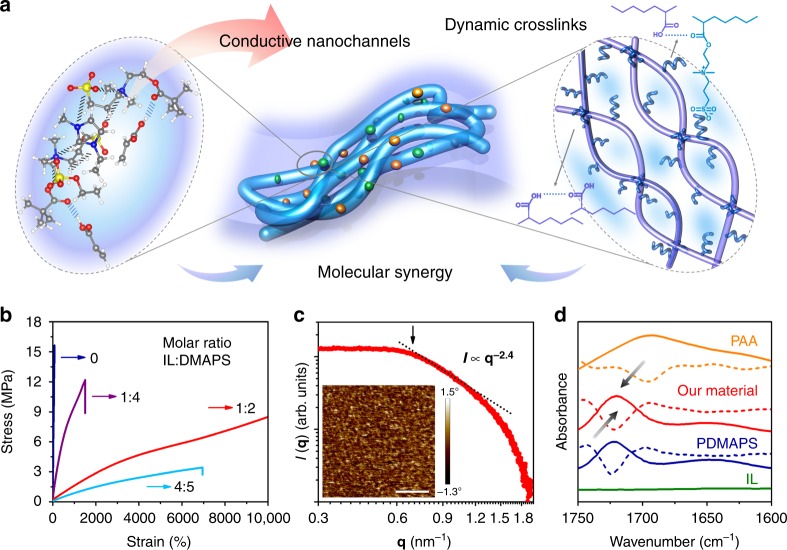
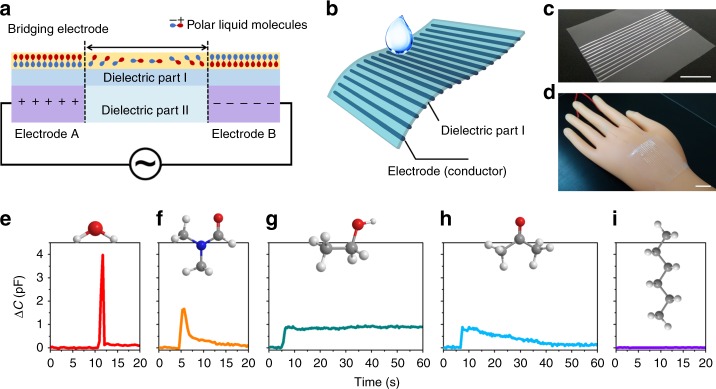
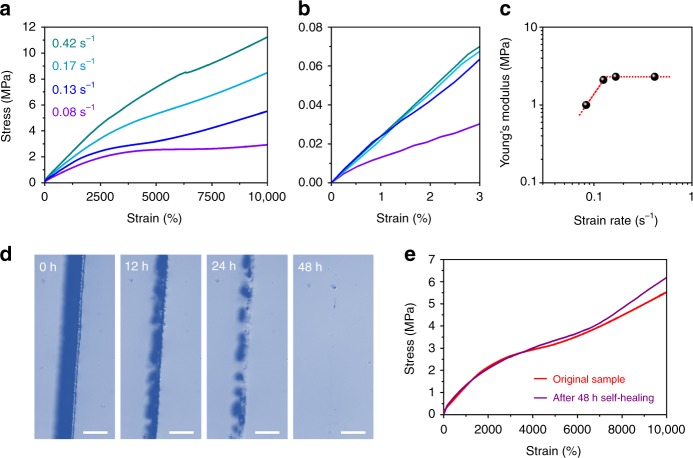
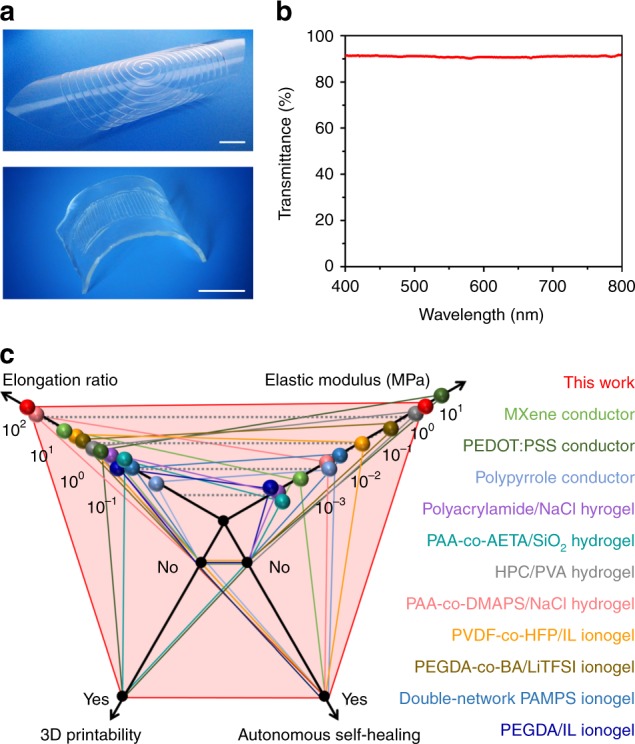
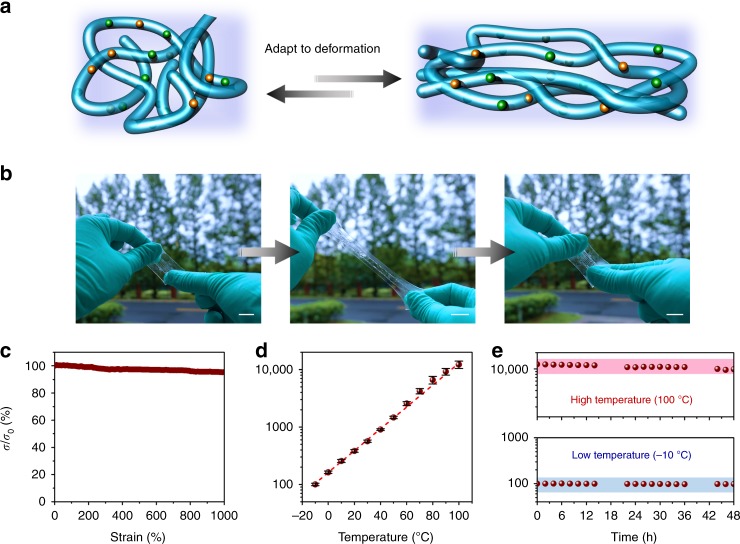
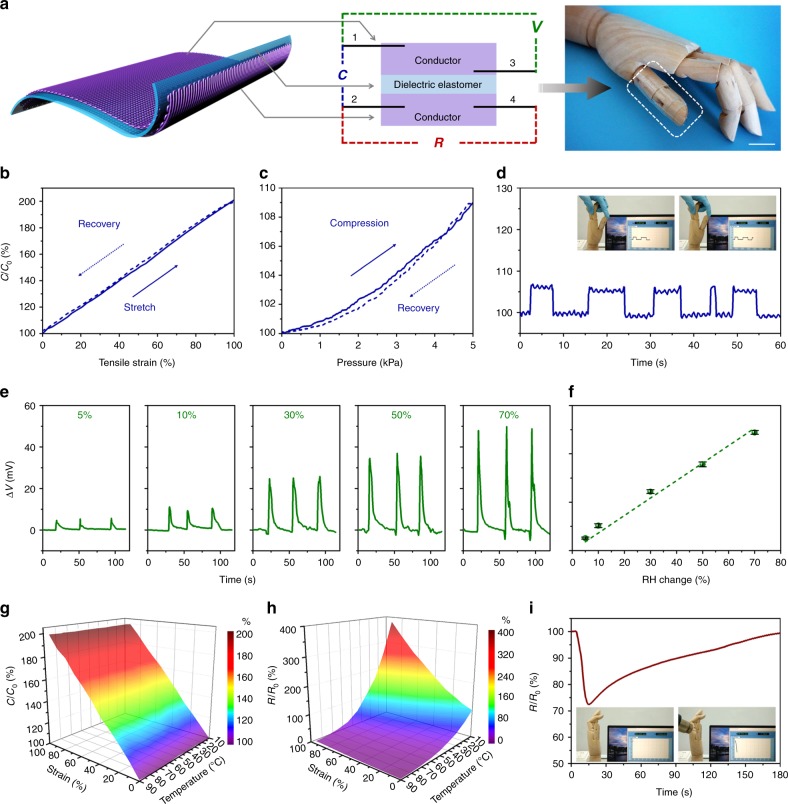
Intrinsically stretchable conductors have undergone rapid development in the past few years and a variety of strategies have been established to improve their electro-mechanical properties. However, ranging from electronically to ionically conductive materials, they are usually vulnerable either to large deformation or at high/low temperatures, mainly due to the fact that conductive domains are generally incompatible with neighboring elastic networks. This is a problem that is usually overlooked and remains challenging to address. Here, we introduce synergistic effect between conductive zwitterionic nanochannels and dynamic hydrogen-bonding networks to break the limitations. The conductor is highly transparent (>90% transmittance), ultra-stretchable (>10,000% strain), high-modulus (>2 MPa Young's modulus), self-healing, and capable of maintaining stable conductivity during large deformation and at different temperatures. Transparent integrated systems are further demonstrated via 3D printing of its precursor and could achieve diverse sensory capabilities towards strain, temperature, humidity, etc., and even recognition of different liquids.
在过去几年中,本征可拉伸导体发展迅速,人们已经建立了多种策略来改善其机电性能。然而,从电子导电材料到离子导电材料,它们通常在大变形或高/低温下易受影响,主要原因是导电域通常与相邻的弹性网络不相容。这是一个通常被忽视且仍具挑战性的问题。在此,我们引入导电两性离子纳米通道与动态氢键网络之间的协同效应来突破这些限制。该导体具有高透明度(透光率>90%)、超拉伸性(应变>10000%)、高模量(杨氏模量>2MPa)、自修复能力,并且能够在大变形和不同温度下保持稳定的导电性。通过对其前驱体进行3D打印进一步展示了透明集成系统,该系统能够实现对应变、温度、湿度等多种传感功能,甚至能够识别不同液体。