
皮层脑电图脑机接口中的直接电刺激:用于向皮层输入的使能技术。
Direct Electrical Stimulation in Electrocorticographic Brain-Computer Interfaces: Enabling Technologies for Input to Cortex.
作者信息
Caldwell David J, Ojemann Jeffrey G, Rao Rajesh P N
机构信息
Department of Bioengineering, University of Washington, Seattle, WA, United States.
Medical Scientist Training Program, University of Washington, Seattle, WA, United States.
出版信息
Front Neurosci. 2019 Aug 7;13:804. doi: 10.3389/fnins.2019.00804. eCollection 2019.
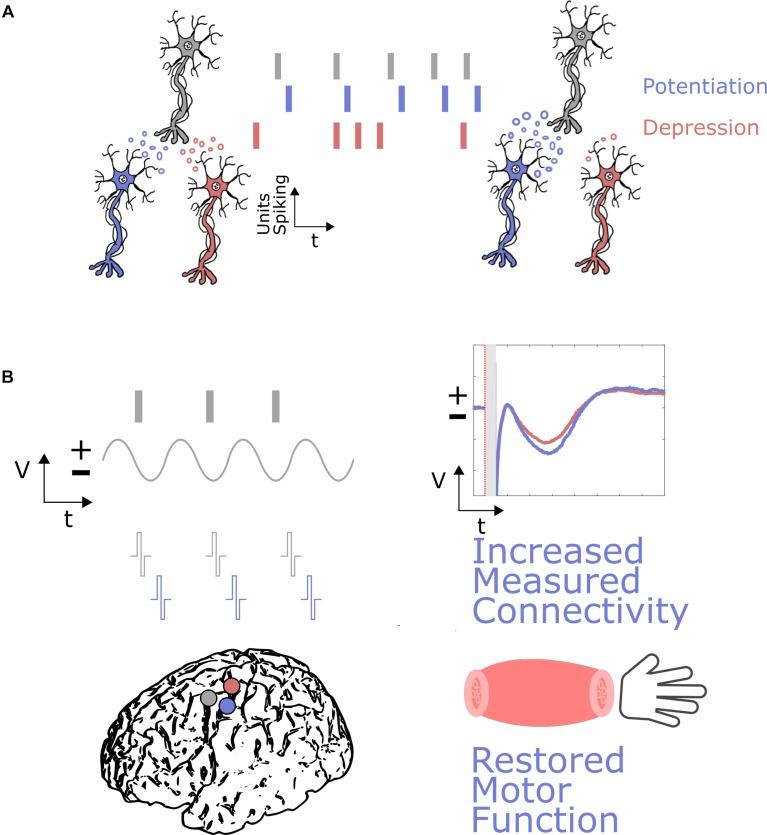
Electrocorticographic brain computer interfaces (ECoG-BCIs) offer tremendous opportunities for restoring function in individuals suffering from neurological damage and for advancing basic neuroscience knowledge. ECoG electrodes are already commonly used clinically for monitoring epilepsy and have greater spatial specificity in recording neuronal activity than techniques such as electroencephalography (EEG). Much work to date in the field has focused on using ECoG signals recorded from cortex as control outputs for driving end effectors. An equally important but less explored application of an ECoG-BCI is directing input into cortex using ECoG electrodes for direct electrical stimulation (DES). Combining DES with ECoG recording enables a truly bidirectional BCI, where information is both read from and written to the brain. We discuss the advantages and opportunities, as well as the barriers and challenges presented by using DES in an ECoG-BCI. In this article, we review ECoG electrodes, the physics and physiology of DES, and the use of electrical stimulation of the brain for the clinical treatment of disorders such as epilepsy and Parkinson's disease. We briefly discuss some of the translational, regulatory, financial, and ethical concerns regarding ECoG-BCIs. Next, we describe the use of ECoG-based DES for providing sensory feedback and for probing and modifying cortical connectivity. We explore future directions, which may draw on invasive animal studies with penetrating and surface electrodes as well as non-invasive stimulation methods such as transcranial magnetic stimulation (TMS). We conclude by describing enabling technologies, such as smaller ECoG electrodes for more precise targeting of cortical areas, signal processing strategies for simultaneous stimulation and recording, and computational modeling and algorithms for tailoring stimulation to each individual brain.
皮层脑电图脑机接口(ECoG-BCI)为神经损伤患者恢复功能以及推进基础神经科学知识提供了巨大机遇。ECoG电极已在临床上普遍用于监测癫痫,并且在记录神经元活动方面比脑电图(EEG)等技术具有更高的空间特异性。该领域迄今为止的许多工作都集中在将从皮层记录的ECoG信号用作驱动终端效应器的控制输出。ECoG-BCI一个同样重要但较少被探索的应用是使用ECoG电极进行直接电刺激(DES)将输入导向皮层。将DES与ECoG记录相结合可实现真正的双向脑机接口,即信息既能从大脑读取,也能写入大脑。我们讨论了在ECoG-BCI中使用DES的优势和机遇,以及所面临的障碍和挑战。在本文中,我们回顾了ECoG电极、DES的物理和生理学,以及利用脑电刺激对癫痫和帕金森病等疾病进行临床治疗的情况。我们简要讨论了一些与ECoG-BCI相关的转化、监管、财务和伦理问题。接下来,我们描述基于ECoG的DES用于提供感觉反馈以及探测和改变皮层连接性的情况。我们探索未来的方向,这些方向可能借鉴使用穿透电极和表面电极的侵入性动物研究以及诸如经颅磁刺激(TMS)等非侵入性刺激方法。我们通过描述使能技术来得出结论,例如用于更精确靶向皮层区域的更小的ECoG电极、用于同时刺激和记录的信号处理策略,以及针对每个个体大脑定制刺激的计算建模和算法。


 Zotero 插件