Gazzi Arianna, Fusco Laura, Khan Anooshay, Bedognetti Davide, Zavan Barbara, Vitale Flavia, Yilmazer Acelya, Delogu Lucia Gemma
Department of Chemical and Pharmaceutical Sciences, University of Trieste, Trieste, Italy.
Fondazione Istituto di Ricerca Pediatrica Città della Speranza, Padua, Italy.
Front Bioeng Biotechnol. 2019 Oct 25;7:295. doi: 10.3389/fbioe.2019.00295. eCollection 2019.
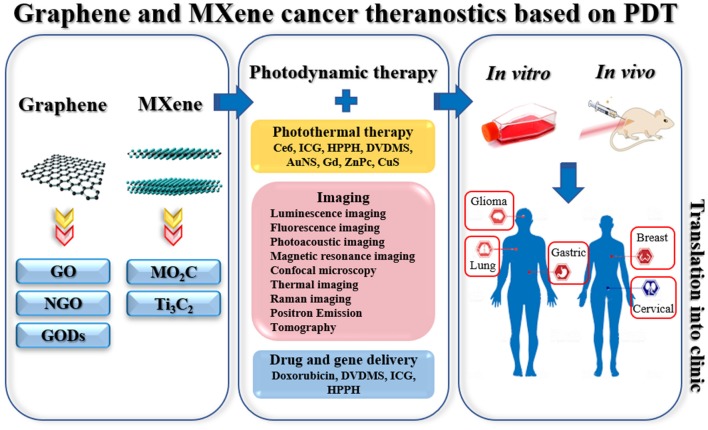
Cancer is one of the leading causes of death in the world. Therefore, the development of new advanced and targeted strategies in cancer research for early diagnosis and treatment has become essential to improve diagnosis outcomes and reduce therapy side effects. Graphene and more recently, MXene, are the main representatives of the family of two-dimensional (2D) materials and are widely studied as multimodal nanoplatforms for cancer diagnostics and treatment, in particular leveraging their potentialities as photodynamic therapeutic agents. Indeed, due to their irreplaceable physicochemical properties, they are virtuous allies for photodynamic therapy (PDT) in combination with bioimaging, photothermal therapy, as well as drug and gene delivery. In this review, the rapidly progressing literature related to the use of these promising 2D materials for cancer theranostics is described in detail, highlighting all their possible future advances in PDT.
癌症是全球主要死因之一。因此,在癌症研究中开发新的先进靶向策略用于早期诊断和治疗,对于改善诊断结果和减少治疗副作用至关重要。石墨烯以及最近的MXene,是二维(2D)材料家族的主要代表,作为用于癌症诊断和治疗的多模态纳米平台被广泛研究,特别是利用它们作为光动力治疗剂的潜力。事实上,由于其不可替代的物理化学性质,它们是光动力疗法(PDT)与生物成像、光热疗法以及药物和基因递送相结合的理想盟友。在这篇综述中,详细描述了与这些有前景的二维材料用于癌症诊疗相关的快速发展的文献,突出了它们在光动力疗法中所有可能的未来进展。