Farzamfar Saeed, Salehi Majid, Tavangar Seyed Mohammad, Verdi Javad, Mansouri Korosh, Ai Arman, Malekshahi Ziba Veisi, Ai Jafar
Department of Tissue Engineering and Applied Cell Sciences, School of Advanced Technologies in Medicine, Tehran University of Medical Sciences, Tehran, Iran.
Department of Tissue Engineering, School of Medicine, Shahroud University of Medical Sciences, Shahroud, Iran.
Prog Biomater. 2019 Dec;8(4):239-248. doi: 10.1007/s40204-019-00121-3. Epub 2019 Dec 12.
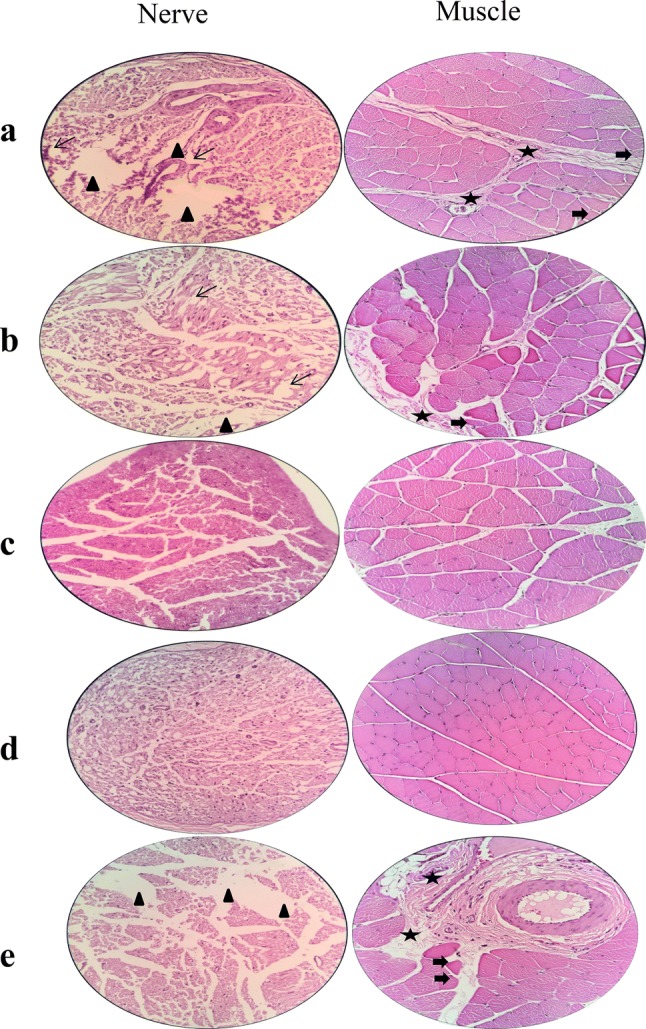
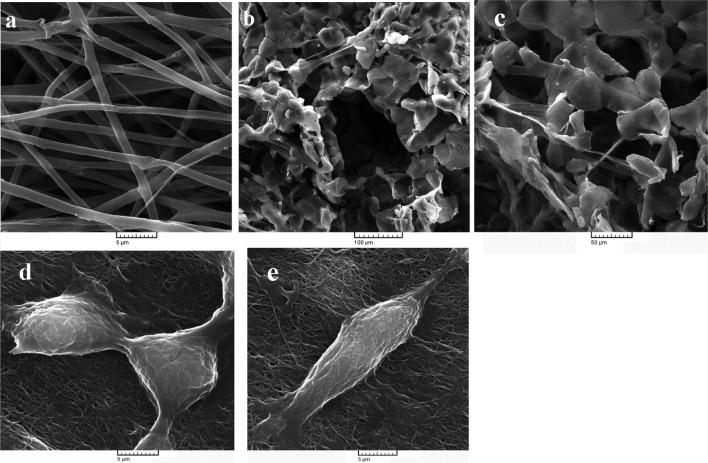
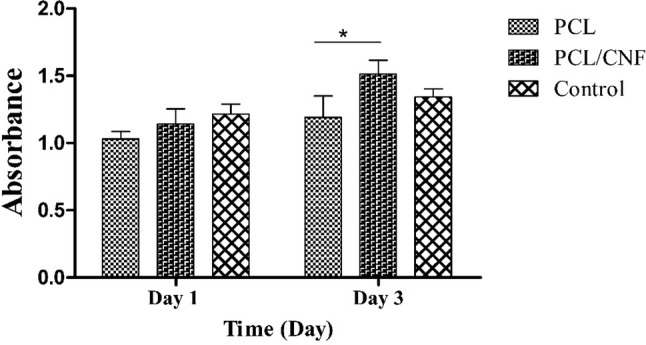
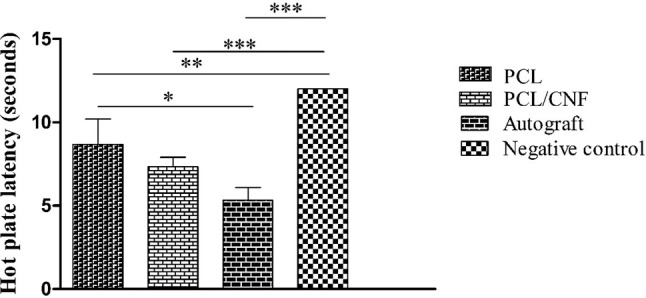
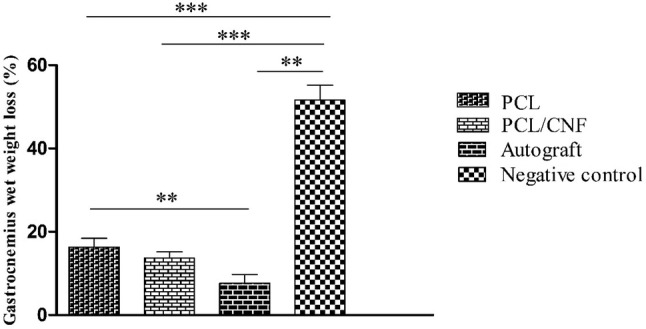
The current study aimed to investigate the potential of carbon nanofibers to promote peripheral nerve regeneration. The carbon nanofiber-imbedded scaffolds were produced from polycaprolactone and carbon nanofibers using thermally induced phase separation method. Electrospinning technique was utilized to fabricate polycaprolactone/collagen nanofibrous sheets. The incorporation of carbon nanofibers into polycaprolactone's matrix significantly reduced its electrical resistance from 4.3 × 10 ± 0.34 × 10 Ω to 8.7 × 10 ± 1.2 × 10 Ω. Further in vitro studies showed that polycaprolactone/carbon nanofiber scaffolds had the porosity of 82.9 ± 3.7% and degradation rate of 1.84 ± 0.37% after 30 days and 3.58 ± 0.39% after 60 days. The fabricated scaffolds were favorable for PC-12 cells attachment and proliferation. Neural guidance channels were produced from the polycaprolactone/carbon nanofiber composites using water jet cutter machine then incorporated with PCL/collagen nanofibrous sheets. The composites were implanted into severed rat sciatic nerve. After 12 weeks, the results of histopathological examinations and functional analysis proved that conductive conduit out-performed the non-conductive type and induced no toxicity or immunogenic reactions, suggesting its potential applicability to treat peripheral nerve damage in the clinic.
当前的研究旨在探究碳纳米纤维促进周围神经再生的潜力。采用热致相分离法,由聚己内酯和碳纳米纤维制备出嵌入碳纳米纤维的支架。利用静电纺丝技术制备聚己内酯/胶原纳米纤维片。将碳纳米纤维掺入聚己内酯基质中,使其电阻从4.3×10±0.34×10Ω显著降低至8.7×10±1.2×10Ω。进一步的体外研究表明,聚己内酯/碳纳米纤维支架在30天后的孔隙率为82.9±3.7%,降解率为1.84±0.37%;60天后的降解率为3.58±0.39%。所制备的支架有利于PC-12细胞的附着和增殖。使用水刀切割机由聚己内酯/碳纳米纤维复合材料制作神经导向通道,然后与聚己内酯/胶原纳米纤维片结合。将该复合材料植入切断的大鼠坐骨神经。12周后,组织病理学检查和功能分析结果证明,导电导管的性能优于非导电型,且未引起毒性或免疫原性反应,表明其在临床上治疗周围神经损伤具有潜在的适用性。