Department of Nutritional Sciences, The Pennsylvania State University, University Park, PA, USA.
J Nutr. 2020 Apr 1;150(4):818-825. doi: 10.1093/jn/nxz313.
Walnuts have established lipid-/lipoprotein-lowering properties; however, their effect on lipoprotein subclasses has not been investigated. Furthermore, the mechanisms by which walnuts improve lipid/lipoprotein concentrations are incompletely understood.
We aimed to examine, as exploratory outcomes of this trial, the effect of replacing SFAs with unsaturated fats from walnuts or vegetable oils on lipoprotein subclasses, cholesterol efflux, and proprotein convertase subtilisin/kexin type 9 (PCSK9).
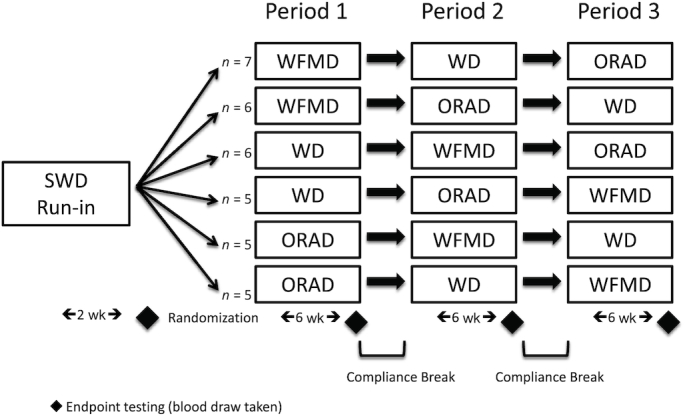
A randomized, crossover, controlled-feeding study was conducted in individuals at risk of cardiovascular disease (CVD) (n = 34; 62% men; mean ± SD age 44 ± 10 y; BMI: 30.1 ± 4.9 kg/m2). After a 2-wk run-in diet (12% SFAs, 7% PUFAs, 12% MUFAs), subjects consumed the following diets, in randomized order, for 6 wk: 1) walnut diet (WD) [57-99 g/d walnuts, 7% SFAs, 16% PUFAs [2.7% α-linolenic acid (ALA)], 9% MUFAs]; 2) walnut fatty acid-matched diet [7% SFAs, 16% PUFAs (2.6% ALA), 9% MUFAs]; and 3) oleic acid replaces ALA diet (ORAD) [7% SFAs, 14% PUFAs (0.4% ALA); 12% MUFAs] (all percentages listed are of total kilocalories ). Serum collected after the run-in (baseline) and each diet period was analyzed for lipoprotein classes and subclasses (vertical auto profile), cholesterol efflux, and PCSK9. Linear mixed models were used for data analysis.
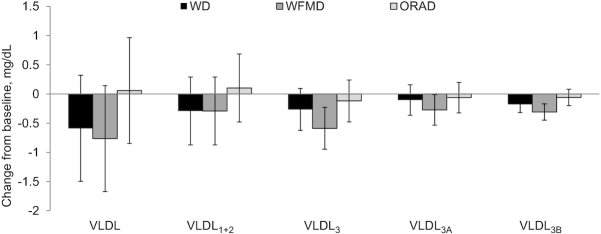
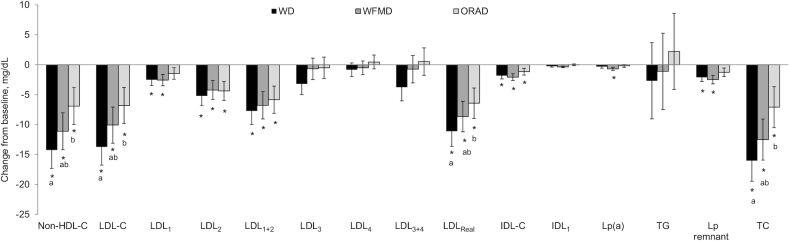
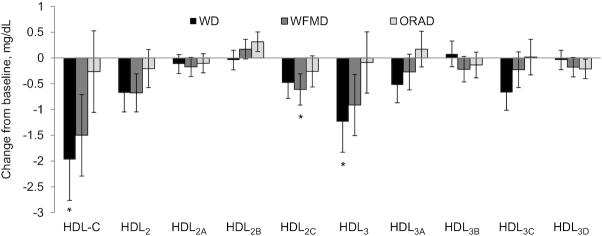
Compared with the ORAD, total cholesterol (mean ± SEM -8.9± 2.3 mg/dL; -5.1%; P < 0.001), non-HDL cholesterol (-7.4 ± 2.0 mg/dL; -5.4%; P = 0.001), and LDL cholesterol (-6.9 ± 1.9 mg/dL; -6.5%; P = 0.001) were lower after the WD; no other pairwise differences existed. There were no between-diet differences for HDL-cholesterol or LDL-cholesterol subclasses. Lipoprotein(a) [Lp(a)], cholesterol efflux, and PCSK9 were unchanged after the diets.
In individuals at risk of CVD, replacement of SFAs with unsaturated fats from walnuts or vegetable oils improved lipid/lipoprotein classes, including LDL-cholesterol, non-HDL cholesterol, and total cholesterol, without an increase in Lp(a). These improvements were not explained by changes in cholesterol efflux capacity or PCSK9. This trial was registered at clinicaltrials.gov as NCT01235832.
核桃具有降低血脂/脂蛋白的特性;然而,其对脂蛋白亚类的影响尚未得到研究。此外,核桃改善血脂/脂蛋白浓度的机制还不完全清楚。
本试验旨在作为探索性结果,研究用核桃或植物油中的不饱和脂肪替代饱和脂肪(SFAs)对脂蛋白亚类、胆固醇外排和前蛋白转化酶枯草溶菌素/克氏蛋白酶 9(PCSK9)的影响。
对心血管疾病(CVD)风险人群(n=34;62%男性;平均年龄±标准差 44±10 岁;BMI:30.1±4.9kg/m2)进行了一项随机、交叉、对照喂养研究。在为期 2 周的适应期饮食(12%SFAs、7%PUFAs、12%MUFA)后,受试者以随机顺序分别食用以下饮食 6 周:1)核桃饮食(WD)[57-99g/d 核桃、7%SFAs、16%PUFAs[2.7%α-亚麻酸(ALA)]、9%MUFA];2)核桃脂肪酸匹配饮食[7%SFAs、16%PUFAs(2.6%ALA)、9%MUFA];3)油酸替代 ALA 饮食(ORAD)[7%SFAs、14%PUFAs(0.4%ALA)、12%MUFA](所有百分比均为总卡路里的百分比)。在适应期(基线)和每个饮食期后采集血清,用于分析脂蛋白类别和亚类(垂直自动谱)、胆固醇外排和 PCSK9。使用线性混合模型进行数据分析。
与 ORAD 相比,WD 后总胆固醇(平均±SEM-8.9±2.3mg/dL;-5.1%;P<0.001)、非高密度脂蛋白胆固醇(-7.4±2.0mg/dL;-5.4%;P=0.001)和 LDL 胆固醇(-6.9±1.9mg/dL;-6.5%;P=0.001)降低;其他两两之间无差异。HDL-胆固醇或 LDL 胆固醇亚类在不同饮食之间无差异。脂蛋白(a)[Lp(a)]、胆固醇外排和 PCSK9在饮食后均无变化。
在 CVD 风险人群中,用核桃或植物油中的不饱和脂肪替代 SFAs 可改善血脂/脂蛋白类别,包括 LDL 胆固醇、非高密度脂蛋白胆固醇和总胆固醇,而不会增加 Lp(a)。这些改善与胆固醇外排能力或 PCSK9 无关。本试验在 clinicaltrials.gov 上注册为 NCT01235832。