Department of Psychiatry, Kaohsiung Chang Gung Memorial Hospital and Chang Gung University College of Medicine, Kaohsiung, Taiwan.
Department of Psychiatry, Kaohsiung Veterans General Hospital, Kaohsiung, Taiwan.
BMC Psychiatry. 2020 Jan 31;20(1):39. doi: 10.1186/s12888-020-2459-y.
Neurocognitive dysfunction is a common symptom of various major psychiatric disorders, including schizophrenia, major depressive disorder (MDD), and bipolar I disorder (BD). In this study, we investigated whether cognitive profiles and daily skill functioning could effectively differentiate between patients with schizophrenia, MDD, and BD.
In this cross-sectional study, we recruited a total of 63 patients with schizophrenia, 55 patients with MDD, 43 patients with BD, and 92 healthy control subjects. We evaluated participants' cognitive functions and functional capacity using the Brief Assessment of Cognition in Schizophrenia (BACS) and the UCSD Performance-based Skills Assessment, Brief Version (UPSA-B), respectively. Multivariate analysis of covariance was then adopted to determine inter-group differences in BACS and UPSA-B performance.
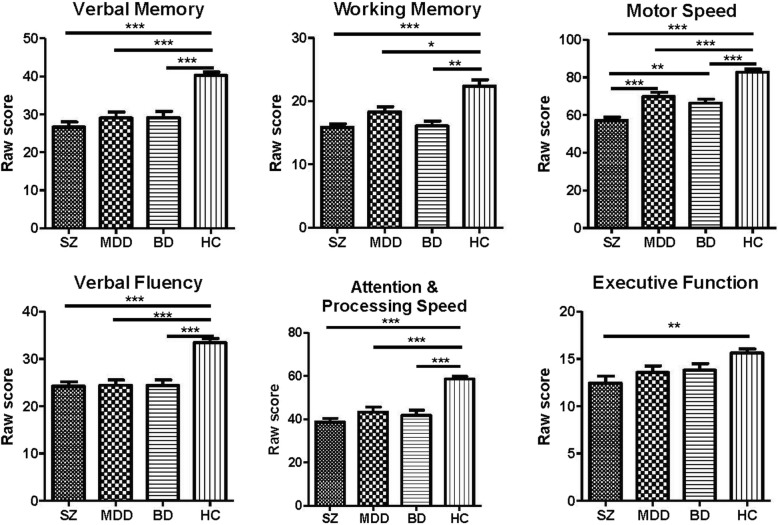
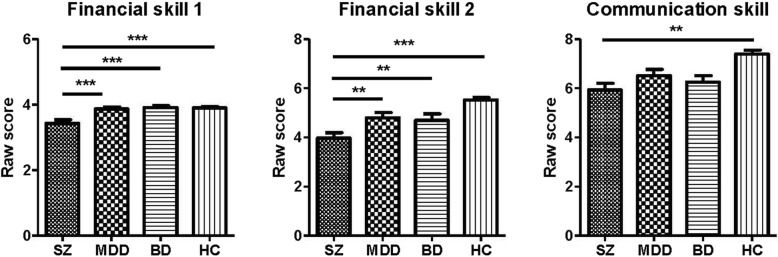
The BACS was capable of differentiating patients with a major psychiatric disorder (schizophrenia, MDD, and BD) from healthy subjects. Furthermore, schizophrenia patients had poorer motor speed performance than patients with affective disorders. The UPSA-B, particularly the financial portion, was able to distinguish schizophrenia patients from other groups. However, we did not observe any differences in UPSA-B performance between patients with mood disorders and the healthy controls. No significant difference between patients with BD and those with MDD were observed in either cognitive function or in functional capacity. The performances of the BACS and the UPSA-B were positively correlated, particularly in the MDD group.
Considering overall performance, the BACS and the UPSA-B characterize different endophenotyping profiles in the aforementioned four participant groups. Therefore, the results support the need for comprehensive assessments that target both cognitive function and functional capacity for patients with major psychiatric disorders.
神经认知功能障碍是各种主要精神疾病的常见症状,包括精神分裂症、重性抑郁障碍(MDD)和双相 I 障碍(BD)。在本研究中,我们调查了认知特征和日常技能功能是否能有效地将精神分裂症、MDD 和 BD 患者区分开来。
在这项横断面研究中,我们共招募了 63 名精神分裂症患者、55 名 MDD 患者、43 名 BD 患者和 92 名健康对照组。我们分别使用Brief Assessment of Cognition in Schizophrenia(BACS)和UCSD Performance-based Skills Assessment,Brief Version(UPSA-B)评估参与者的认知功能和功能能力。然后,采用多元协方差分析确定 BACS 和 UPSA-B 表现的组间差异。
BACS 能够将患有主要精神障碍(精神分裂症、MDD 和 BD)的患者与健康受试者区分开来。此外,精神分裂症患者的运动速度表现比情感障碍患者差。UPSA-B,特别是财务部分,能够将精神分裂症患者与其他组区分开来。然而,我们没有观察到情绪障碍患者与健康对照组在 UPSA-B 表现上的差异。BD 和 MDD 患者之间在认知功能或功能能力方面没有显著差异。BACS 和 UPSA-B 的表现呈正相关,尤其是在 MDD 组。
考虑到整体表现,BACS 和 UPSA-B 描述了上述四组参与者不同的表型特征。因此,结果支持需要对患有主要精神疾病的患者进行全面的认知功能和功能能力评估。