Bottolfs Marthe, Støa Eva Maria, Reinboth Michael Sæther, Svendsen Martin Veel, Schmidt Sabrina Krogh, Oellingrath Inger Margaret, Bratland-Sanda Solfrid
University of South-Eastern Norway, Kongsberg, Norway.
Telemark Hospital, Skien, Norway.
J Int Med Res. 2020 Feb;48(2):300060520903656. doi: 10.1177/0300060520903656.
To examine whether lifestyle-related factors and resilience predict health-related quality of life (HRQoL) in a sample of early adolescents.
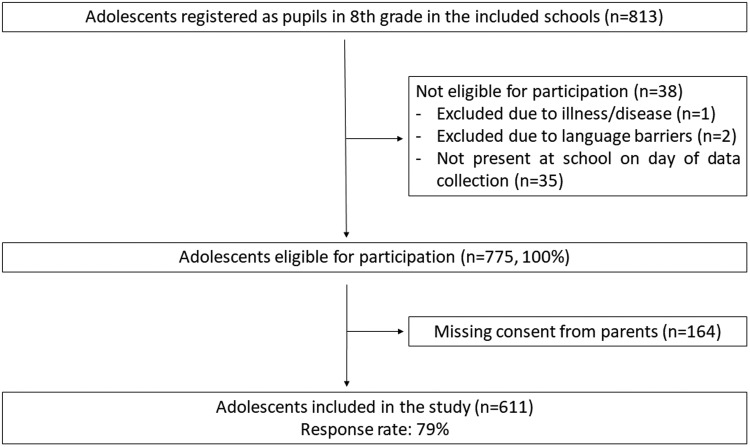
A total of 611 eighth grade pupils (response rate: 79%) participated in this cross-sectional study. The variables measured were physical activity (accelerometer), cardiorespiratory fitness (Andersen test) and a questionnaire assessing dietary habits, sleep disturbance, resilience (Resilience Scale for Adolescents) and HRQoL (KIDSCREEN-27).
A total of 36% of the sample met the official recommendations of 60 minutes of daily physical activity. Univariate analysis identified physical activity, dietary habits, sleep disturbances, body mass index (BMI), cardiorespiratory fitness and resilience, but not sedentary time, as predictors of HRQoL. Multivariate regression analysis identified resilience as a positive predictor (β 0.18 to 0.27) of all HRQoL domains and sleep disturbance as a negative predictor (β −0.65 to −0.24) of four HRQoL domains. BMI (β = −0.27) and cardiorespiratory fitness (β = 0.021) were predictors of the HRQoL domain physical well-being. Adherence to dietary recommendations was both a positive and a negative predictor of HRQoL (β −0.45 to 0.59).
Resilience and sleep disturbances were the main predictors of HRQoL.
在青少年早期样本中检验与生活方式相关的因素和心理弹性是否能预测健康相关生活质量(HRQoL)。
共有611名八年级学生(应答率:79%)参与了这项横断面研究。所测量的变量包括身体活动(加速度计)、心肺适能(安德森测试)以及一份评估饮食习惯、睡眠障碍、心理弹性(青少年心理弹性量表)和HRQoL(儿童生活质量量表-27)的问卷。
共有36%的样本达到了每日60分钟身体活动的官方建议。单因素分析确定身体活动、饮食习惯、睡眠障碍、体重指数(BMI)、心肺适能和心理弹性为HRQoL的预测因素,但久坐时间不是。多因素回归分析确定心理弹性是所有HRQoL领域的正向预测因素(β为0.18至0.27),睡眠障碍是四个HRQoL领域的负向预测因素(β为-0.65至-0.24)。BMI(β = -0.27)和心肺适能(β = 0.021)是HRQoL领域身体健康的预测因素。遵守饮食建议既是HRQoL的正向预测因素,也是负向预测因素(β为-0.45至0.59)。
心理弹性和睡眠障碍是HRQoL的主要预测因素。