Medical Imaging Center, The First Affiliated Hospital of Jinan University, Guangzhou, 510630, China.
Beijing Advanced Innovation Center for Big Data-Based Precision Medicine, School of Medicine, Beihang University, Beijing, 100191, China.
Theranostics. 2020 Jan 16;10(5):2284-2292. doi: 10.7150/thno.37429. eCollection 2020.
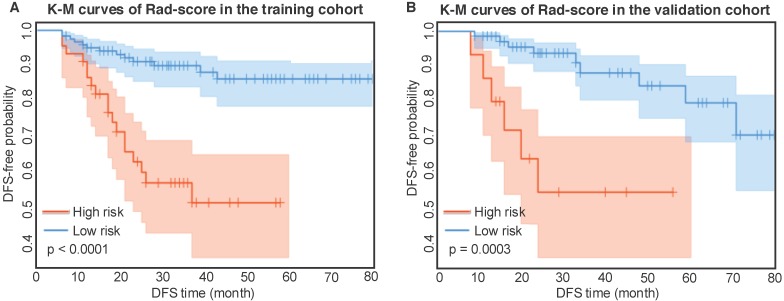
Pre-treatment survival prediction plays a key role in many diseases. We aimed to determine the prognostic value of pre-treatment Magnetic Resonance Imaging (MRI) based radiomic score for disease-free survival (DFS) in patients with early-stage (IB-IIA) cervical cancer. A total of 248 patients with early-stage cervical cancer underwent radical hysterectomy were included from two institutions between January 1, 2011 and December 31, 2017, whose MR imaging data, clinicopathological data and DFS data were collected. Patients data were randomly divided into the training cohort (n = 166) and the validation cohort (n=82). Radiomic features were extracted from the pre-treatment T2-weighted (T2w) and contrast-enhanced T1-weighted (CET1w) MR imagings for each patient. Least absolute shrinkage and selection operator (LASSO) regression and Cox proportional hazard model were applied to construct radiomic score (Rad-score). According to the cutoff of Rad-score, patients were divided into low- and high- risk groups. Pearson's correlation and Kaplan-Meier analysis were used to evaluate the association of Rad-score with DFS. A combined model incorporating Rad-score, lymph node metastasis (LNM) and lymphovascular space invasion (LVI) by multivariate Cox proportional hazard model was constructed to estimate DFS individually. Higher Rad-scores were significantly associated with worse DFS in the training and validation cohorts (<0.001 and =0.011, respectively). The Rad-score demonstrated better prognostic performance in estimating DFS (C-index, 0.753; 95% CI: 0.696-0.805) than the clinicopathological features (C-index, 0.632; 95% CI: 0.567-0.700). However, the combined model showed no significant improvement (C-index, 0.714; 95%CI: 0.642-0.784). The results demonstrated that MRI-derived Rad-score can be used as a prognostic biomarker for patients with early-stage (IB-IIA) cervical cancer, which can facilitate clinical decision-making.
治疗前生存预测在许多疾病中起着关键作用。我们旨在确定早期(IB-IIA)宫颈癌患者治疗前磁共振成像(MRI)基于放射组学评分对无病生存(DFS)的预后价值。
从 2011 年 1 月 1 日至 2017 年 12 月 31 日,来自两个机构的 248 名接受根治性子宫切除术的早期宫颈癌患者纳入研究,收集了 MRI 数据、临床病理数据和 DFS 数据。患者数据被随机分为训练队列(n=166)和验证队列(n=82)。从每位患者的治疗前 T2 加权(T2w)和对比增强 T1 加权(CET1w)MRI 中提取放射组学特征。应用最小绝对收缩和选择算子(LASSO)回归和 Cox 比例风险模型构建放射组学评分(Rad-score)。根据 Rad-score 的截断值,患者分为低风险组和高风险组。Pearson 相关性和 Kaplan-Meier 分析用于评估 Rad-score 与 DFS 的相关性。通过多变量 Cox 比例风险模型构建了包含 Rad-score、淋巴结转移(LNM)和脉管间隙浸润(LVI)的联合模型,分别估计 DFS。
在训练和验证队列中,较高的 Rad-score 与较差的 DFS 显著相关(<0.001 和=0.011)。Rad-score 在估计 DFS 方面的预后性能优于临床病理特征(C 指数,0.753;95%CI:0.696-0.805)(C 指数,0.632;95%CI:0.567-0.700)。然而,联合模型并没有显著改善(C 指数,0.714;95%CI:0.642-0.784)。结果表明,MRI 衍生的 Rad-score 可作为早期(IB-IIA)宫颈癌患者的预后生物标志物,有助于临床决策。