Nadeem Muhammad Waqas, Ghamdi Mohammed A Al, Hussain Muzammil, Khan Muhammad Adnan, Khan Khalid Masood, Almotiri Sultan H, Butt Suhail Ashfaq
Department of Computer Science, Lahore Garrison University, Lahore 54000, Pakistan.
Department of Computer Science, School of Systems and Technology, University of Management and Technology, Lahore 54000, Pakistan.
Brain Sci. 2020 Feb 22;10(2):118. doi: 10.3390/brainsci10020118.
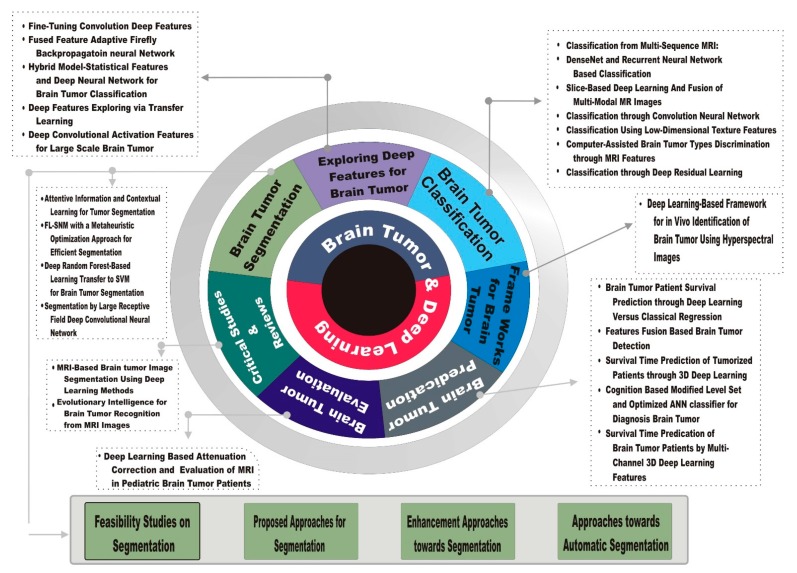
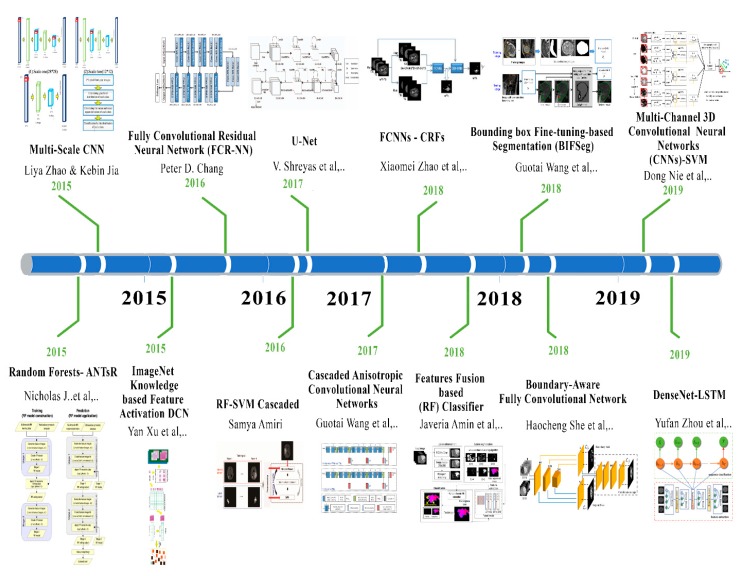
Deep Learning (DL) algorithms enabled computational models consist of multiple processing layers that represent data with multiple levels of abstraction. In recent years, usage of deep learning is rapidly proliferating in almost every domain, especially in medical image processing, medical image analysis, and bioinformatics. Consequently, deep learning has dramatically changed and improved the means of recognition, prediction, and diagnosis effectively in numerous areas of healthcare such as pathology, brain tumor, lung cancer, abdomen, cardiac, and retina. Considering the wide range of applications of deep learning, the objective of this article is to review major deep learning concepts pertinent to brain tumor analysis (e.g., segmentation, classification, prediction, evaluation.). A review conducted by summarizing a large number of scientific contributions to the field (i.e., deep learning in brain tumor analysis) is presented in this study. A coherent taxonomy of research landscape from the literature has also been mapped, and the major aspects of this emerging field have been discussed and analyzed. A critical discussion section to show the limitations of deep learning techniques has been included at the end to elaborate open research challenges and directions for future work in this emergent area.
深度学习(DL)算法使计算模型由多个处理层组成,这些处理层以多个抽象级别表示数据。近年来,深度学习的应用几乎在每个领域都迅速扩散,尤其是在医学图像处理、医学图像分析和生物信息学领域。因此,深度学习在病理学、脑肿瘤、肺癌、腹部、心脏和视网膜等众多医疗保健领域有效地显著改变并改进了识别、预测和诊断方法。考虑到深度学习的广泛应用,本文的目的是回顾与脑肿瘤分析相关的主要深度学习概念(例如,分割、分类、预测、评估)。本研究通过总结该领域(即脑肿瘤分析中的深度学习)的大量科学贡献进行了综述。还绘制了文献中研究领域的连贯分类法,并对这一新兴领域的主要方面进行了讨论和分析。最后包括一个批判性讨论部分,以展示深度学习技术的局限性,阐述这一新兴领域的开放研究挑战和未来工作方向。