Chen Tong, Chen Haishan, Xiao Hua, Tang Hongjuan, Xiang Zhicong, Wang Xin, Wang Xuan, Zou Hequn
Department of Nephrology, The Third Affiliated Hospital, Southern Medical University, Guangzhou 510630, People's Republic of China.
Diabetes Metab Syndr Obes. 2020 Feb 28;13:597-605. doi: 10.2147/DMSO.S238990. eCollection 2020.
This study aimed to determine the optimal cutoff values and evaluate the associations of neutrophil to high-density lipoprotein cholesterol ratio (NHR) and lymphocyte to high-density lipoprotein cholesterol ratio (LHR) with metabolic syndrome (MetS), stratified by sex.
A large-scale cross-sectional survey was conducted among 1401 adults from January to April 2018 in six communities in Wanzhai Town, Zhuhai City, on the southern coast of China. Receiver operating characteristics (ROC) analyses and logistic regression analysis were conducted to assess the optimal cutoff and value of NHR and LHR for predicting MetS.
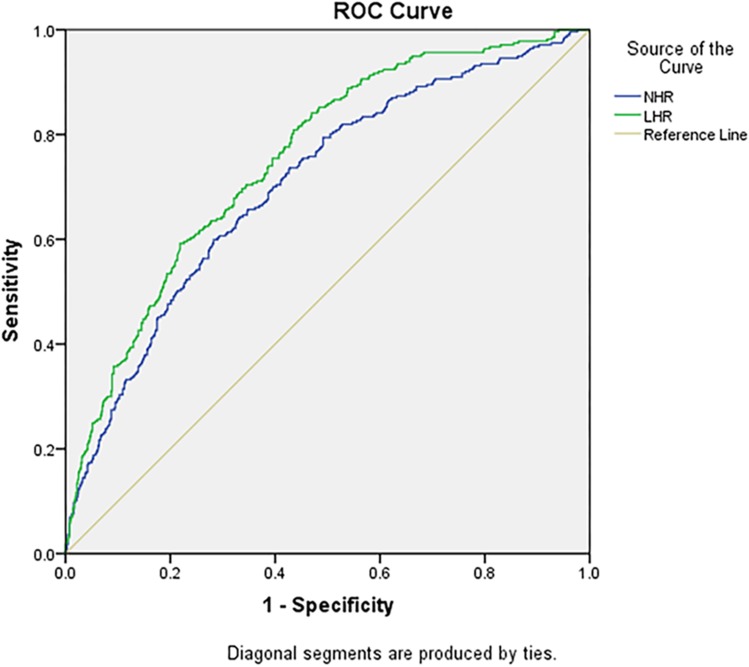
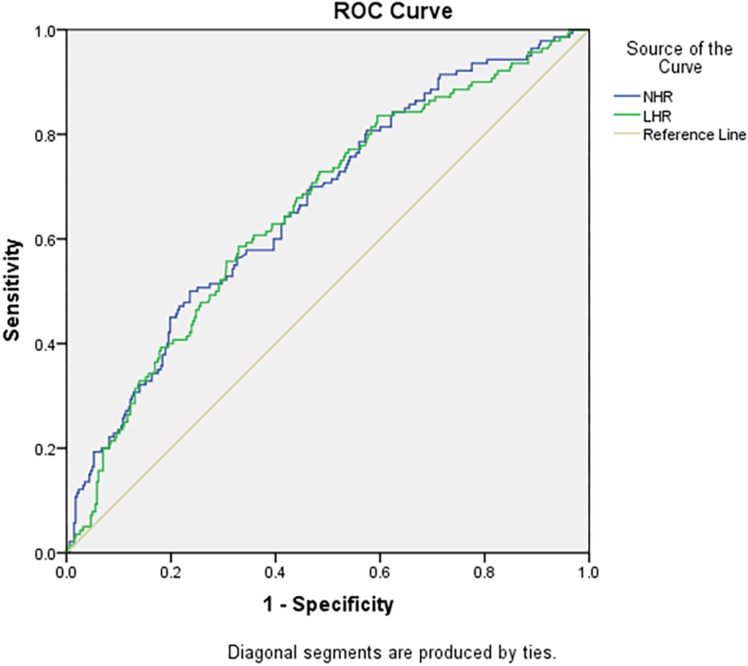
Hematological parameters showed the correlation with the occurrence of MetS (red blood cells, hemoglobin, and white blood cells and subtypes). Binomial logistic regression analysis found that LHR (OR: 3.671; 95% CI: 2.385-5.651; <0.001) and NHR (OR: 1.728; 95% CI: 1.353-2.207; <0.001) can predict MetS in females, independent of confounding factors. Although LHR (OR: 1.571; 95% CI: 1.001-2.468; =0.05) and NHR (OR: 1.163; 95% CI: 0.909-1.48; <0.01) were independent risk factors for MetS in males after adjustment for age, current smoking, current alcohol use, physical activity, educational attainment, waist circumference, systolic pressure, diastolic pressure and hypersensitive C-reactive protein (hs-CRP), when further adjusted for fasting plasma glucose level, LHR and NHR, both lost their independence. ROC curves showed that LHR had the highest AUC for predicting MetS in females and NHR had the highest AUC in males. The cutoff points of LHR and NHR were 1.36 and 2.31 in females, and 1.96 and 3.38 in males.
LHR and NHR may become valuable makers and have strong predictive power for predicting MetS, especially in females.
本研究旨在确定最佳截断值,并按性别分层评估中性粒细胞与高密度脂蛋白胆固醇比值(NHR)和淋巴细胞与高密度脂蛋白胆固醇比值(LHR)与代谢综合征(MetS)的相关性。
2018年1月至4月,在中国南部沿海珠海市湾仔镇的六个社区对1401名成年人进行了大规模横断面调查。采用受试者工作特征(ROC)分析和逻辑回归分析来评估NHR和LHR预测MetS的最佳截断值。
血液学参数与MetS的发生相关(红细胞、血红蛋白、白细胞及其亚型)。二项逻辑回归分析发现,LHR(比值比:3.671;95%置信区间:2.385 - 5.651;<0.001)和NHR(比值比:1.728;95%置信区间:1.353 - 2.207;<0.001)可独立于混杂因素预测女性的MetS。尽管在调整年龄、当前吸烟、当前饮酒、体育活动、教育程度、腰围、收缩压、舒张压和超敏C反应蛋白(hs-CRP)后,LHR(比值比:1.571;95%置信区间:1.001 - 2.468;=0.05)和NHR(比值比:1.163;95%置信区间:0.909 - 1.48;<0.01)是男性MetS的独立危险因素,但在进一步调整空腹血糖水平后,LHR和NHR均失去其独立性。ROC曲线显示,LHR预测女性MetS的曲线下面积(AUC)最高,NHR预测男性MetS的AUC最高。女性LHR和NHR的截断点分别为1.36和2.31,男性为1.96和3.38。
LHR和NHR可能成为有价值的指标,对预测MetS具有较强的预测能力,尤其是在女性中。