WHO Collaborating Centre for Healthy Urban Environments, UWE Bristol, Coldharbour Ln, Stoke Gifford, Bristol BS16 1QY, United Kingdom of Great Britain and Northern Ireland.
Birmingham Energy Institute at University of Birmingham, Edgbaston, Birmingham B15 2TT, United Kingdom of Great Britain and Northern Ireland.
Sci Total Environ. 2020 Jun 1;719:137146. doi: 10.1016/j.scitotenv.2020.137146. Epub 2020 Feb 5.
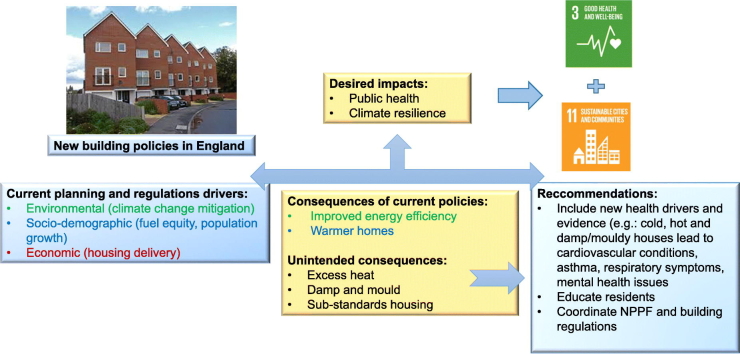
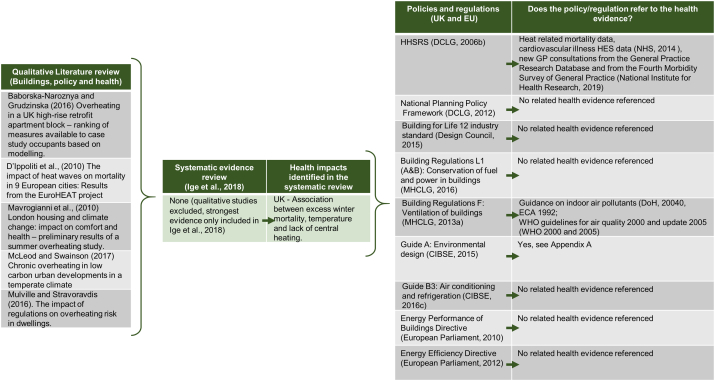
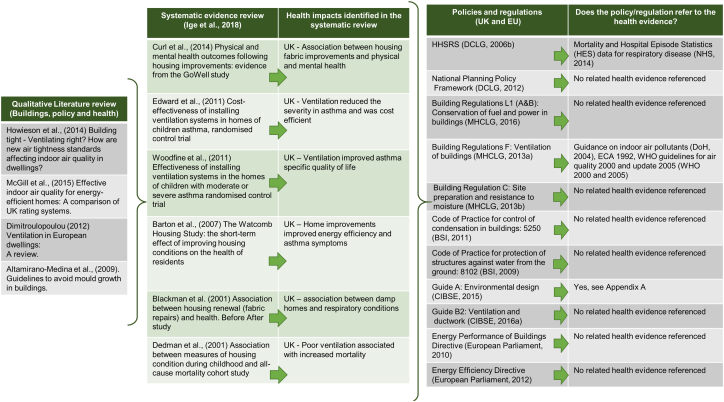
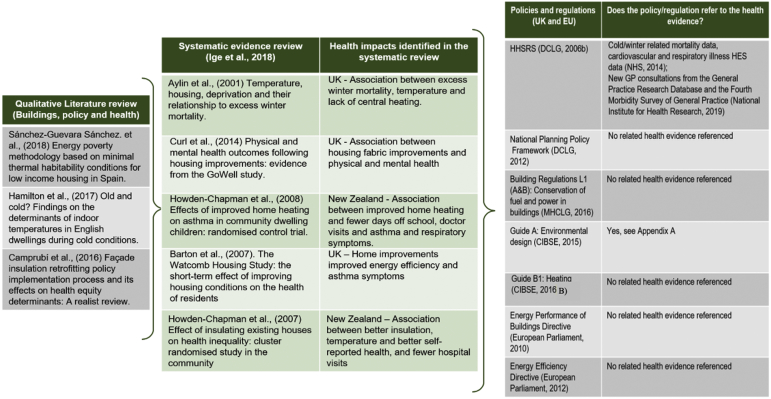
Research has demonstrated that housing quality is a key urban intervention in reducing health risks and improving climate resilience, addressing a key ambition of the United Nations Sustainable Development Goals. Yet housing quality remains a problem even in high income countries such as England. In particular, hazards such as excess cold, excess heat and lack of ventilation leading to damp and mould have been identified as a major issue in homes. Research shows that these hazards can lead to a range of health conditions, such as respiratory and cardiovascular disease, infections and mental health problems. This article explores the use of public health research and evidence in policy to regulate new buildings in England to deliver improved public health, climate resilience and a reduced carbon footprint, in particular exploring the policy drivers and awareness of the public health evidence. Findings show that public health evidence is hardly referenced in policy and that the focus on other evidence bases such as on climate mitigation in building regulations results in both positive and negative impacts on health. This reflects a lack of a systems approach around urban interventions leading to weaknesses in standards regulating the private development sector. In conclusion, this paper recommends: 1. the consideration of health impact in future building regulations; 2. the integration and coordination of key policies covering various scales and phases of the development processes and 3. the better education of residents to understand advances in new energy performance technologies.
研究表明,住房质量是减少健康风险和提高气候适应能力的关键城市干预措施,这也是联合国可持续发展目标的一个主要目标。然而,即使在像英国这样的高收入国家,住房质量仍然是一个问题。特别是,诸如过度寒冷、过度炎热和通风不良导致潮湿和发霉等危害已被确定为家庭中的一个主要问题。研究表明,这些危害会导致一系列健康问题,如呼吸道和心血管疾病、感染和心理健康问题。本文探讨了在英格兰,利用公共卫生研究和证据来规范新建筑,以改善公共卫生、气候适应能力和减少碳足迹,特别是探索政策驱动因素和对公共卫生证据的认识。研究结果表明,公共卫生证据在政策中几乎没有被提及,而建筑法规中对气候缓解等其他证据基础的关注,对健康产生了积极和消极的影响。这反映了在城市干预措施方面缺乏系统方法,导致规范私营发展部门的标准存在弱点。总之,本文建议:1. 在未来的建筑法规中考虑健康影响;2. 整合和协调涵盖发展过程各个规模和阶段的关键政策;3. 更好地教育居民,了解新能源性能技术的进步。