• 文献检索
  • 文档翻译
  • 深度研究
  • 学术资讯
  • Suppr Zotero 插件Zotero 插件
  • 邀请有礼
  • 套餐&价格
  • 历史记录
应用&插件
Suppr Zotero 插件Zotero 插件浏览器插件Mac 客户端Windows 客户端微信小程序
定价
高级版会员购买积分包购买API积分包
服务
文献检索文档翻译深度研究API 文档MCP 服务
关于我们
关于 Suppr公司介绍联系我们用户协议隐私条款
关注我们

Suppr 超能文献

核心技术专利:CN118964589B侵权必究
粤ICP备2023148730 号-1Suppr @ 2026

文献检索

告别复杂PubMed语法,用中文像聊天一样搜索,搜遍4000万医学文献。AI智能推荐,让科研检索更轻松。

立即免费搜索

文件翻译

保留排版,准确专业,支持PDF/Word/PPT等文件格式,支持 12+语言互译。

免费翻译文档

深度研究

AI帮你快速写综述,25分钟生成高质量综述,智能提取关键信息,辅助科研写作。

立即免费体验

采用下一代测序技术检测绒毛膜羊膜炎患者母血和脐血中游离微生物 DNA。

Detection of microbial cell-free DNA in maternal and umbilical cord plasma in patients with chorioamnionitis using next generation sequencing.

机构信息

Eli and Edythe Broad Center of Regeneration Medicine, University of California, San Francisco, California, United States of America.

Department of Surgery, University of California, San Francisco, California, United States of America.

出版信息

PLoS One. 2020 Apr 15;15(4):e0231239. doi: 10.1371/journal.pone.0231239. eCollection 2020.

DOI:10.1371/journal.pone.0231239
PMID:32294121
原文链接:https://pmc.ncbi.nlm.nih.gov/articles/PMC7159194/
Abstract

BACKGROUND

Chorioamnionitis has been linked to spontaneous preterm labor and complications such as neonatal sepsis. We hypothesized that microbial cell-free (cf) DNA would be detectable in maternal plasma in patients with chorioamnionitis and could be the basis for a non-invasive method to detect fetal exposure to microorganisms.

OBJECTIVE

The purpose of this study was to determine whether next generation sequencing could detect microbial cfDNA in maternal plasma in patients with chorioamnionitis.

STUDY DESIGN

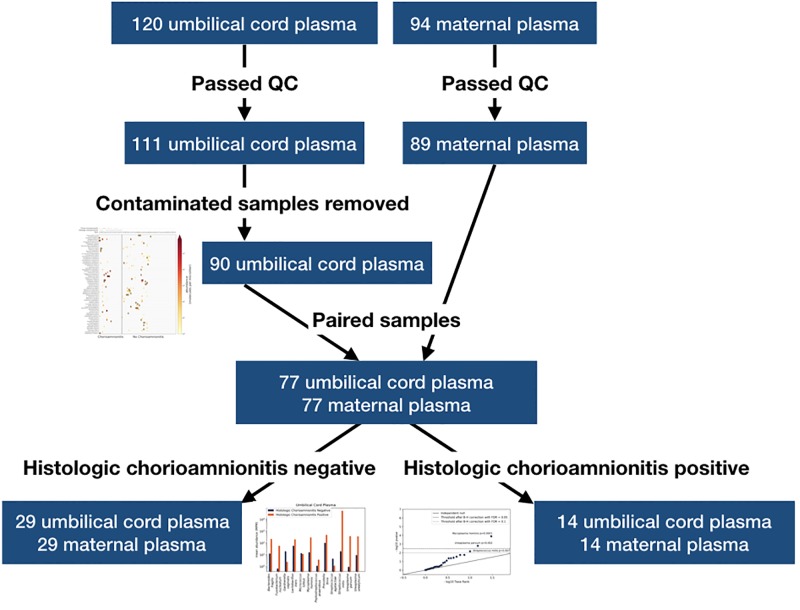
Maternal plasma (n = 94) and umbilical cord plasma (n = 120) were collected during delivery at gestational age 28-41 weeks. cfDNA was extracted and sequenced. Umbilical cord plasma samples with evidence of contamination were excluded. The prevalence of microorganisms previously implicated in choriomanionitis, neonatal sepsis and intra-amniotic infections, as described in the literature, were examined to determine if there was enrichment of these microorganisms in this cohort. Specific microbial cfDNA associated with chorioamnionitis was first detected in umbilical cord plasma and confirmed in the matched maternal plasma samples (n = 77 matched pairs) among 14 cases of histologically confirmed chorioamnionitis and one case of clinical chorioamnionitis; 63 paired samples were used as controls. A correlation of rank of a given microorganism across maternal plasma and matched umbilical cord plasma was used to assess whether signals found in umbilical cord plasma were also present in maternal plasma.

RESULTS

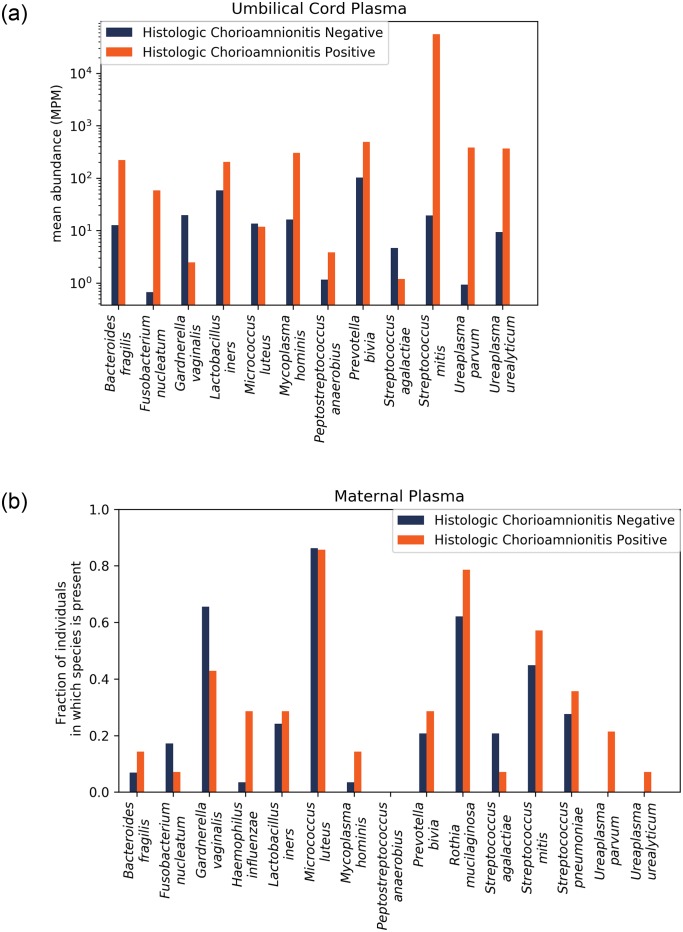
Microbial DNA sequences associated with clinical and/or histological chorioamnionitis were enriched in maternal plasma in cases with suspected chorioamnionitis when compared to controls (12/14 microorganisms, p = 0.02). Analysis of the microbial cfDNA in umbilical cord plasma among the 1,251 microorganisms detectable with this assay identified Streptococcus mitis, Ureaplasma spp., and Mycoplasma spp. in cases of suspected chorioamnionitis. This assay also detected cfDNA from Lactobacillus spp. in controls. Comparison between maternal plasma and umbilical cord plasma confirmed these signatures were also present in maternal plasma. Unbiased analysis of microorganisms with significantly correlated signal between matched maternal plasma and umbilical cord plasma identified the above listed 3 microorganisms, all of which have previously been implicated in patients with chorioamnionitis (Mycoplasma hominis p = 0.0001; Ureaplasma parvum p = 0.002; Streptococcus mitis p = 0.007). These data show that the pathogen signal relevant for chorioamnionitis can be identified in both maternal and umbilical cord plasma.

CONCLUSION

This is the first report showing the detection of relevant microbial cell-free cfDNA in maternal plasma and umbilical cord plasma in patients with clinical and/or histological chorioamnionitis. These results may lead to the development of a specific assay to detect perinatal infections for targeted therapy to reduce early neonatal sepsis complications.

摘要

背景

绒毛膜羊膜炎与自发性早产和新生儿败血症等并发症有关。我们假设在患有绒毛膜羊膜炎的患者的母体外周血中可以检测到微生物无细胞(cf)DNA,并且可以作为一种非侵入性方法来检测胎儿暴露于微生物。

目的

本研究旨在确定下一代测序是否可以检测到患有绒毛膜羊膜炎的患者的母体外周血中的微生物 cfDNA。

研究设计

在 28-41 孕周分娩时采集母体外周血(n = 94)和脐静脉血(n = 120)。提取和测序 cfDNA。排除有污染证据的脐静脉血样本。检查了以前文献中描述的与绒毛膜羊膜炎、新生儿败血症和羊膜内感染有关的微生物的流行情况,以确定在该队列中是否存在这些微生物的富集。在 14 例组织学证实的绒毛膜羊膜炎和 1 例临床绒毛膜羊膜炎病例中,首先在脐静脉血中检测到与绒毛膜羊膜炎相关的特定微生物 cfDNA,并在 77 对匹配的母体外周血样本中得到证实(n = 77 对匹配);63 对配对样本用作对照。使用给定微生物在母体外周血和匹配的脐静脉血中的等级的相关性来评估在脐静脉血中发现的信号是否也存在于母体外周血中。

结果

与对照组相比,在疑似绒毛膜羊膜炎的病例中,与临床和/或组织学绒毛膜羊膜炎相关的微生物 DNA 序列在母体外周血中富集(14 例中的 12 种微生物,p = 0.02)。对可通过该检测方法检测到的 1251 种微生物的脐静脉血浆中的微生物 cfDNA 进行分析,在疑似绒毛膜羊膜炎病例中鉴定出缓症链球菌、解脲脲原体和支原体。该检测还在对照组中检测到乳酸杆菌 cfDNA。母体外周血和脐静脉血之间的比较证实这些特征也存在于母体外周血中。对匹配的母体外周血和脐静脉血之间信号具有显著相关性的微生物进行无偏分析,确定了上述列出的 3 种微生物,所有这些微生物以前都与绒毛膜羊膜炎患者有关(解脲脲原体 p = 0.0001;微小脲原体 p = 0.002;缓症链球菌 p = 0.007)。这些数据表明,与绒毛膜羊膜炎相关的病原体信号可以在母体外周血和脐静脉血中识别。

结论

这是第一个报道在患有临床和/或组织学绒毛膜羊膜炎的患者的母体外周血和脐静脉血中检测到相关微生物无细胞(cf)DNA 的报告。这些结果可能导致开发一种特定的检测方法来检测围产期感染,以进行靶向治疗,从而减少新生儿早期败血症的并发症。
https://cdn.ncbi.nlm.nih.gov/pmc/blobs/0afb/7159194/194add567d41/pone.0231239.g004.jpg
https://cdn.ncbi.nlm.nih.gov/pmc/blobs/0afb/7159194/2fdbe53d6a99/pone.0231239.g001.jpg
https://cdn.ncbi.nlm.nih.gov/pmc/blobs/0afb/7159194/79706802dc53/pone.0231239.g002.jpg
https://cdn.ncbi.nlm.nih.gov/pmc/blobs/0afb/7159194/f0a1f5384b0a/pone.0231239.g003.jpg
https://cdn.ncbi.nlm.nih.gov/pmc/blobs/0afb/7159194/194add567d41/pone.0231239.g004.jpg
https://cdn.ncbi.nlm.nih.gov/pmc/blobs/0afb/7159194/2fdbe53d6a99/pone.0231239.g001.jpg
https://cdn.ncbi.nlm.nih.gov/pmc/blobs/0afb/7159194/79706802dc53/pone.0231239.g002.jpg
https://cdn.ncbi.nlm.nih.gov/pmc/blobs/0afb/7159194/f0a1f5384b0a/pone.0231239.g003.jpg
https://cdn.ncbi.nlm.nih.gov/pmc/blobs/0afb/7159194/194add567d41/pone.0231239.g004.jpg

相似文献

1
Detection of microbial cell-free DNA in maternal and umbilical cord plasma in patients with chorioamnionitis using next generation sequencing.采用下一代测序技术检测绒毛膜羊膜炎患者母血和脐血中游离微生物 DNA。
PLoS One. 2020 Apr 15;15(4):e0231239. doi: 10.1371/journal.pone.0231239. eCollection 2020.
2
Next-generation sequencing-based detection of in the gastric fluid of neonates with respiratory distress and chorioamnionitis.基于下一代测序的胃抽吸物中 检测在有呼吸窘迫和绒毛膜羊膜炎的新生儿中的应用。
J Matern Fetal Neonatal Med. 2023 Dec;36(1):2207113. doi: 10.1080/14767058.2023.2207113.
3
Clinical chorioamnionitis at term V: umbilical cord plasma cytokine profile in the context of a systemic maternal inflammatory response.足月临床绒毛膜羊膜炎V:全身性母体炎症反应背景下的脐带血浆细胞因子谱
J Perinat Med. 2016 Jan;44(1):53-76. doi: 10.1515/jpm-2015-0121.
4
Clinical chorioamnionitis at term: definition, pathogenesis, microbiology, diagnosis, and treatment.足月临床绒毛膜羊膜炎:定义、发病机制、微生物学、诊断和治疗。
Am J Obstet Gynecol. 2024 Mar;230(3S):S807-S840. doi: 10.1016/j.ajog.2023.02.002. Epub 2023 Mar 21.
5
Impact of microbial invasion of amniotic cavity and the type of microorganisms on short-term neonatal outcome in women with preterm labor and intact membranes.胎膜完整的早产女性羊膜腔微生物入侵及微生物类型对新生儿短期结局的影响
Acta Obstet Gynecol Scand. 2017 May;96(5):570-579. doi: 10.1111/aogs.13095. Epub 2017 Feb 23.
6
Clinical chorioamnionitis at term X: microbiology, clinical signs, placental pathology, and neonatal bacteremia - implications for clinical care.足月临床绒毛膜羊膜炎 X:微生物学、临床征象、胎盘病理学和新生儿菌血症-对临床护理的影响。
J Perinat Med. 2021 Jan 26;49(3):275-298. doi: 10.1515/jpm-2020-0297. Print 2021 Mar 26.
7
The common vaginal commensal bacterium Ureaplasma parvum is associated with chorioamnionitis in extreme preterm labor.常见的阴道共生细菌微小脲原体与极早早产时的绒毛膜羊膜炎有关。
J Matern Fetal Neonatal Med. 2016 Nov;29(22):3646-51. doi: 10.3109/14767058.2016.1140734. Epub 2016 Feb 26.
8
The natural interleukin-1 receptor antagonist in the fetal, maternal, and amniotic fluid compartments: the effect of gestational age, fetal gender, and intrauterine infection.胎儿、母体及羊水腔室中的天然白细胞介素-1受体拮抗剂:胎龄、胎儿性别及宫内感染的影响。
Am J Obstet Gynecol. 1994 Oct;171(4):912-21. doi: 10.1016/s0002-9378(94)70058-3.
9
Ureaplasma urealyticum and Mycoplasma hominis presence in umbilical cord is associated with pathogenesis of funisitis.解脲脲原体和人型支原体在脐带中的存在与脐带炎的发病机制有关。
Kobe J Med Sci. 2007;53(5):241-9.
10
The relationship among the progression of inflammation in umbilical cord, fetal inflammatory response, early-onset neonatal sepsis, and chorioamnionitis.脐带炎症进展、胎儿炎症反应、早发型新生儿败血症和绒毛膜羊膜炎之间的关系。
PLoS One. 2019 Nov 19;14(11):e0225328. doi: 10.1371/journal.pone.0225328. eCollection 2019.

引用本文的文献

1
prosthetic valve infective endocarditis and endophthalmitis in a renal transplant recipient: a case report.肾移植受者人工瓣膜感染性心内膜炎和眼内炎:一例报告
Ther Adv Infect Dis. 2025 Jul 20;12:20499361251357405. doi: 10.1177/20499361251357405. eCollection 2025 Jan-Dec.
2
Identification of bacteriophage DNA in human umbilical cord blood.人脐带血中噬菌体DNA的鉴定
JCI Insight. 2025 Jul 8;10(13). doi: 10.1172/jci.insight.183123.
3
Prevalence of in pregnant women undergoing high-risk prenatal care at a maternal and child reference unit in Bahia, Brazil.

本文引用的文献

1
Community-acquired pneumonia in children: cell-free plasma sequencing for diagnosis and management.儿童社区获得性肺炎:无细胞血浆测序在诊断和管理中的应用。
Diagn Microbiol Infect Dis. 2019 Jun;94(2):188-191. doi: 10.1016/j.diagmicrobio.2018.12.016. Epub 2019 Feb 2.
2
Analytical and clinical validation of a microbial cell-free DNA sequencing test for infectious disease.微生物无细胞 DNA 测序检测用于感染性疾病的分析和临床验证。
Nat Microbiol. 2019 Apr;4(4):663-674. doi: 10.1038/s41564-018-0349-6. Epub 2019 Feb 11.
3
Liquid biopsy for infectious diseases: sequencing of cell-free plasma to detect pathogen DNA in patients with invasive fungal disease.
巴西巴伊亚州一家母婴转诊机构中接受高危产前护理的孕妇的患病率。
Epidemiol Infect. 2025 Jun 25;153:e73. doi: 10.1017/S0950268825100137.
4
Placental Molecular Expression of Different Pathogenic Vaginal Infections.不同致病性阴道感染的胎盘分子表达
Int J Mol Sci. 2025 Mar 21;26(7):2863. doi: 10.3390/ijms26072863.
5
Circulating Microbial Cell-Free DNA in Health and Disease.循环游离微生物 DNA 在健康与疾病中的作用。
Int J Mol Sci. 2023 Feb 3;24(3):3051. doi: 10.3390/ijms24033051.
6
The Role of Genital Mycoplasmas in Preterm Labor.生殖道支原体在早产中的作用。
J Reprod Infertil. 2022 Apr-Jun;23(2):114-119. doi: 10.18502/jri.v23i2.8996.
7
Gestational Age Dependence of the Maternal Circulating Long Non-Coding RNA Transcriptome During Normal Pregnancy Highlights Antisense and Pseudogene Transcripts.正常妊娠期间母体循环长链非编码RNA转录组的孕周依赖性突显了反义转录本和假基因转录本。
Front Genet. 2021 Nov 22;12:760849. doi: 10.3389/fgene.2021.760849. eCollection 2021.
8
Maternal and Infant Immune Repertoire Sequencing Analysis Identifies Distinct Ig and TCR Development in Term and Preterm Infants.母婴免疫文库测序分析鉴定足月和早产儿中独特的 Ig 和 TCR 发育。
J Immunol. 2021 Nov 15;207(10):2445-2455. doi: 10.4049/jimmunol.2100566. Epub 2021 Oct 15.
9
Pathophysiological and molecular considerations of viral and bacterial infections during maternal-fetal and -neonatal interactions of SARS-CoV-2, Zika, and Mycoplasma infectious diseases.SARS-CoV-2、寨卡病毒和支原体传染病在母胎和新生儿期相互作用期间的病毒和细菌感染的病理生理和分子考虑因素。
Biochim Biophys Acta Mol Basis Dis. 2022 Jan 1;1868(1):166285. doi: 10.1016/j.bbadis.2021.166285. Epub 2021 Oct 6.
10
A global point prevalence survey of antimicrobial use in neonatal intensive care units: The no-more-antibiotics and resistance (NO-MAS-R) study.新生儿重症监护病房抗菌药物使用全球现况调查:“无更多抗生素与耐药性”(NO-MAS-R)研究
EClinicalMedicine. 2021 Jan 29;32:100727. doi: 10.1016/j.eclinm.2021.100727. eCollection 2021 Feb.
用于传染病的液体活检:对无细胞血浆进行测序以检测侵袭性真菌病患者的病原体DNA。
Diagn Microbiol Infect Dis. 2018 Nov;92(3):210-213. doi: 10.1016/j.diagmicrobio.2018.06.009. Epub 2018 Jun 22.
4
Fusobacterium nucleatum and adverse pregnancy outcomes: Epidemiological and mechanistic evidence.具核梭杆菌与不良妊娠结局:流行病学及机制证据
Anaerobe. 2018 Apr;50:55-59. doi: 10.1016/j.anaerobe.2018.01.008. Epub 2018 Feb 2.
5
Microbiome profile of the amniotic fluid as a predictive biomarker of perinatal outcome.羊水微生物组特征作为围产结局的预测生物标志物。
Sci Rep. 2017 Sep 22;7(1):12171. doi: 10.1038/s41598-017-11699-8.
6
Twenty-four percent of patients with clinical chorioamnionitis in preterm gestations have no evidence of either culture-proven intraamniotic infection or intraamniotic inflammation.早产临床绒毛膜羊膜炎患者中有24%没有经培养证实的羊膜腔内感染或羊膜腔内炎症的证据。
Am J Obstet Gynecol. 2017 Jun;216(6):604.e1-604.e11. doi: 10.1016/j.ajog.2017.02.035. Epub 2017 Feb 28.
7
Blood-Based Analysis of Circulating Cell-Free DNA and Tumor Cells for Early Cancer Detection.基于血液的循环游离DNA和肿瘤细胞分析用于早期癌症检测
PLoS Med. 2016 Dec 27;13(12):e1002205. doi: 10.1371/journal.pmed.1002205. eCollection 2016 Dec.
8
The Human Ureaplasma Species as Causative Agents of Chorioamnionitis.人脲原体作为绒毛膜羊膜炎的病原体
Clin Microbiol Rev. 2016 Dec 14;30(1):349-379. doi: 10.1128/CMR.00091-16. Print 2017 Jan.
9
Origins, structures, and functions of circulating DNA in oncology.肿瘤学中循环DNA的起源、结构及功能
Cancer Metastasis Rev. 2016 Sep;35(3):347-76. doi: 10.1007/s10555-016-9629-x.
10
Revisiting the diagnostic criteria of clinical chorioamnionitis in preterm birth.重新审视早产时临床绒毛膜羊膜炎的诊断标准。
BJOG. 2017 Apr;124(5):775-783. doi: 10.1111/1471-0528.14176. Epub 2016 Jul 1.