Feng Xue, Tustison Nicholas J, Patel Sohil H, Meyer Craig H
Department of Biomedical Engineering, University of Virginia, Charlottesville, VA, United States.
Department of Radiology and Medical Imaging, University of Virginia, Charlottesville, VA, United States.
Front Comput Neurosci. 2020 Apr 8;14:25. doi: 10.3389/fncom.2020.00025. eCollection 2020.
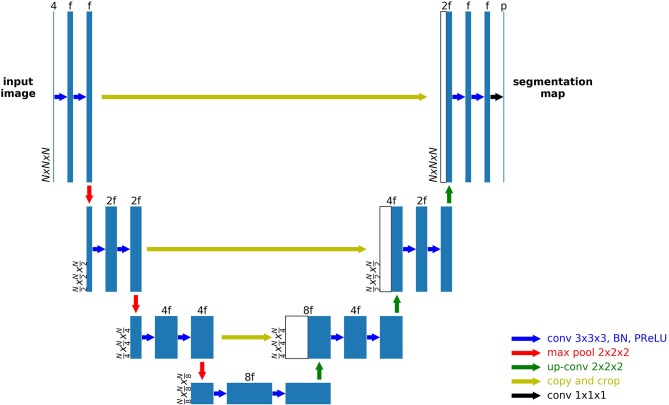
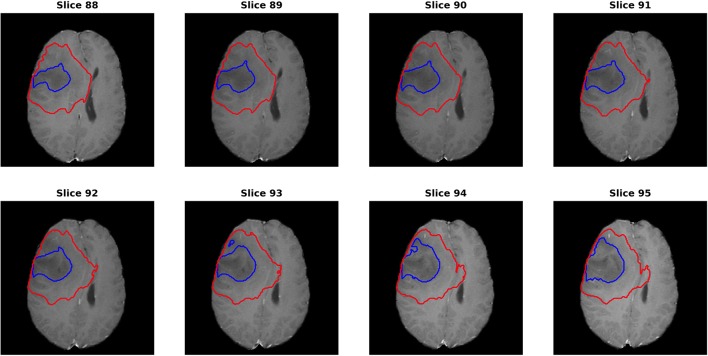
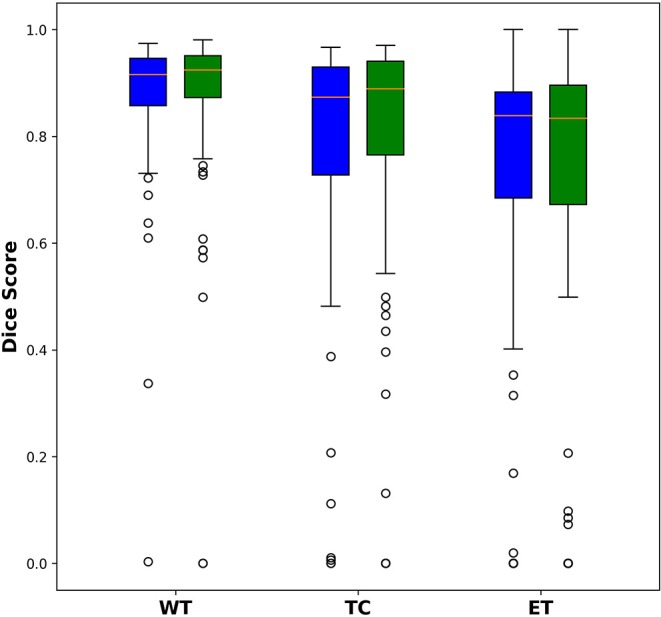
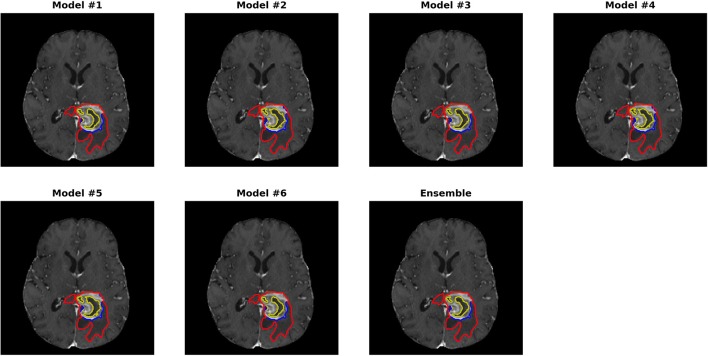
Accurate segmentation of different sub-regions of gliomas such as peritumoral edema, necrotic core, enhancing, and non-enhancing tumor core from multimodal MRI scans has important clinical relevance in diagnosis, prognosis and treatment of brain tumors. However, due to the highly heterogeneous appearance and shape of these tumors, segmentation of the sub-regions is challenging. Recent developments using deep learning models has proved its effectiveness in various semantic and medical image segmentation tasks, many of which are based on the U-Net network structure with symmetric encoding and decoding paths for end-to-end segmentation due to its high efficiency and good performance. In brain tumor segmentation, the 3D nature of multimodal MRI poses challenges such as memory and computation limitations and class imbalance when directly adopting the U-Net structure. In this study we aim to develop a deep learning model using a 3D U-Net with adaptations in the training and testing strategies, network structures, and model parameters for brain tumor segmentation. Furthermore, instead of picking one best model, an ensemble of multiple models trained with different hyper-parameters are used to reduce random errors from each model and yield improved performance. Preliminary results demonstrate the effectiveness of this method and achieved the 9th place in the very competitive 2018 Multimodal Brain Tumor Segmentation (BraTS) challenge. In addition, to emphasize the clinical value of the developed segmentation method, a linear model based on the radiomics features extracted from segmentation and other clinical features are developed to predict patient overall survival. Evaluation of these innovations shows high prediction accuracy in both low-grade glioma and glioblastoma patients, which achieved the 1st place in the 2018 BraTS challenge.
从多模态磁共振成像(MRI)扫描中准确分割胶质瘤的不同子区域,如瘤周水肿、坏死核心、强化和非强化肿瘤核心,在脑肿瘤的诊断、预后和治疗中具有重要的临床意义。然而,由于这些肿瘤的外观和形状高度异质性,子区域的分割具有挑战性。最近使用深度学习模型的进展已证明其在各种语义和医学图像分割任务中的有效性,其中许多基于具有对称编码和解码路径的U-Net网络结构进行端到端分割,因其效率高和性能好。在脑肿瘤分割中,多模态MRI的三维性质带来了诸如内存和计算限制以及直接采用U-Net结构时的类别不平衡等挑战。在本研究中,我们旨在开发一种深度学习模型,该模型使用3D U-Net,并在训练和测试策略、网络结构和模型参数方面进行调整以用于脑肿瘤分割。此外,不是选择一个最佳模型,而是使用由不同超参数训练的多个模型的集成来减少每个模型的随机误差并提高性能。初步结果证明了该方法的有效性,并在竞争激烈的2018年多模态脑肿瘤分割(BraTS)挑战赛中获得了第9名。此外,为了强调所开发分割方法的临床价值,基于从分割中提取的放射组学特征和其他临床特征开发了一种线性模型来预测患者的总生存期。对这些创新的评估显示,在低级别胶质瘤和胶质母细胞瘤患者中均具有较高的预测准确性,这在2018年BraTS挑战赛中获得了第1名。