Department of Radiology, Henan Provincial People's Hospital & Imaging Diagnosis of Neurological Diseases and Research Laboratory of Henan Province & People's Hospital of Zhengzhou University, Henan, China, 450003.
Department of Hematology, Henan Provincial People's Hospital & People's Hospital of Zhengzhou University, Henan, China, 450003.
Br J Radiol. 2020 Jul;93(1111):20191019. doi: 10.1259/bjr.20191019. Epub 2020 May 27.
To establish a radiomics nomogram by integrating clinical risk factors and radiomics features extracted from digital mammography (MG) images for pre-operative prediction of axillary lymph node (ALN) metastasis in breast cancer.
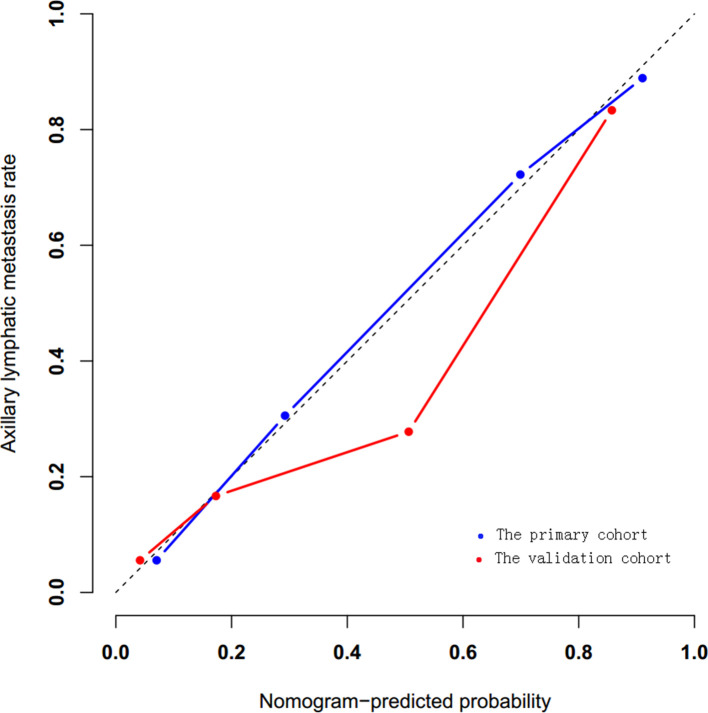
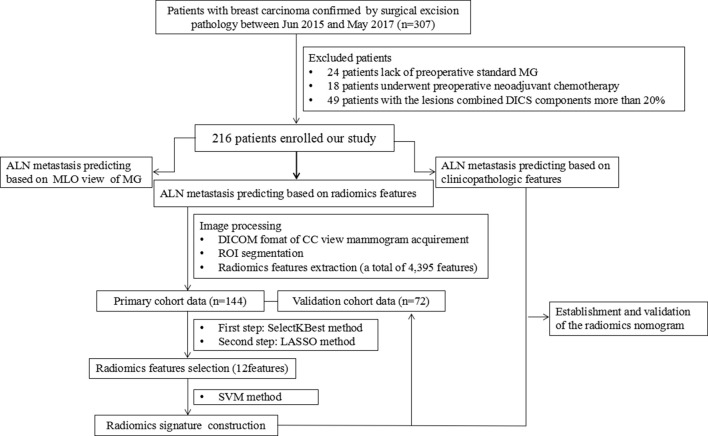
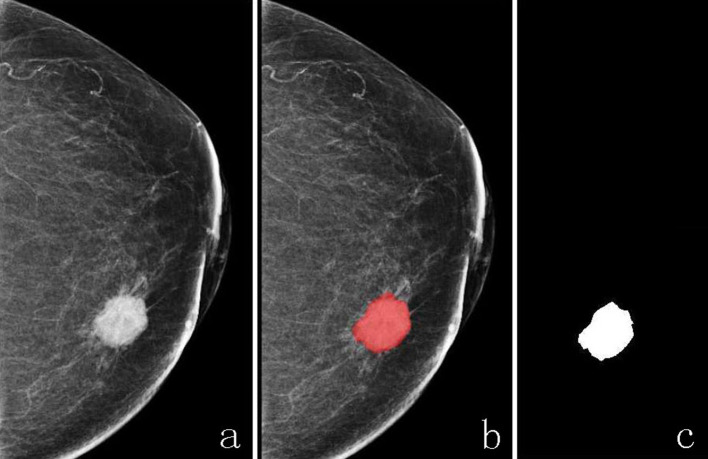
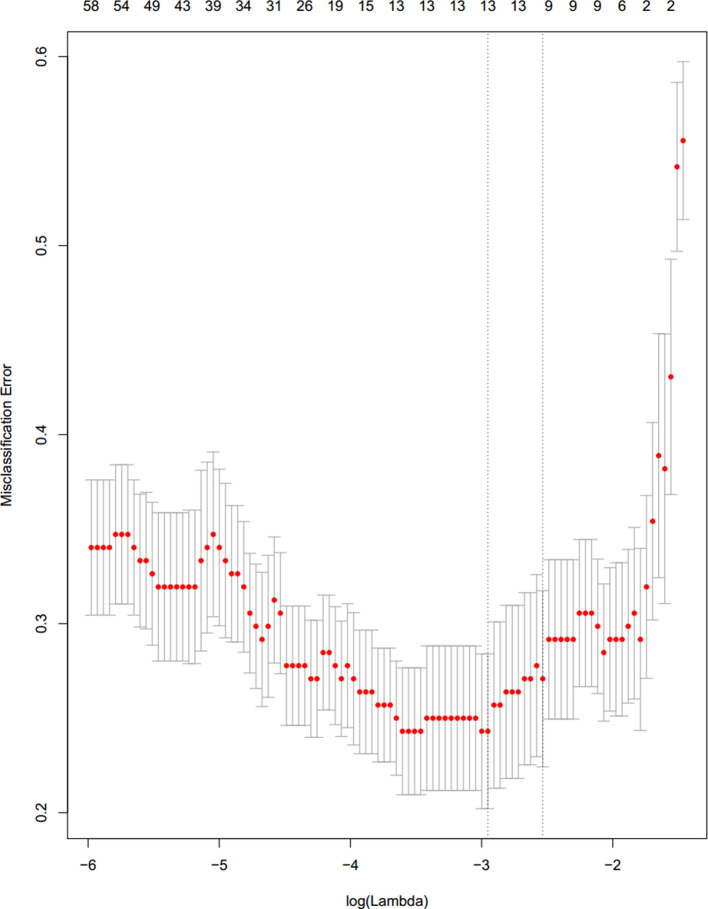
216 patients with breast cancer lesions confirmed by surgical excision pathology were divided into the primary cohort ( = 144) and validation cohort ( = 72). Radiomics features were extracted from craniocaudal (CC) view of mammograms, and radiomics features selection were performed using the methods of ANOVA F-value and least absolute shrinkage and selection operator; then a radiomics signature was constructed with the method of support vector machine. Multivariate logistic regression analysis was used to establish a radiomics nomogram based on the combination of radiomics signature and clinical factors. The C-index and calibration curves were derived based on the regression analysis both in the primary and validation cohorts.
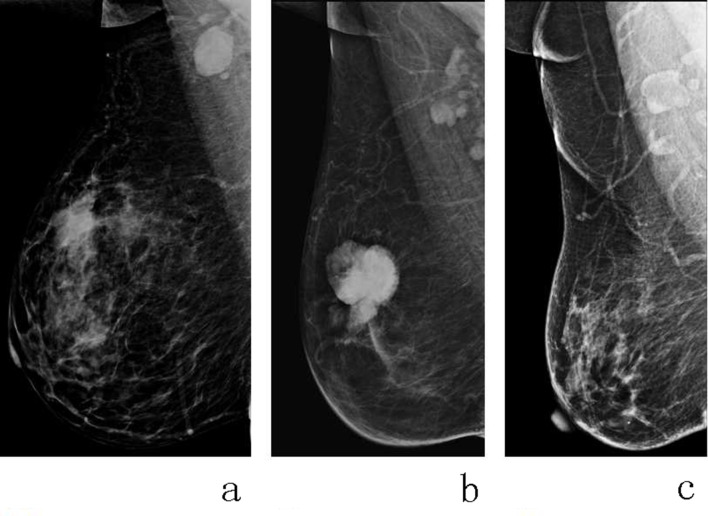
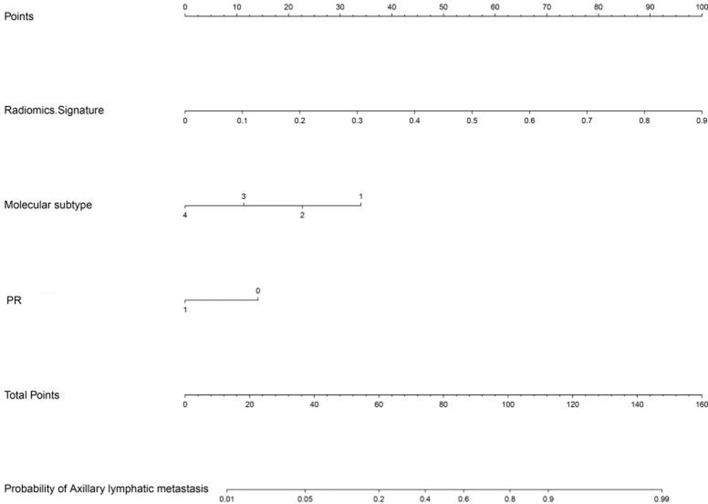
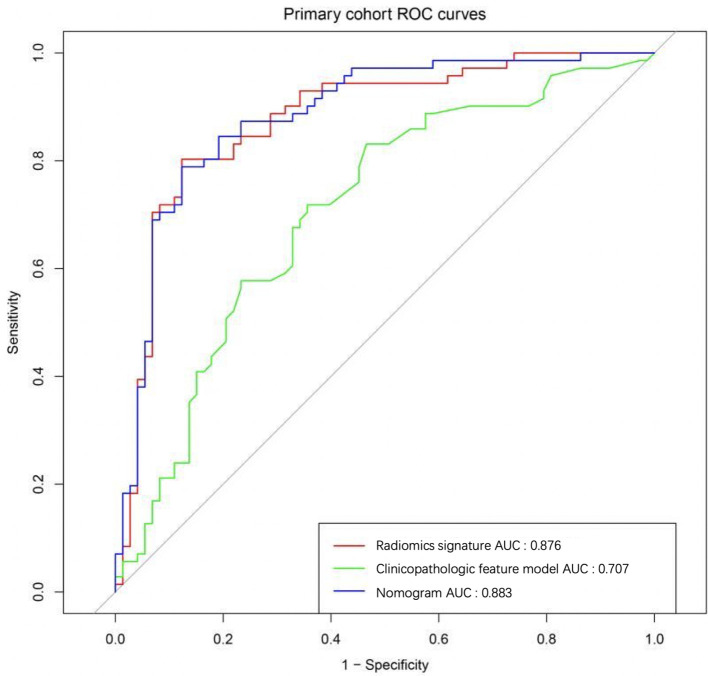
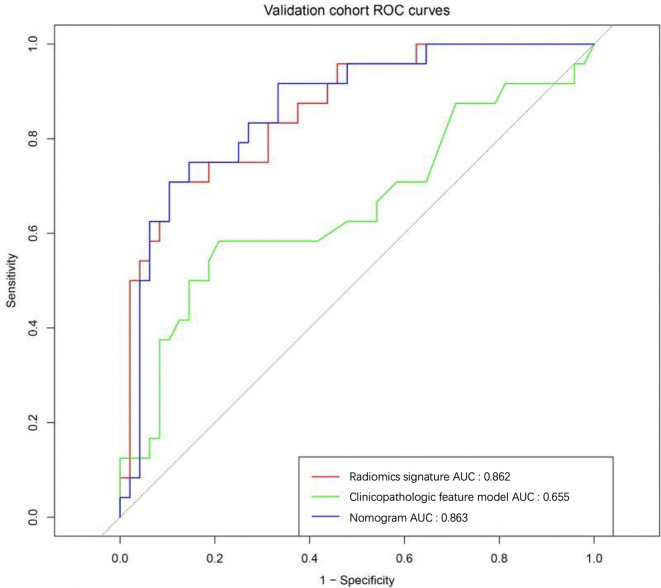
95 of 216 patients were confirmed with ALN metastasis by pathology, and 52 cases were diagnosed as ALN metastasis based on MG-reported criteria. The sensitivity, specificity, accuracy and AUC (area under the receiver operating characteristic curve of MG-reported criteria were 42.7%, 90.8%, 24.1% and 0.666 (95% confidence interval: 0.591-0.741]. The radiomics nomogram, comprising progesterone receptor status, molecular subtype and radiomics signature, showed good calibration and better favorite performance for the metastatic ALN detection (AUC 0.883 and 0.863 in the primary and validation cohorts) than each independent clinical features (AUC 0.707 and 0.657 in the primary and validation cohorts) and radiomics signature (AUC 0.876 and 0.862 in the primary and validation cohorts).
The MG-based radiomics nomogram could be used as a non-invasive and reliable tool in predicting ALN metastasis and may facilitate to assist clinicians for pre-operative decision-making.
ALN status remains among the most important breast cancer prognostic factors and is essential for making treatment decisions. However, the value of detecting metastatic ALN by MG is very limited. The studies on pre-operative ALN metastasis prediction using the method of MG-based radiomics in breast cancer are very few. Therefore, we studied whether MG-based radiomics nomogram could be used as a predictive biomarker for the detection of metastatic ALN.
通过整合临床风险因素和从数字乳腺 X 线摄影(MG)图像中提取的放射组学特征,建立术前预测乳腺癌腋窝淋巴结(ALN)转移的放射组学列线图。
将 216 例经手术切除病理证实的乳腺癌病变患者分为主队列(n=144)和验证队列(n=72)。从乳腺头尾位(CC)视图的 MG 图像中提取放射组学特征,并采用方差分析 F 值和最小绝对值收缩和选择算子(least absolute shrinkage and selection operator)的方法进行放射组学特征选择;然后使用支持向量机(support vector machine)的方法构建放射组学特征模型。采用多变量逻辑回归分析,基于放射组学特征和临床因素建立放射组学列线图。基于回归分析,在主队列和验证队列中分别获得 C 指数和校准曲线。
216 例患者中,95 例经病理证实存在 ALN 转移,52 例经 MG 报告标准诊断为 ALN 转移。MG 报告标准的敏感性、特异性、准确性和 AUC(接收器工作特征曲线下面积)分别为 42.7%、90.8%、24.1%和 0.666(95%置信区间:0.591-0.741]。包括孕激素受体状态、分子亚型和放射组学特征的放射组学列线图,对转移性 ALN 检测具有良好的校准和更好的优势表现(主队列和验证队列的 AUC 分别为 0.883 和 0.863),优于每个独立的临床特征(主队列和验证队列的 AUC 分别为 0.707 和 0.657)和放射组学特征(主队列和验证队列的 AUC 分别为 0.876 和 0.862)。
基于 MG 的放射组学列线图可作为预测 ALN 转移的一种非侵入性、可靠的工具,并有助于辅助临床医生进行术前决策。
ALN 状态仍然是乳腺癌最重要的预后因素之一,对于治疗决策至关重要。然而,MG 检测转移性 ALN 的价值非常有限。在乳腺癌中,使用 MG 基于放射组学的方法进行术前 ALN 转移预测的研究非常少。因此,我们研究了 MG 基于放射组学的列线图是否可作为检测转移性 ALN 的预测生物标志物。