Networks and Urban Systems Centre, University of Greenwich, London, United Kingdom.
Max Planck Institute for Demographic Research, Rostock, Germany.
PLoS Comput Biol. 2020 May 13;16(5):e1007879. doi: 10.1371/journal.pcbi.1007879. eCollection 2020 May.
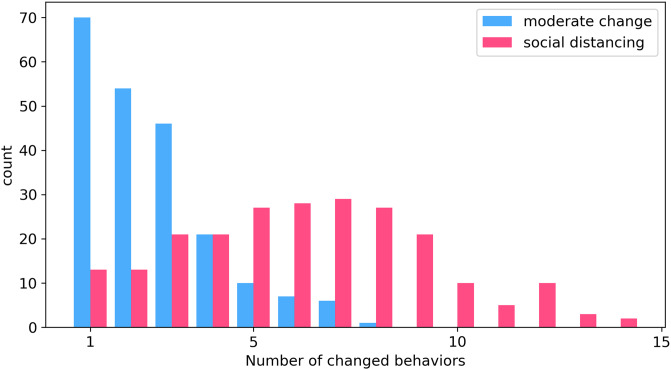
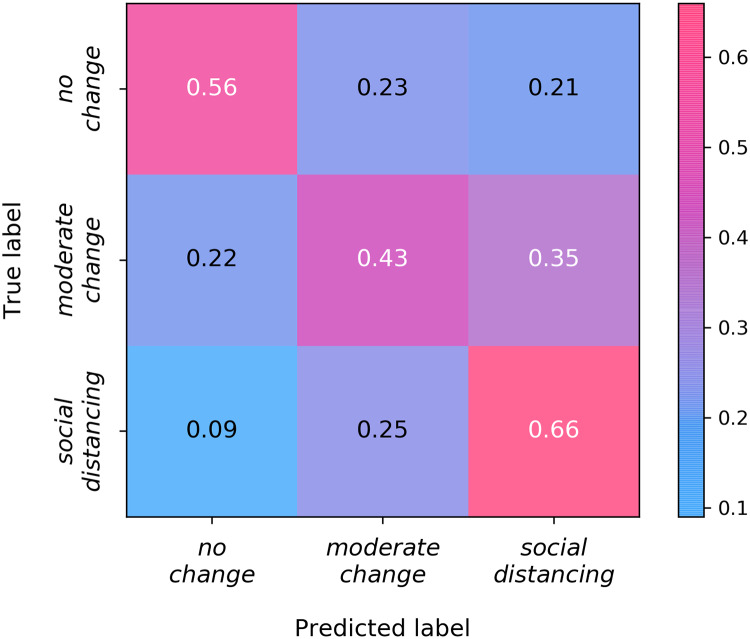
In this work, we aim to determine the main factors driving self-initiated behavioral changes during the seasonal flu. To this end, we designed and deployed a questionnaire via Influweb, a Web platform for participatory surveillance in Italy, during the 2017 - 18 and 2018 - 19 seasons. We collected 599 surveys completed by 434 users. The data provide socio-demographic information, level of concerns about the flu, past experience with illnesses, and the type of behavioral changes voluntarily implemented by each participant. We describe each response with a set of features and divide them in three target categories. These describe those that report i) no (26%), ii) only moderately (36%), iii) significant (38%) changes in behaviors. In these settings, we adopt machine learning algorithms to investigate the extent to which target variables can be predicted by looking only at the set of features. Notably, 66% of the samples in the category describing more significant changes in behaviors are correctly classified through Gradient Boosted Trees. Furthermore, we investigate the importance of each feature in the classification task and uncover complex relationships between individuals' characteristics and their attitude towards behavioral change. We find that intensity, recency of past illnesses, perceived susceptibility to and perceived severity of an infection are the most significant features in the classification task and are associated to significant changes in behaviors. Overall, the research contributes to the small set of empirical studies devoted to the data-driven characterization of behavioral changes induced by infectious diseases.
在这项工作中,我们旨在确定驱动季节性流感期间自我发起行为变化的主要因素。为此,我们在意大利的参与式监测网络平台 Influweb 上设计并部署了一份问卷,该问卷在 2017-2018 年和 2018-2019 年两个季节进行了收集。我们共收集了 434 名用户完成的 599 份调查。这些数据提供了社会人口统计学信息、对流感的关注程度、过去的疾病经历以及每个参与者自愿实施的行为变化类型。我们用一组特征来描述每一个回答,并将它们分为三个目标类别。这些描述了那些报告 i)没有(26%)、ii)只有适度(36%)、iii)行为显著(38%)变化的人。在这些设置中,我们采用机器学习算法来研究仅通过观察特征集,目标变量可以在多大程度上被预测。值得注意的是,通过梯度提升树,描述行为变化更显著的类别中的 66%的样本得到了正确分类。此外,我们还研究了每个特征在分类任务中的重要性,并揭示了个体特征与其对行为变化态度之间的复杂关系。我们发现,疾病的强度、过去疾病的近期性、对感染的易感性和严重程度是分类任务中最重要的特征,与行为变化显著相关。总的来说,这项研究有助于推动一小部分致力于对传染病引起的行为变化进行数据驱动描述的实证研究。